Banner creative has changed a lot over the last few years. Browsers are stricter, Core Web Vitals matter, and users scroll past anything that looks like an ad. So which format should you run: a simple static image, an animated GIF, or a full HTML5 creative? The answer depends on your goals, your traffic and your production budget. This guide compares the three formats and shows where each one performs best.
Why Banner Format Still Matters in 2026
Banner ads remain one of the most scalable display formats. They run on almost every website and app, work with every major buying model, and give advertisers precise control over placement and frequency.
But the format you choose affects more than looks. It shapes:
- Click-through rate (CTR): motion attracts the eye, but too much of it irritates users.
- Page speed: heavy files slow down the page and hurt viewability.
- Production cost: every extra layer of animation costs design hours.
- Compatibility: some placements, apps and networks restrict certain file types.
Static Banners: Simple, Fast and Reliable
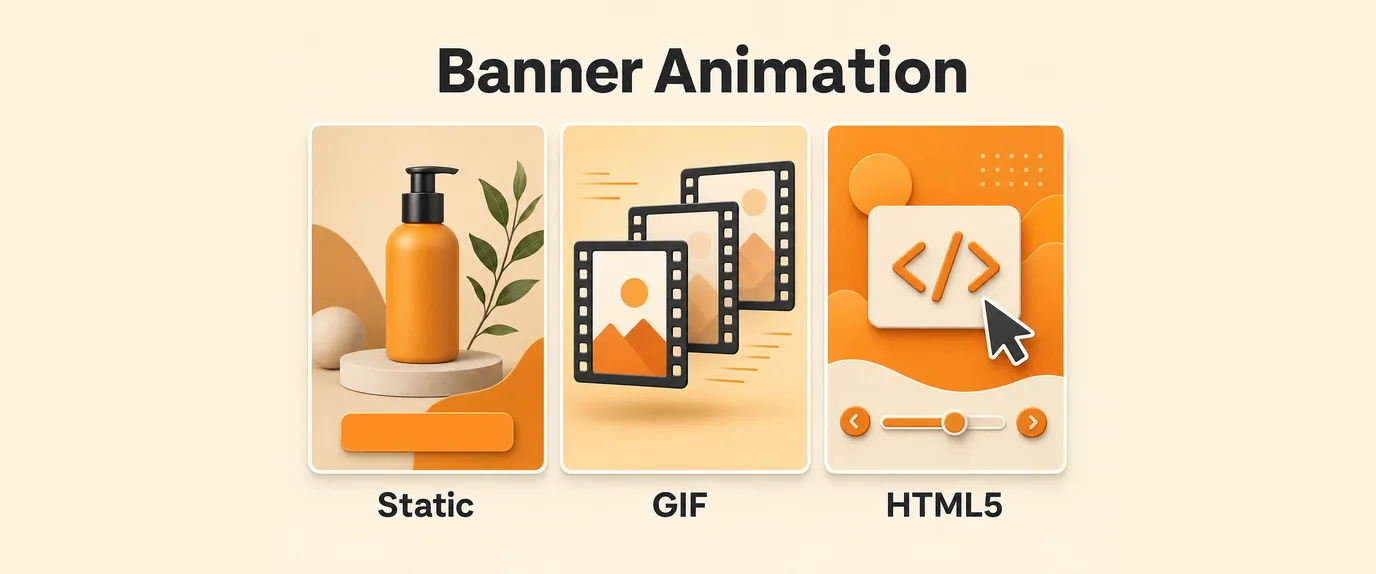
A static banner is a single image in JPG, PNG or WebP format. It carries one message, one visual and one call to action.
Advantages of static banners
- Smallest file size and the fastest load time
- Cheap and quick to produce, which makes A/B testing easy
- Accepted by virtually every ad network and placement
- No rendering issues across devices and browsers
Limitations
- Easy to ignore on busy pages
- Only one message, with no way to tell a short story
- Lower attention in crowded placements
Static creatives work best for retargeting, branding with a strong visual, and any campaign where you need to test many ideas fast.
Animated GIF Banners: Motion Without the Complexity
An animated GIF is a looped sequence of frames. It is the easiest way to add motion without coding.
Advantages of GIF banners
- Movement catches attention faster than a static frame
- Can show a mini story in 3–4 frames: problem, solution, offer, CTA
- Supported almost everywhere, including legacy placements
Limitations
- Large files for their quality, because GIF compression is poor
- Limited color palette, so gradients and photos can look grainy
- No interactivity and no dynamic data
- Endless loops can annoy users and may be restricted by ad policies
If you use GIFs, keep the animation under 15 seconds, limit loops, and put the key message in the first frame. Some users will only ever see that frame.
HTML5 Banners: The Most Flexible Option
HTML5 banners are built with HTML, CSS and JavaScript, often packaged as a ZIP file. They give you full control over animation, timing and interaction.
Advantages of HTML5 banners
- Sharp vector graphics and smooth animation at any screen density
- Small file weight compared with GIFs of similar quality
- Support for dynamic content such as live prices, countdowns or personalization
- Interactive elements like hover effects, expanding panels and mini-games
- Better control over loops, pauses and the end frame
Limitations
- Higher production cost and a need for front-end skills
- Not every network, SSP or placement accepts HTML5 creatives
- Strict QA required, because broken scripts can ruin the user experience
- Security checks and click-tag requirements add setup time
HTML5 is the best choice for premium placements, large campaigns and any case where personalization or interactivity can raise conversions.
Static vs Animated vs HTML5: Side-by-Side Comparison
| Criteria | Static (JPG/PNG/WebP) | Animated GIF | HTML5 |
|---|---|---|---|
| Typical file weight | Very low | Medium to high | Low to medium |
| Attention level | Low to medium | Medium to high | High |
| Production cost | Low | Medium | High |
| Interactivity | None | None | Yes |
| Dynamic content | No | No | Yes |
| Visual quality | Good | Limited palette | Excellent |
| Compatibility | Universal | Very wide | Depends on network |
| Best for | Retargeting, testing | Quick motion, simple offers | Premium campaigns, personalization |
Which Format Wins in 2026?
There is no single winner. The best banner format depends on what you are trying to achieve.
- Static wins on speed and efficiency. It is the best format for fast testing and low-cost scaling.
- Animated GIF wins on simplicity. It is a good middle ground when you want motion without development work.
- HTML5 wins on performance potential. It delivers the best quality, flexibility and engagement, as long as your placements support it.
In practice, most experienced buyers do not pick one format. They run all three, compare results by placement and geo, and keep the winner.
Best Practices for Banner Animation in 2026
Keep the message simple
One offer, one visual, one CTA. If a user needs more than two seconds to understand the ad, it is too complex.
Front-load the key information
Assume many users never see the full animation. Make sure the first frame and the end frame both carry the offer and the call to action.
Control loops and duration
Limit animation to a few loops and a short total runtime. Endless motion is distracting and can violate placement rules.
Optimize file weight
Compress images, use WebP where possible, and strip unused code from HTML5 files. Lighter creatives load faster and get seen more often.
Test by traffic source and device
A format that wins on desktop may lose on mobile. Always split results by device, geo and placement before scaling.
Match creative to ad format
Banners are only one part of the mix. For high-reach campaigns you can combine them with native ads, push ads, or popunder and clickunder ads. For performance campaigns that need automatic traffic routing, smartlink advertising can help you find the best offer-to-audience match.
How to Test Banner Formats Properly
A clean test gives you reliable data. Follow this simple process:
- Define one goal: CTR, conversions or cost per acquisition.
- Change one variable at a time: format, headline or color, never all at once.
- Use equal budgets and the same placements for each variant.
- Collect enough data before deciding, rather than judging after a few hundred impressions.
- Scale the winner and retest. Creative fatigue sets in quickly, so refresh regularly.
If you buy traffic programmatically, real time bidding for advertisers lets you adjust bids and targeting by creative performance in real time. To get started with campaigns across several formats, explore the ads network for advertisers.
For Publishers: What Banner Format Means for Your Inventory
Publishers also feel the impact of creative format. Heavy HTML5 and GIF files can slow down pages, while well-optimized creatives protect user experience and viewability.
- Set clear file-size and animation rules for your placements.
- Monitor load time and layout shifts after adding new ad slots.
- Work with a partner that screens creatives before they go live.
If you want to monetize websites efficiently, join an ads network for publishers. For mobile app owners, the Android SDK for publishers offers a simple way to bring ad formats into your app.
FAQ
Are animated banners always better than static ones?
No. Animation usually raises attention, but it also increases file weight and can annoy users. Static banners often win in retargeting and in crowded A/B tests because they load instantly and deliver a clear message.
Is HTML5 worth the extra cost?
It is worth it when you run large campaigns, premium placements, or need dynamic content and interactivity. For small budgets or fast tests, static or GIF creatives usually give a better return on effort.
What is the ideal length for banner animation?
Keep it short, generally under 15 seconds with limited loops. The most important message should appear within the first few seconds.
Which banner format is best for mobile?
Lightweight static and well-optimized HTML5 banners perform best on mobile because they load fast on slower connections. Large GIFs are the riskiest choice on mobile.
Can I use all three formats in one campaign?
Yes, and you should. Running static, GIF and HTML5 versions side by side is the most reliable way to find which format works for your audience, geo and placement.
How often should I refresh banner creatives?
Watch for falling CTR and rising costs. In most campaigns, refreshing creatives every few weeks keeps performance stable and reduces ad fatigue.
Final Thoughts
In 2026, the winning banner strategy is not about picking the fanciest format. It is about matching the format to the goal: static for speed and testing, GIF for easy motion, HTML5 for premium quality and interactivity. Test all three, measure by placement, and keep what delivers the best return