Monetizing high-volume, unsegmented traffic is one of the most persistent challenges in digital performance marketing. Publishers operating content platforms, file hosts, or viral social channels—as well as media buyers purchasing broad pop, push, or social bios—deal with wildly heterogeneous user streams. A single traffic feed often contains dozens of countries, hundreds of mobile network operators (MNOs), diverse device tiers, and disparate user intents.
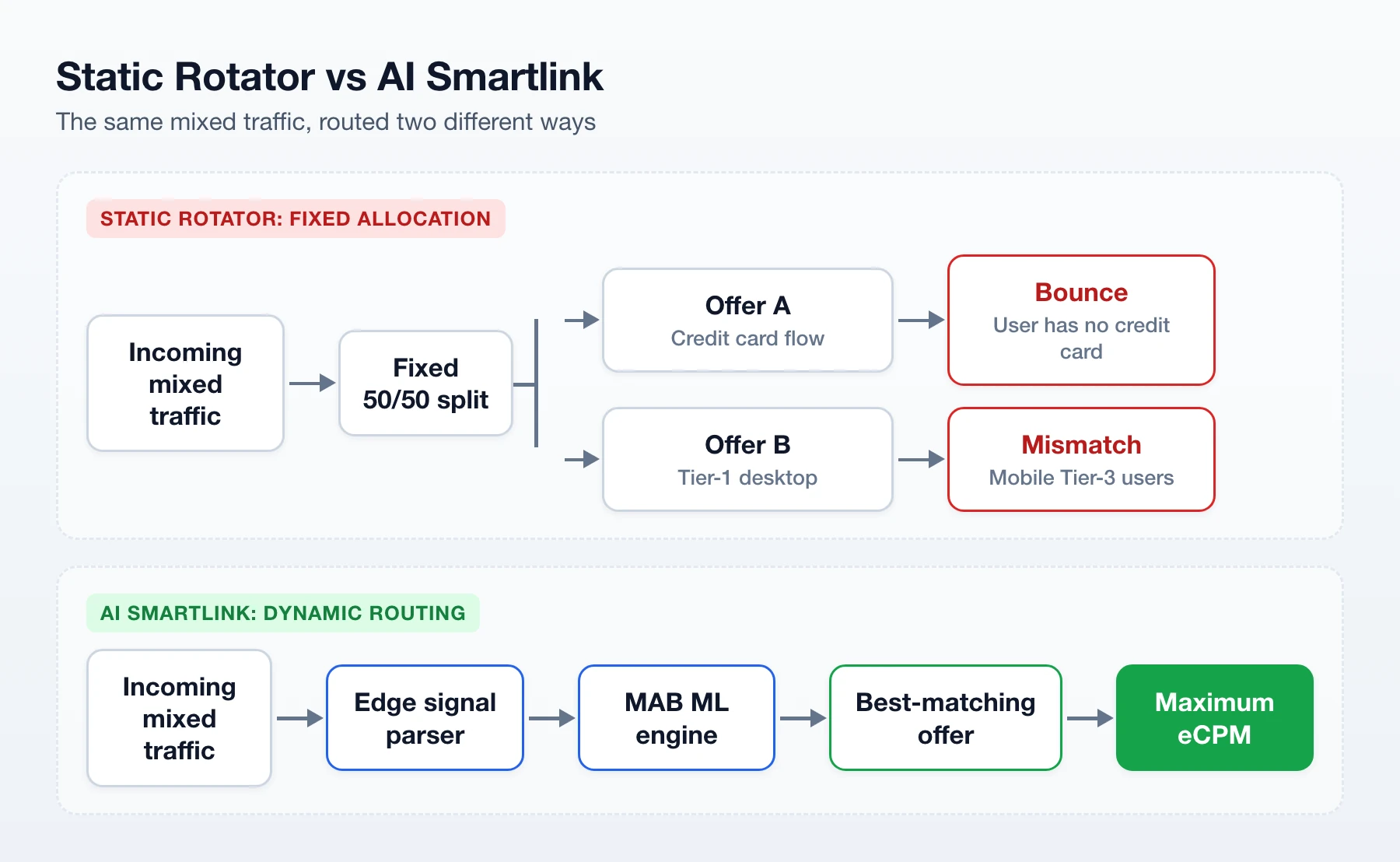
Routing this mixed traffic to a static landing page or a fixed A/B rotator results in severe revenue leakage. If a visitor from Brazil on a 3G mobile carrier hits an e-commerce offer requiring credit card billing, conversion probability drops to near zero. If that same user is routed to a localized 1-Click Direct Carrier Billing (DCB) flow, the impression converts instantly.
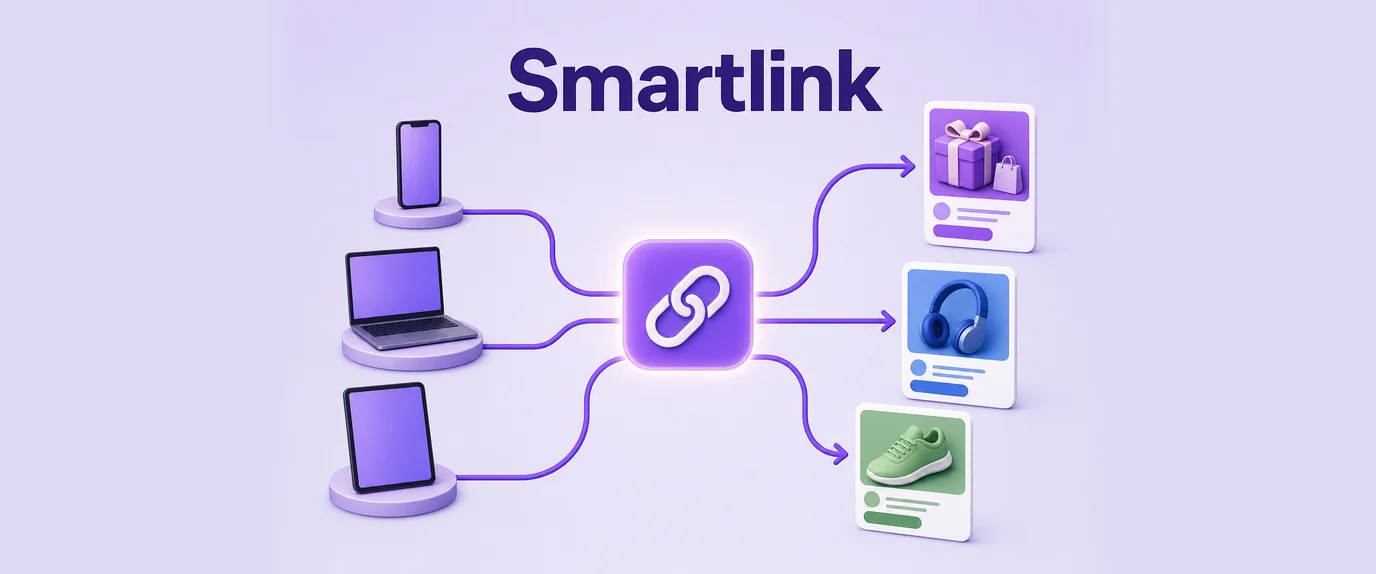
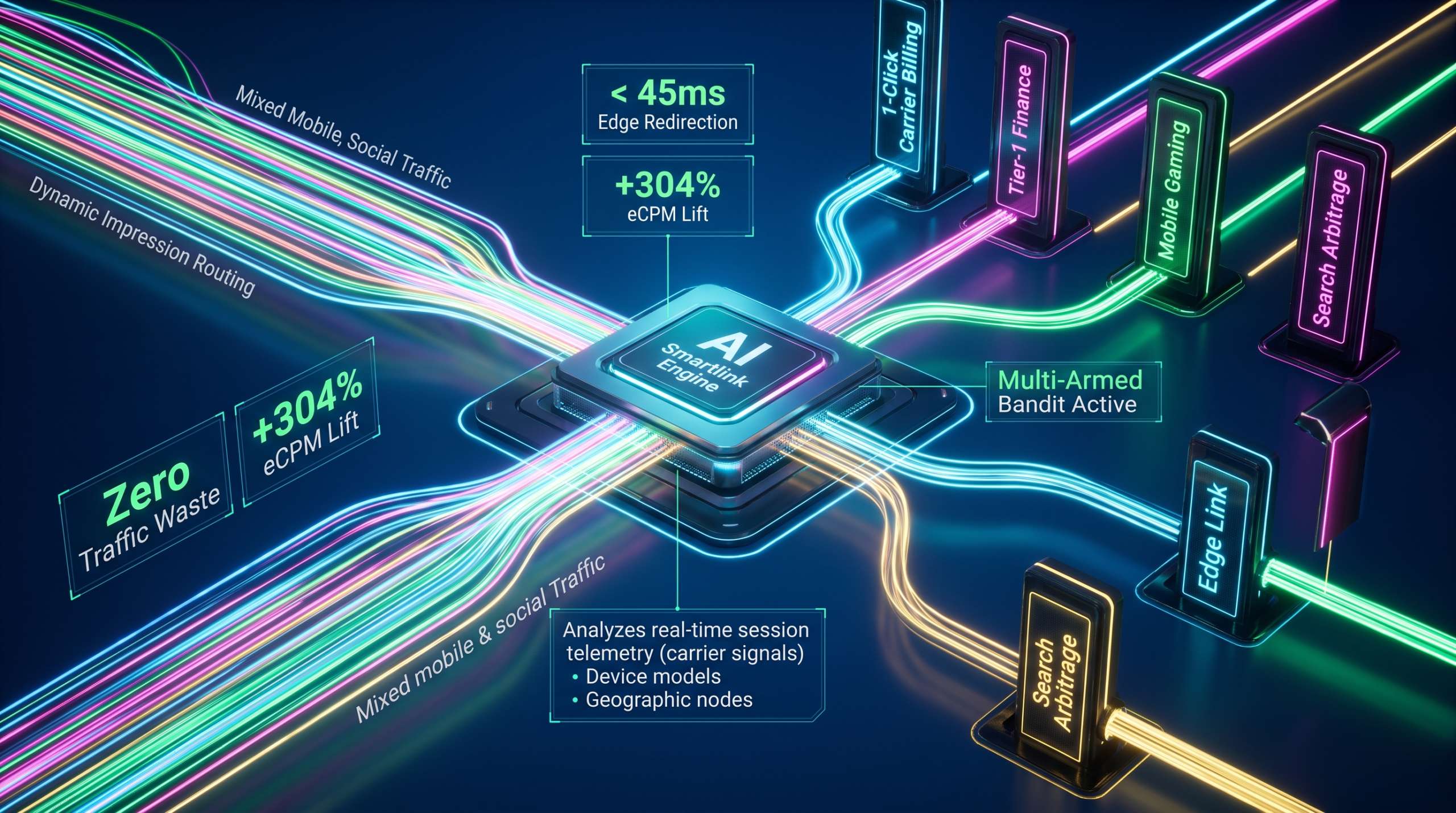
AI-Driven Smartlinks eliminate this manual segmentation problem. By combining real-time multi-signal parsing, edge compute redirection, and machine learning exploration algorithms (such as Multi-Armed Bandits), Smartlink engines evaluate every incoming HTTP request and route the visitor to the highest-yielding offer in under 50 milliseconds.
1. The Fragmentation Trap: Why Static Offer Rotators Fail
Traditional affiliate campaigns rely on static traffic distribution. A media buyer configures a tracker with fixed percentage weights (e.g., Offer A: 50%, Offer B: 50%) or simple geo-rules.
While functional for homogeneous traffic, static setups fail when applied to mixed, mobile, and social traffic streams.
Critical Bottlenecks of Static Distribution:
- The Payment Rail Mismatch: In developing markets (LATAM, SEA, MENA), credit card penetration is often under 20%. Forcing credit-card checkouts on mobile carrier traffic kills conversions. Conversely, routing Tier-1 desktop traffic to low-payout carrier billing offers wastes high-purchasing-power users.
- Latency-Induced Churn: Traditional multi-tier redirect chains through intermediary tracking servers add 400 to 1,200 milliseconds of latency. In mobile networks, every 200ms of delay increases bounce rates by 5% to 8%.
- Stale Offer Fatigue: Individual affiliate offers face sudden conversion dips due to cap exhaustion, advertiser budget limits, or degraded merchant processing gateways. Static rotators continue sending traffic to dying offers until a human operator intervenes.
2. The Multi-Signal Parsing Pipeline: 20+ Real-Time Session Parameters
When an impression hits a Smartlink endpoint, the routing engine must dissect the HTTP request, TCP connection metadata, and client-side device characteristics before deciding where to route the user.
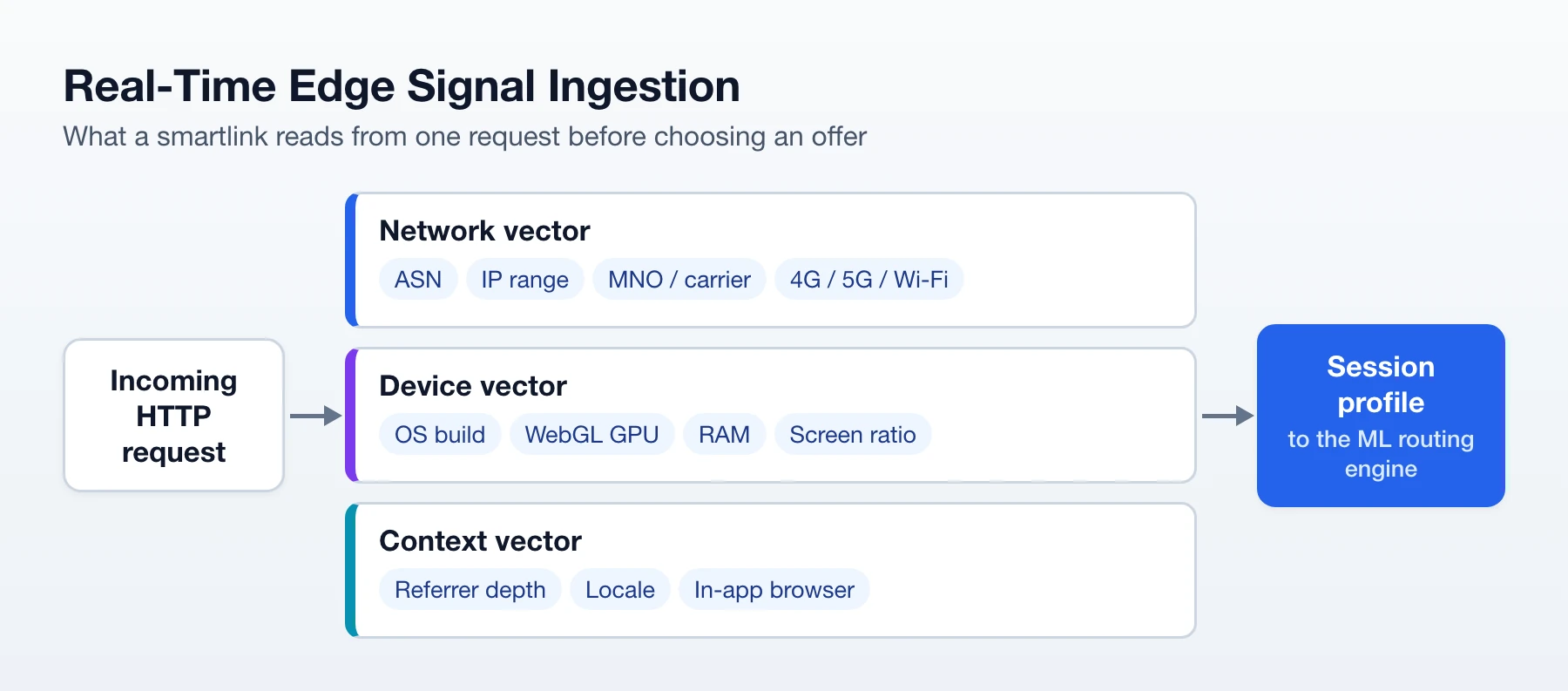
Modern Smartlink architectures evaluate three primary tiers of session telemetry within the first 5 milliseconds:
A. Network & Carrier Signals (Carrier Billing Optimization)
- Autonomous System Number (ASN) & IP Mapping: Identifies whether the visitor originates from a residential ISP, commercial datacenter, public proxy, or cellular mobile carrier.
- Mobile Network Operator (MNO) Detection: Dissects cellular network headers to isolate specific telecom carriers (e.g., Claro, Vodafone, Telkomsel) to instantly match against direct carrier billing (DCB) contracts.
- Connection Profile: Distinguishes high-bandwidth fiber/Wi-Fi from high-latency 3G/LTE connections to determine whether to deliver rich interactive media or lightweight text landers.
B. Hardware & Device Telemetry
- User-Agent Client Hints (UA-CH): Extracts granular operating system versions, architecture, and platform models without relying on deprecated raw User-Agent strings.
- Hardware Capabilities: Evaluates client device memory (
navigator.deviceMemory), CPU cores (navigator.hardwareConcurrency), and screen aspect ratios to separate low-end budget smartphones from flagship devices.
C. Contextual & Behavioral Vectors
- In-App Browser (IAB) Detection: Detects whether the visitor is viewing content inside embedded webviews (such as Telegram, TikTok, Instagram, or Facebook webviews) where native cookie access, file downloads, or external app switching may be restricted.
- Locale & Language Matching: Cross-references browser system language with geographic IP location to serve culturally and linguistically aligned copy.
3. Real-Time Algorithmic Routing: Multi-Armed Bandit (MAB) vs. Static Weighting
The core engine of a Smartlink is its mathematical allocation algorithm. Standard A/B testing allocates fixed proportions of traffic (e.g., 50/50) across the entire test period, incurring an Opportunity Cost by repeatedly serving underperforming offers to valuable traffic.
Smartlinks solve this using Multi-Armed Bandit (MAB) frameworks, which balance the exploration of new or untested offers with the exploitation of known, high-converting winners.
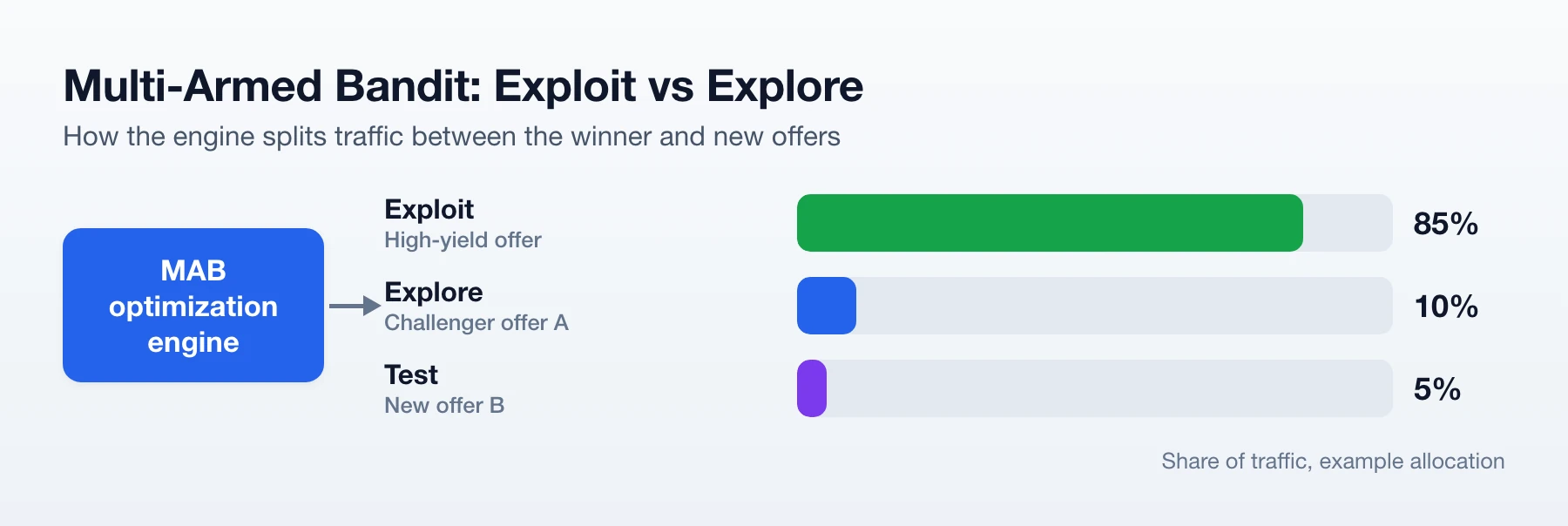
1. The Epsilon-Greedy (ε-Greedy) Strategy
The system allocates a large percentage of traffic (1 − ε, typically 85–90%) to the historically highest-performing offer cluster (Exploitation). The remaining percentage (ε, typically 10–15%) is distributed randomly across challenger offers (Exploration). As soon as a challenger’s performance outpaces the control, the engine dynamically shifts the exploitation budget.
2. Thompson Sampling (Bayesian Optimization)
Advanced Smartlink platforms deploy Thompson Sampling, treating conversion rates not as fixed numbers, but as dynamic Beta probability distributions:

Where:
- α represents successful conversions.
- β represents failed impressions / non-converting visits.
For every incoming impression matching a specific cluster profile (e.g., Android + Brazil + Claro + In-App Webview), the engine samples each offer’s probability distribution and selects the arm with the highest simulated return:

This allows the Smartlink to adapt within minutes to live market changes—such as an advertiser running out of budget or a competitor saturating an offer—without human intervention.
4. Latency Mitigation & Edge Serverless Architecture
In performance marketing, redirection latency directly erodes conversion rates. Routing global traffic through a single origin database introduces geographic ping delays of 200–500ms.
High-performance Smartlinks run on Edge Serverless Infrastructure (such as Cloudflare Workers, AWS Lambda@Edge, or Fastly Compute), moving decision-making logic closer to the physical end user.
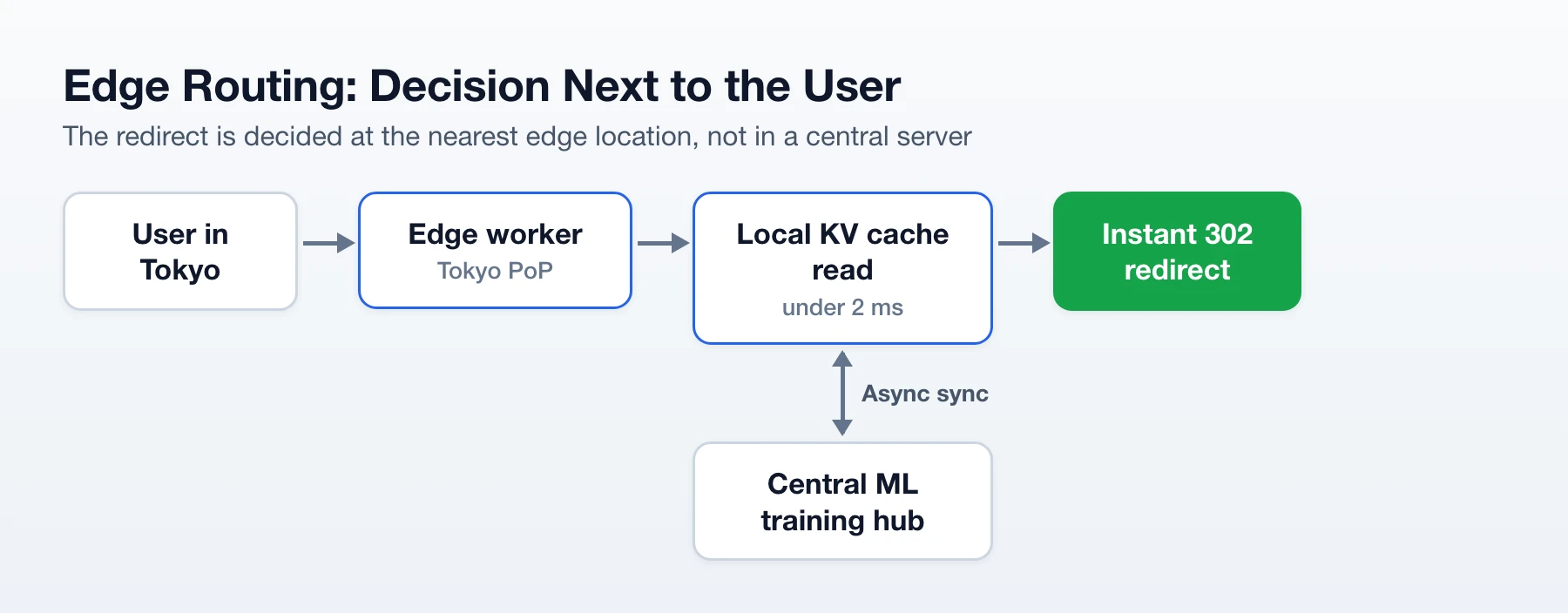
Technical Execution at the Edge:
- Edge Key-Value (KV) Caching: Pre-computed offer matrices and probability weights are cached in distributed Key-Value stores located at over 300 Point-of-Presence (PoP) edge nodes globally. Read latency is kept below 2ms.
- Single-Hop HTTP 302/307 Redirection: Rather than relying on client-side JavaScript redirects (which require full HTML parsing and DOM painting), edge workers issue immediate HTTP
302 Foundor307 Temporary Redirectheaders, eliminating browser execution delays. - Server-to-Server (S2S) Token Forwarding: The edge worker dynamically injects click trackers (
click_id,subids, source placement IDs) into the redirect target URL while asynchronously logging the impression event to a data warehouse via non-blocking background workers (waitUntil).
5. Primary Monetization Use Cases: Messengers, Bio Links, and Fallback Traffic
Smartlinks unlock maximum revenue across three notoriously difficult traffic sources:
A. Telegram & Social Messenger Channels
- The Problem: Channel administrators and media buyers drive massive volumes of mobile clicks through Telegram broadcast channels, bio links, and direct bots. Users arrive from globally dispersed regions with locked-in in-app browser sessions where cookies are ephemeral.
- The Smartlink Solution: The engine identifies the messenger webview environment, extracts the user’s localized device context, and routes them to low-friction funnels (e.g., 1-click subscription services, gaming portals, or localized sweepstakes) that do not require external App Store transitions or complex identity registration.
B. Utility Portals & File-Sharing Services
- The Problem: Free online utilities (PDF converters, video downloaders, file-sharing platforms) receive mixed global desktop and mobile traffic with low commercial intent.
- The Smartlink Solution: Traffic is automatically bifurcated: Tier-1 desktop users are directed to high-RPC Search Arbitrage or VPN subscription landers, while emerging-market mobile traffic is routed to carrier billing and utility software installations.
C. Exit-Intent & Back-Button Fallback
- The Problem: Across standard affiliate landing pages, 60% to 80% of users leave without converting, clicking the browser “Back” button or closing the tab.
- The Smartlink Solution: Injecting a Smartlink handler into the browser history stack (
window.history.pushState) captures exiting users. When the user attempts to leave, the engine catches the event and serves an alternative offer cluster matching their profile, capturing incremental revenue from otherwise lost traffic.
6. Performance Benchmarks: Static Rotators vs. AI Smartlink Routing
Data compiled across high-volume publishers and media buyers handling mixed global traffic illustrates the operational lift delivered by AI-driven Smartlink routing:
| Metric | Static 50/50 Split Rotator | Rule-Based Manual Geo-Links | AI Smartlink Engine (MAB + Edge) |
| Global Mixed Traffic eCPM | $1.20 Baseline | $2.45 (+104%) | $4.85 (+304% Lift) |
| Average Redirect Latency | 480ms – 1,100ms | 350ms – 650ms | < 45ms (Edge Processed) |
| Traffic Wastage (Unmatched Offers) | 38.5% of Clicks | 14.2% of Clicks | < 0.5% (Universal Coverage) |
| Offer Cap Failure Rate | High (Manual Monitoring) | Moderate (Requires Rules) | Zero (Automated Fallback) |
| Mobile Carrier (DCB) Conversion Rate | 1.1% | 3.8% | 9.4% (Direct MNO Matching) |
| Manual Media Buyer Overhead | 15+ Hours / Week | 8 Hours / Week | Zero (Fully Autonomous) |
7. Operational Deployment & Integration Checklist
Follow this technical roadmap to deploy and scale Smartlink monetization across mixed traffic portfolios:
- [ ] Configure Clean DNS Routing: Point your custom tracking domain to edge-accelerated CDN nameservers (Cloudflare, AWS Route 53) to minimize TLS handshake latency.
- [ ] Implement Client Hints Capture: Ensure web pre-landers or edge endpoints request high-entropy Client Hints (
Sec-CH-UA-Model,Sec-CH-UA-Platform-Version) for granular OS targeting. - [ ] Set Up Upstream Postback Tracking: Ensure your affiliate network and DSP connections return real-time Server-to-Server (S2S) postbacks with revenue values to feed the Thompson Sampling algorithm.
- [ ] Define Offer Pool Fallbacks: Group offers into dedicated fallback tiers (Primary Tier-1 CPA → Secondary DCB/mVAS → Global Monetization Smartlink) to prevent dead-end impressions.
- [ ] Configure Back-Button Trapping: Integrate lightweight
pushStatescripts on high-bounce pre-landers to route exiting users directly into the Smartlink monetization loop. - [ ] Audit Carrier Range Accuracy: Regularly refresh IP-to-MNO routing databases to prevent misrouting cellular traffic to non-carrier payment gateways.
Monetizing complex, unsegmented traffic requires moving beyond rigid, manual campaign routing. By utilizing AI Smartlink architecture—integrating sub-50ms edge processing, comprehensive 20-signal session evaluation, and self-optimizing Multi-Armed Bandit algorithms—publishers and media buyers eliminate traffic waste, maximize carrier-level monetization, and achieve superior eCPMs across all channels.