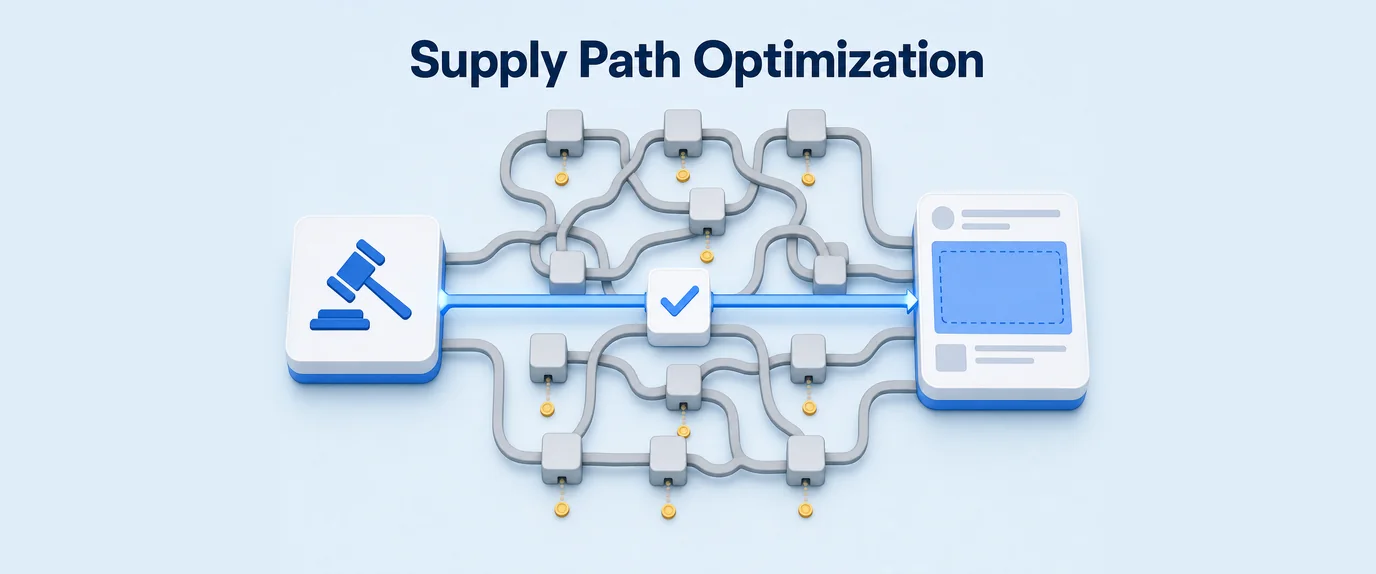
In real-time bidding (RTB), media buyers routinely assume that their programmatic bids travel through a clean, direct pipeline from their Demand-Side Platform (DSP) straight to the publisher’s Supply-Side Platform (SSP). The reality of modern programmatic infrastructure is far more fragmented.
A single publisher impression is frequently resold, re-packaged, and auctioned through 3 to 5 intermediary ad networks, exchanges, and re-brokers before hitting the programmatic open market. This supply chain complexity creates Programmatic Margin Erosion: every middleman takes a fee (take-rate), adds latency, and creates artificial bid competition against your own campaign.
Supply Path Optimization (SPO) is the technical framework used by advanced advertisers and DSPs to audit, filter, and consolidate impression inventory paths. By evaluating OpenRTB supply chains, validating seller authorization, and pruning duplicate auction hops, media buyers eliminate hidden intermediary fees, recover lost working capital, and lower effective Cost Per Acquisition (eCPA).
1. The Programmatic Middleman Tax: How Supply Chain Friction Erodes Working Capital
When an ad campaign bids $2.00 CPM on an open RTB exchange, a significant portion of that bid never reaches the publisher or converts into measurable media value. Instead, it is consumed by intermediary transaction fees across multi-hop reselling paths.
[Media Buyer Bid: $2.00 CPM]
             │
             ├── Intermediary Reseller 1 (15% Take-Rate) ──► $1.70 Remaining
             ├── Re-Broker Exchange 2  (10% Take-Rate) ──► $1.53 Remaining
             └── Downstream SSP 3       (15% Take-Rate) ──► $1.30 Working CPM Delivered
The Three Operational Failures of Unoptimized Supply Paths:
- Fee Stacking (Take-Rate Inflation): When an impression passes through multiple reseller hops, each node deducts a percentage fee. By the time the bid reaches the publisher’s ad server, working CPM has shrunk significantly, reducing auction win rates for high-converting inventory.
- Auction Duplication (Self-Cannibalization): A single publisher unit connected to multiple SSPs sends duplicate impression requests to your DSP simultaneously. Your DSP ends up bidding against itself across different supply paths for the exact same impression, artificially driving up effective CPMs.
- Latency & Attribution Timeouts: Every extra intermediary hop adds 20 to 50 milliseconds of network latency. High-latency paths frequently exceed DSP auction timeouts (>100ms), causing winning bid responses to be dropped after capital has been committed.
2. Technical Mechanisms of SPO: Auditing schain, ads.txt, and sellers.json
Executing Supply Path Optimization requires leveraging open IAB Tech Lab standards to trace the cryptographic lineage of every impression request in real time.
┌────────────────────────────────────────────────────────────────────────┐
│                   Programmatic Supply Lineage Audit                    │
│                                                                        │
│  [Incoming OpenRTB Bid Request]                                        │
│            │                                                           │
│            ├──► Step 1: Validate `ads.txt` on Publisher Domain         │
│            ├──► Step 2: Audit `schain` (SupplyChain Object) Nodes       │
│            └──► Step 3: Cross-Reference `sellers.json` Entity IDs      │
│                                                                        │
│  Decision: [DIRECT PATH: Bid Full Rate] OR [RESELLER HOP: Suppress Bid]│
└────────────────────────────────────────────────────────────────────────┘
Core Transparency Standards:
- The OpenRTB SupplyChain Object (
schain): Theschainobject tracks every entity that handles a bid request on its path from publisher to DSP. Each node in the array contains the seller’s domain, account ID, and request ID. SPO engines analyze the node count; paths with node counts greater than 1 indicate reseller intervention. - Authorized Digital Sellers (
ads.txt): A public text file hosted on the publisher’s root domain that lists all authorized sales partners. SPO filters verify that the exchange offering the inventory is explicitly listed asDIRECTor an authorizedRESELLER. - Publisher & Reseller Identity (
sellers.json): A public directory hosted by SSPs and exchanges that maps account IDs to real corporate entities. Cross-referencingsellers.jsonagainstads.txtallows DSPs to detect fraudulent re-brokering and masked entity identities.
3. Eliminating Auction Duplication and Phantom Competition
Auction duplication occurs when a publisher integrates multiple header bidding wrappers or supply partners, causing the same ad slot to trigger concurrent bid requests across several exchanges.
                                ┌──► Exchange A (SSP 1) ──┐
[Publisher Impression Trigger] ─┼──► Exchange B (SSP 2) ──┼─► [DSP Receives 3 Identical Requests]
                                └──► Exchange C (SSP 3) ──┘
Without SPO, a bidding engine treats these as three separate opportunities, potentially placing bids on all three. This creates artificial competition that inflates the market clearing price.
Algorithmic SPO Suppression Tactics:
- Impression Deduplication Fingerprinting: The SPO engine generates a real-time hash combining
User ID + IP Address + Device Model + Publisher Domain + Timestamp (100ms window). When duplicate hashes hit the bid stream, the engine routes the bid exclusively to the shortest, lowest-cost supply path and drops the rest. - Win-Rate vs. Cost Path Profiling: The system evaluates historical win rates and clearing prices across all supply channels for a given publisher. Traffic is automatically routed away from exchanges with high take-rates or elevated bid latency.
4. Strategic Integration Framework: Direct DSP-to-SSP & Direct Publisher Paths
To maximize working media budgets, advertisers and media buyers should transition away from open-market reseller networks toward direct supply paths.
┌────────────────────────────────────────────────────────────────────────┐
│                    SPO Direct Access Framework                         │
│                                                                        │
│  [Media Buyer DSP] ──► Direct SSP / PMP Pipeline ──► Publisher Inventory│
│                             │                                          │
│                             └── Eliminates Reseller Take-Rates         │
│                             └── Prevents Multi-Exchange Bidding        │
│                             └── Guarantees Sub-20ms Latency            │
└────────────────────────────────────────────────────────────────────────┘
Strategic SPO Tiers:
- Tier 1: Private Marketplace (PMP) & Direct Deals: Establishing direct deal IDs with premium publishers or primary SSPs bypasses open-market resellers entirely, securing guaranteed placement priorities and fixed, transparent margin structures.
- Tier 2: Preferred Direct SSP Connections: Restricting open-market bidding rules to primary SSPs that maintain direct
ads.txtrelationships with publishers (DIRECTdesignation). - Tier 3: Automated Reseller Pruning: Automatically blacklisting any supply path that contains more than one reseller node (
schain.nodes.length > 1), cutting out opportunistic re-brokers.
5. Performance Comparison: Unoptimized Open Market vs. SPO-Optimized Pipelines
Data compiled across high-volume programmatic display, native, and video campaigns demonstrates the financial impact of Supply Path Optimization:
| Programmatic Metric | Unoptimized Open RTB Stream | SPO-Optimized Supply Pipeline | Performance Impact |
Average Supply Chain Nodes (schain) | 3.4 Intermediary Hops | 1.0 Node (Direct Path) | -70.5% Chain Reduction |
| Effective Middleman Take-Rate Fee | 28% – 42% Total Deductions | < 8% Single Fee | +30%+ Working Media Capital |
| Bid-to-Win Rate (Auction Yield) | 4.2% (Lost to Latency/Fees) | 16.8% (Direct Clearance) | 4.0x Higher Auction Efficiency |
| Duplicate Impression Requests | 35% Duplicate Volume | < 1% Deduplicated | Eliminates Self-Bidding |
| Effective CPA (eCPA) | $34.50 Baseline | $18.10 | -47.5% Lower Acquisition Cost |
| Net Campaign ROI Expansion | +28% | +132% | +104% Net Profit Margin |
6. Media Buyer Deployment & SPO Execution Checklist
Follow this operational checklist to execute Supply Path Optimization across your programmatic campaigns:
- [ ] Audit
schainObject Depth: Set your campaign optimization rules to flag or suppress bid requests whereschain.nodes.lengthexceeds 1. - [ ] Enforce
ads.txtDirect Verification: Restrict bidding to impression paths where the exchange relationship is explicitly verified asDIRECTin the domain’sads.txtfile. - [ ] Cross-Reference
sellers.jsonDatabases: Periodically cross-reference seller IDs against officialsellers.jsonfeeds to identify and block anonymous re-brokers. - [ ] Enable Impression Deduplication Filters: Activate real-time impression hashing in your DSP to prevent multiple bids on duplicate header-bidding requests.
- [ ] Establish Direct PMP Deals: Negotiate direct Private Marketplace deals with high-converting publisher clusters to lock in transparent eCPM pricing.
- [ ] Monitor Supply Path Win Rates: Track eCPA and conversion rates by supply path channel, systematically shifting budget toward channels with the lowest take-rates and lowest latency.
Eliminating middleman margin tax and auction duplication is essential for scaling performance campaigns efficiently. By deploying Supply Path Optimization (SPO) principles—auditing schain lineage, enforcing ads.txt authorization, and consolidating supply routes—media buyers maximize working media value, lower effective CPAs, and drive predictable campaign growth.
Supply Path Optimization turns programmatic buying from a “bid and hope” process into a transparent, measurable one. Every extra hop between your DSP and the publisher costs you in three ways: fees that shrink working CPM, duplicate requests that make you bid against yourself, and latency that costs you auctions you should have won. The IAB Tech Lab standards (ads.txt, sellers.json and schain) give media buyers the tools to see that lineage and act on it.
The practical path is straightforward. Start by auditing schain depth and verifying DIRECT relationships in ads.txt. Then turn on impression deduplication, and move spend toward PMP deals and direct SSP connections. Track eCPA by supply path so budget keeps flowing to the cleanest, cheapest routes. Even partial adoption recovers working media, and the gains compound as campaigns scale.
SPO at a Glance: Problems, Fixes and Outcomes
| Supply Chain Problem | What It Costs You | SPO Fix | Where to Check | Expected Outcome |
|---|---|---|---|---|
| Fee stacking across reseller hops | 28%–42% of bid value lost to intermediaries | Prune paths with more than one reseller node | schain object | Higher working CPM, more working media |
| Auction duplication | Bidding against yourself on the same impression | Real-time impression deduplication hashing | DSP bid stream | Inflated clearing prices eliminated |
| Unauthorized or masked sellers | Fraud exposure, wasted spend | Cross-reference seller IDs with publisher declarations | ads.txt + sellers.json | Fewer anonymous re-brokers |
| Latency and timeouts | Winning bids dropped after commitment | Route to the shortest supply paths | Path-level latency reports | Better bid-to-win rate |
| No visibility into path performance | Budget spread across weak routes | Track eCPA and win rate by supply path | DSP reporting | Budget shifts to best-performing paths |
| Open-market dependency | No pricing transparency | Direct PMP deals and preferred SSP connections | Deal IDs, DIRECT designation | Predictable, transparent margins |
Frequently Asked Questions
1. What is Supply Path Optimization (SPO) in programmatic advertising?
Supply Path Optimization is the practice of auditing and consolidating the routes through which ad impressions reach your DSP. By favoring direct, authorized and low-latency paths and cutting duplicate or reseller-heavy ones, advertisers reduce intermediary fees, avoid bidding against themselves and improve campaign efficiency.
2. How do ads.txt, sellers.json and schain work together?
ads.txt is a file on the publisher’s domain listing which sellers are authorized to sell its inventory. sellers.json is published by SSPs and exchanges and identifies the entities behind each seller account. The schain object travels with the bid request and records every node that handled it. Together they let a DSP verify that a seller is authorized, confirm who they are and see how many hops the impression took.
3. Why is auction duplication a problem?
When the same impression reaches your DSP through several SSPs or header bidding wrappers, your DSP may treat each copy as a separate opportunity. You then compete against your own bids, which can push up clearing prices and waste budget without adding reach.
4. Should I block every path with more than one node?
Not necessarily. A strict rule such as schain.nodes.length > 1 is a useful starting filter, but some legitimate publishers use authorized resellers. A better approach is to test the rule, compare eCPA, win rate and scale by path, and make exceptions for trusted partners that perform well.
5. How quickly can SPO improve campaign performance?
Results vary by DSP, inventory mix and starting supply quality. Many teams see changes in win rate, effective CPM and path-level eCPA within a few weeks of enabling schain filters and deduplication. Gains from PMP deals and direct SSP relationships typically build over a longer period. Use your own reporting to confirm results rather than relying on benchmarks alone