Why do we still click on notifications? The answer lies deep within the layers of human psychology. Unlike banners, which are often perceived as “background noise,” a push notification is a personal signal.
1. The Psychology of the “Signal”: Why It Works
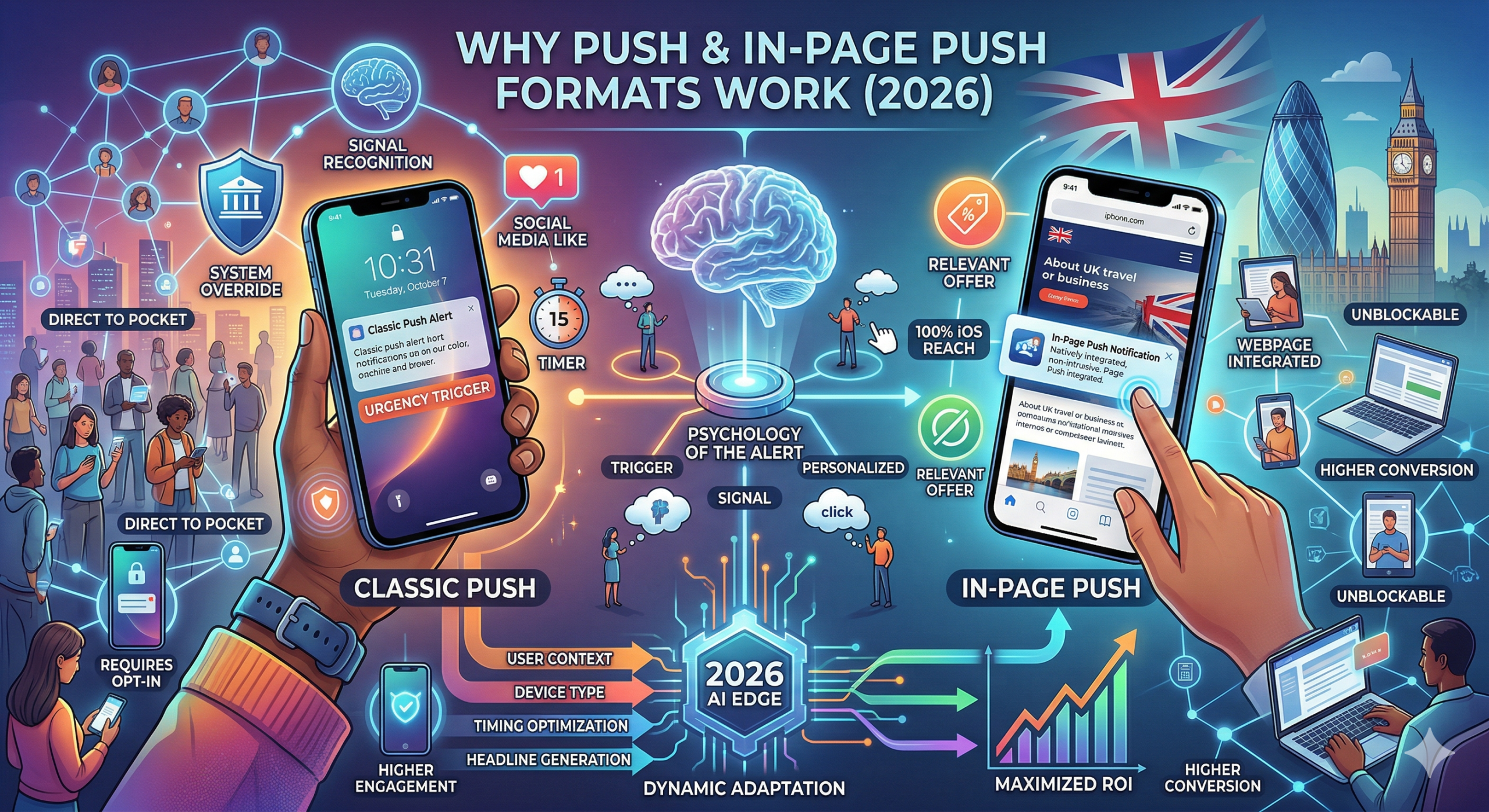
Our brains have been conditioned by years of smartphone use: a ping or a pop-up window is almost always something important (a message from a friend, a bank code, or a social media like).
- Urgency Trigger: A notification feels momentary. If you don’t click now, the information might disappear or lose its relevance.
- Personalization: A push looks like a private message addressed specifically to you, which significantly lowers subconscious “advertising resistance.”
2. Classic Push Notifications: A Direct Channel to the User’s Pocket
Classic pushes are delivered directly to the user’s device, even if the browser is closed.
- Advantages: Maximum visibility. The message appears over all open windows or on the lock screen.
- Key Feature: Requires an Opt-in. In 2026, this has become a quality filter: if a user subscribes, they have already demonstrated loyalty to the topic.
- Best Use Cases: Limited-time offers (Sweepstakes, Betting), news (Finance), and reminders.
3. In-Page Push (IPP): The Savior for iOS and “Cold” Traffic
In-Page Push is a visual imitation of a push notification displayed directly on a website. It is the “little brother” of the classic format that solved its biggest headaches.
- 100% iOS Reach: Classic pushes on iPhones were always a struggle. IPP works across all devices and browsers, unlocking access to Apple’s high-spending audience.
- No Subscription Needed: Users don’t have to click “Allow” in a system prompt. They simply see the notification while they are active on the site.
- Blocker Immunity: IPP is much harder to block at a system level because it is part of the page’s actual content.
4. Format Synergy: How to Maximize Yield
In 2026, top-tier media buyers don’t choose between these formats; they use them in tandem.
| Feature | Classic Push | In-Page Push |
| Delivery | To the device (even offline) | Only in-browser (online) |
| Subscription | Required | Not required |
| iOS Reach | Limited | Full |
| User Experience | More aggressive | More native |
5. 2026 Trends: Push on AI Steroids
This year, the key success factor is dynamic adaptation. Modern ad engines utilize AI for:
- Delivery Time Optimization: The system waits for the exact moment a specific user is most active to trigger the message.
- Headline Generation: AI sifts through thousands of linguistic triggers (as discussed in our neuro-copywriting guide) to find that perfect “hook.”
The Bottom Line
Push notifications work because they mimic human communication. Classic push provides penetration depth, while In-Page Push offers universal reach and access to premium traffic. In 2026, this isn’t just advertising—it’s the art of delivering the right signal to the right hands at the perfect time.
FAQ
1. What is push and in-page push advertising?
Push and in-page push are ad formats that deliver clickable notifications either directly to a user’s device (push) or embedded within a webpage (in-page push), designed to maximize visibility and engagement.
2. How does click psychology influence push ad performance?
Click psychology leverages urgency, curiosity, and relevance to trigger impulsive interactions, increasing CTR by aligning messaging with user intent and behavioral patterns.
3. Why are in-page push notifications considered more effective in 2026?
In-page push ads avoid subscription barriers, appear natively within content, and deliver higher reach on iOS and desktop, making them more scalable and conversion-friendly in modern traffic environments.
4. What technical advantages do in-page push ads have over classic push?
They do not rely on OS-level permissions, bypass browser limitations, and ensure consistent delivery across devices, improving scalability and reducing user opt-in friction.
5. How can marketers optimize CTR for push campaigns?
By testing creatives, segmenting audiences, using strong CTAs, leveraging behavioral targeting, and continuously optimizing based on real-time performance data.