In 2026, the landscape of webmastering and content marketing has changed forever. Generative AI has become the primary tool for content creation, with millions of articles published daily in an automated mode. However, Google is not standing still. The search engine’s algorithms—including updated Helpful Content systems and next-gen AI detectors—have learned to instantly recognize lifeless, copy-pasted spam (often referred to as AI Slop).
For webmasters, this has created a major dilemma. On one hand, producing content manually at the same scale is no longer economically viable. On the other hand, directly monetizing AI-generated sites with aggressive banners or pop-unders leads to instant demotion in search rankings, a drop in Core Web Vitals, and consequently, an eCPM plummeting to fractions of a cent.
The way out of this dead end is the symbiosis of high-quality AI content and smart native advertising (Native Ads).
In this article, we will break down the technical and strategic nuances of integrating native widgets into auto-generated content, allowing you to maintain search engine trust and squeeze out the maximum eCPM in 2026.
Part 1. Why the “AI Content + Aggressive Banners” Setup is Dead in 2026
For a long time, the standard monetization scheme looked simple: generate thousands of low-quality pages of text, slap on clickunders, pop-ups, and heavy JS-coded banners. In 2026, this scheme guarantees a quick death for your domain due to two main reasons:
- Core Web Vitals Metrics (especially INP and CLS): Heavy ad scripts cause Cumulative Layout Shift (CLS) and Interaction to Next Paint (INP) delays. Google directly penalizes websites that annoy users with slow load times and shifting content.
- Quality Assessment Algorithms (Helpful Content System): If a Google bot sees a page with generic AI text where ads overshadow the content itself, the site is instantly flagged as MFA (Made for Ads) and dropped from the index.
Native Advertising (Native Ads) solves both issues. It mimics helpful recommendations within the article, does not disrupt the page layout, has virtually no impact on load speed, and is perceived by search bots as an organic part of the content.
Part 2. How to Produce AI Content That Defies Google Filters
Before implementing native ads, you must ensure that your content itself does not look like “cheap AI.” Google does not penalize you for the mere fact of using AI, but rather for the lack of added value (Value Add) and violation of the E-E-A-T (Experience, Expertise, Authoritativeness, Trustworthiness) guidelines.
Three Rules to “Humanize” AI Generation:
- Hybrid Approach (Human-in-the-Loop): Never publish raw output from an LLM. Your generation script should output a draft, which is then refined by editorial AI agents to add formatting, inject unique facts, and break up sentence monotony.
- Integrating Personal Experience (The “Experience” Factor): Add requirements to your generation prompts to use markers of personal experience: “In my practice…”, “We tested…”, “Our experience shows…”. Dilute dry theory with realistic, fictionalized micro-case studies.
- Structured Data (Schema.org): Always implement Article, FAQ, and Product markup (if writing a review). This helps the search bot quickly grasp the page’s intent and boosts trust in the content.
Part 3. Architecture of Integrating Native Ads into AI Pages
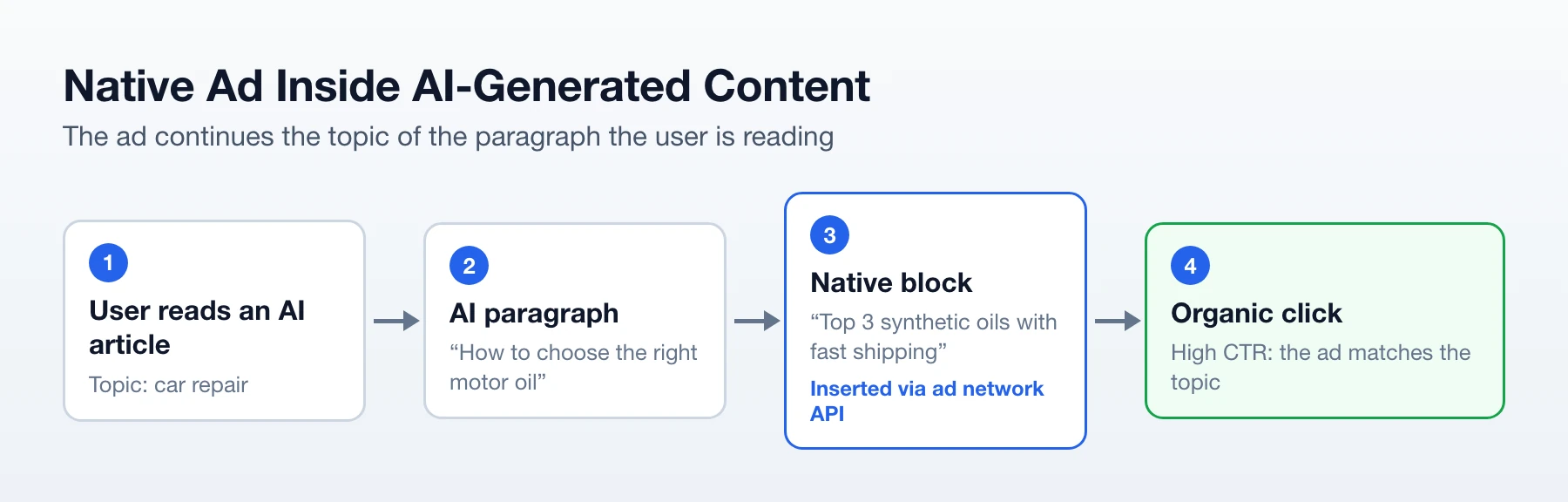
The main secret to achieving a high eCPM with Native Ads is contextual relevance. The ad block should not look foreign; it should logically continue the train of thought of the AI-generated text.
The Seamless Native Integration Funnel:
1. Server-Side Rendering (SSR) over Client-Side Scripts
Most webmasters simply insert a widget’s JS code into the article body. In 2026, this is bad practice. The browser renders the page first, then pulls the ad, causing layout shifts (CLS spikes).
How to do it right: Use your ad network’s API (such as the GTaro Ads API) to fetch ad creatives server-side. Your server should request the ad content (headline, image, link) during page compilation, embed it directly into the article’s HTML, and serve a complete, monolithic document to the user. This drops CLS to zero and makes loading instantaneous.
2. Dynamic Semantic Targeting
Do not use the exact same native block across all articles. Leverage AI to analyze text “on the fly.”
- The script analyzes the keywords of the generated article.
- It sends a query to the ad network with precise tags (e.g., not just “cars”, but “Liqui Moly motor oil”).
- The native block displays the most relevant offer. This boosts your CTR 3 to 4 times compared to blind banner rotators.
Part 4. How to Maintain a High eCPM: Practical Strategies
Switching to native ads should not cut into your revenue. On the contrary, due to a higher Click-Through Rate (CTR) and better user engagement, native ads can yield a significantly higher eCPM than standard display ads.
1. “In-Feed” Format (Within Text)
Place native blocks inside the article after the 2nd and 5th paragraphs. By this point, the user is already engaged in reading. The ad unit should use the same fonts, sizes, and link colors as your main content, differing only by a subtle and legally required “Sponsored” or “Ad” label.
2. Content Recommendation Widgets
Place “You may also like” widgets at the very end of the article. In 2026, these widgets show excellent conversion rates if they mix ad links with internal links to your own site (at a ratio of 1 ad to 3 internal articles). The search engine sees healthy internal linking, while you get monetization.
3. Integrating Smartlinks into AI Anchors
One of the most profitable ways to monetize AI text is automatically replacing specific keywords with Smartlinks. During article generation, our AI script can identify commercial search intent (such as “download VPN,” “buy antivirus,” “play demo”) and automatically wrap them in optimized links that distribute traffic to the highest-paying offers based on the user’s GEO and device.
Part 5. Comparison of AI Site Monetization Approaches
To illustrate, let’s compare the performance of traditional and native monetization approaches for sites with AI-generated content in today’s landscape:
| Metric | Traditional Banners / Pop-unders | Programmatic Native Ads (with SSR) |
| SEO Impact (Google) | High risk of penalty (MFA filters) | Safe, perceived as part of the content |
| CLS Score (Core Web Vitals) | Degraded due to asynchronous JS rendering | Zero (with server-side integration) |
| Average CTR | 0.2% – 0.5% (high ad blindness) | 2.5% – 6.0% (thanks to contextual relevance) |
| eCPM Stability | Drops over time due to ad blockers | Consistently grows with traffic quality |
| User Reaction (UX) | High annoyance, high bounce rates | Highly loyal, deep engagement |
Part 6. Webmaster Checklist: Risk-Free Integration
Before scaling the monetization of your AI portal, cross-reference your setup with this technical checklist:
- [ ] Ad Labeling: All native blocks have a clear yet unobtrusive label (e.g.,
SponsoredorPromoted). Google values transparency. - [ ]
rel="sponsored"Attribute: All external links in your ad widgets and native integrations use therel="nofollow sponsored"tag. This completely protects your site from manual actions for selling links. - [ ] Responsive Layout: The native block scales perfectly on mobile screens (which account for over 85% of traffic in Tier-3 and Tier-2 GEOs in 2026).
- [ ] Lazy Loading: If you are not using SSR, make sure lazy loading (
loading="lazy") is enabled for all images in ad units located below the fold. - [ ] Ad Density: Place no more than one or two native ad units for every 500 words of text. Overloading a page with ads ruins any helpful content.
Conclusion
Integrating Native Ads into AI-generated content is not just a survival tactic under search engine pressure in 2026. It is an upgrade to a higher tier of publishing. By prioritizing page load speeds, semantic relevance, and server-side ad rendering, you build a web asset that yields a high eCPM, retains user loyalty, and maintains top rankings in Google’s SERP for years to come.