In 2026, manual split-testing of offers feels as archaic as trying to outrun a supercar on a bicycle. While old-school media buyers are still manually switching streams in their trackers, Smartlink 3.0 algorithms are making decisions in milliseconds, analyzing data points that the human eye simply cannot process.
Here is why the “Smart Link” has evolved from a beginner’s tool into a high-tech, AI-driven profit control center.
1. The End of the Manual Split-Test Era
In the past, a smartlink was a simple rotator: it showed offers A, B, and C in turn, picking the best one based on average metrics. In 2026, this approach is dead. A modern Smartlink analyzes the individual conversion probability for every single click.
The algorithm understands that a user from London on an iPhone 17 with 20% battery at 11 PM is 85% likely to convert on Offer A, while a similar user during the day would prefer Offer B.
2. Deep Signal Analysis: 150+ Signals per Millisecond
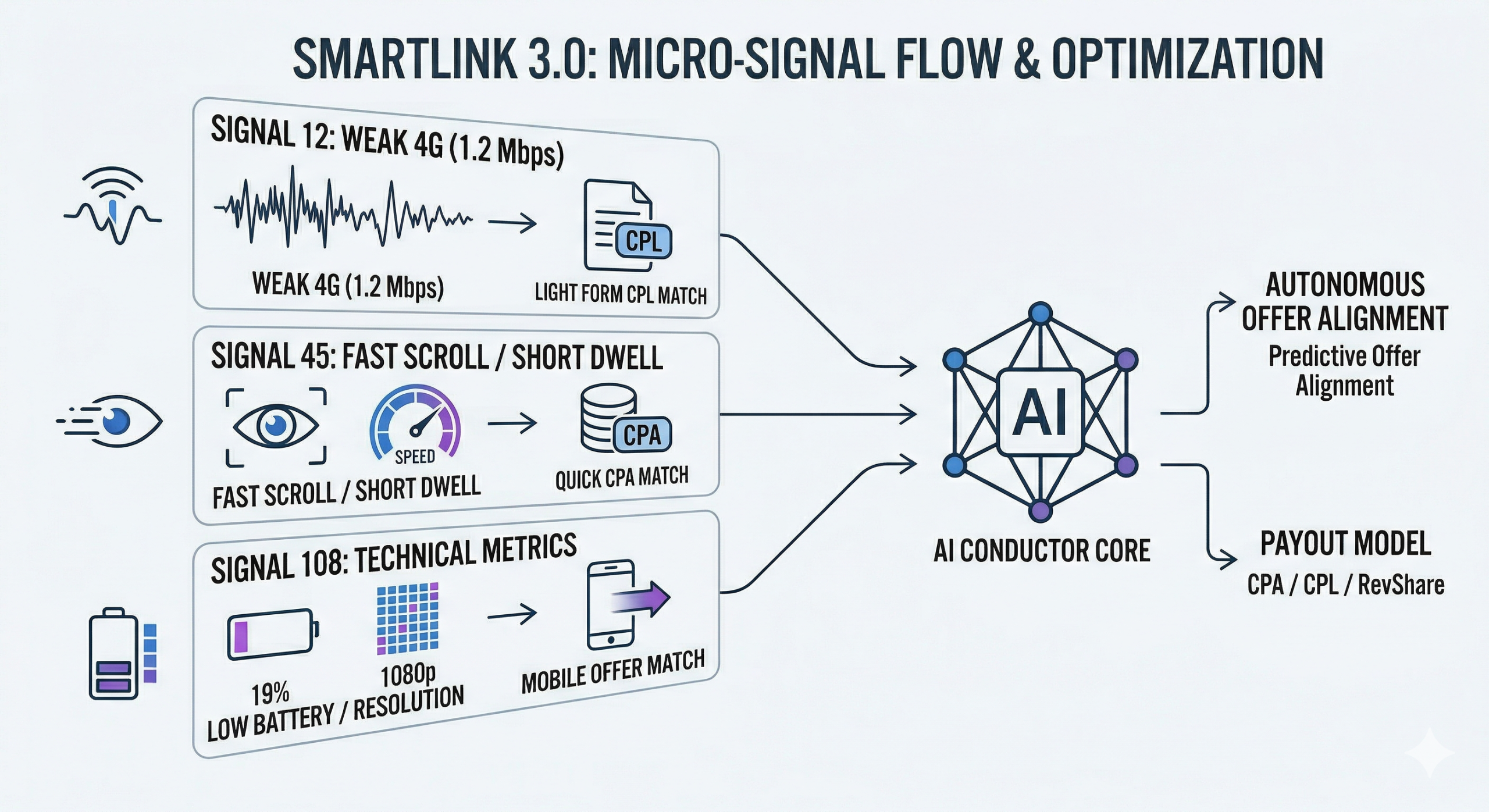
Smartlink 3.0 is no longer limited to GEO and OS types. Now, micro-signals come into play:
- Connection Stability: If a user has a weak 4G signal, the system won’t send them to a “heavy” landing page with video; instead, it selects a lightweight, fast registration form.
- Behavioral Footprint: Analyzing how fast a user scrolls and which elements they linger on (via anonymized patterns) allows the link to select the most relevant visual style for the landing page.
- Technical Metrics: Battery level, screen resolution, and even display refresh rates influence the offer selection.
3. Self-Healing Links: Autonomous Infrastructure
A major pain point for any buyer is a “hit cap” or a crashed advertiser landing page. In 2026, you no longer bleed budget into the void. Smartlink 3.0 features autonomous health monitoring:
- If an offer stops responding or reaches its conversion limit (CAP), the system instantly and seamlessly redirects traffic to the next most profitable option.
- You don’t lose a single cent, even if the advertiser goes offline in the middle of the night.
4. Hybrid Monetization: CPA, CPL, and RevShare in One Bottle
Why choose one payout model when you can have them all? The next-gen smart link simultaneously tests different payout structures:
- For “fast” users, it selects CPL (pay per registration).
- For high-quality, engaged traffic, the system prioritizes CPA or RevShare, maximizing long-term Lifetime Value (LTV).
The Verdict: In 2026, a Smartlink isn’t just a “patch” for remnant traffic; it’s a full-scale AI conductor that transforms a chaotic stream of clicks into structured profit. If you are still testing offers manually, you aren’t just wasting time — you are gifting your profit to your competitors’ algorithms.