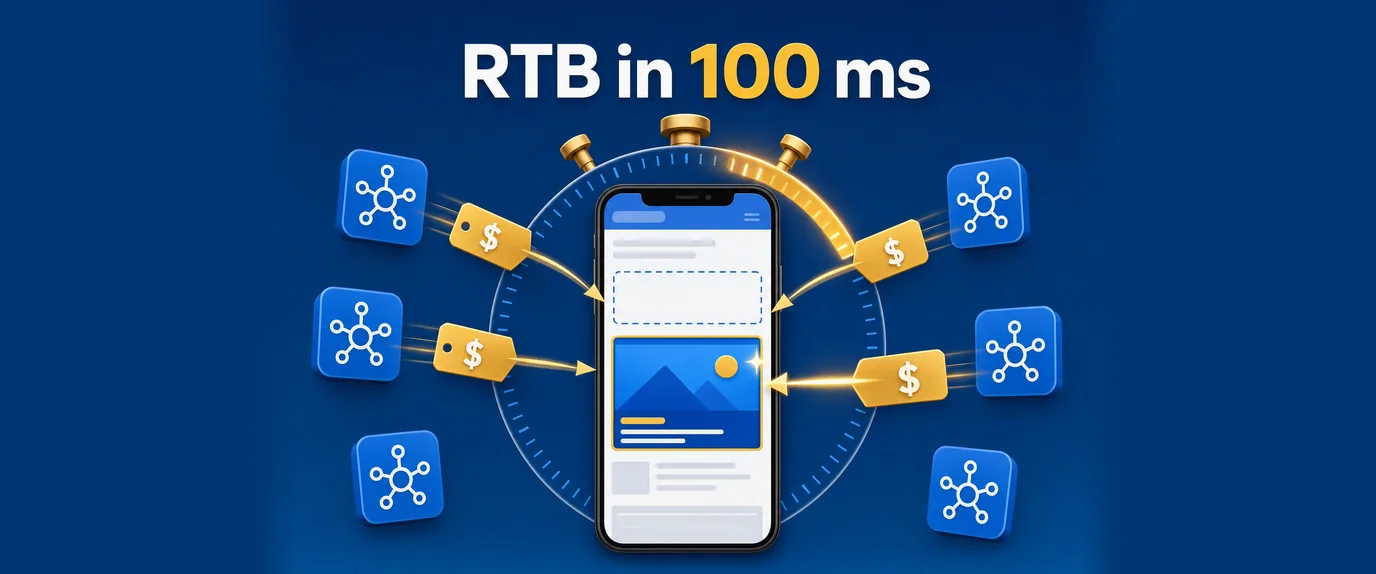
Picture this: you open an article on your favorite news portal. While the page is loading, a true clash of titans unfolds behind the scenes of your screen. Dozens of algorithms instantly evaluate your profile, debate your interests, and place bids. And then, a fraction of a second later, the page is fully ready, and you see a banner advertising the exact wireless headphones you were searching for last night.
Do you think it’s magic or total surveillance? In reality, it is Real-Time Bidding (RTB)—a digital “Wall Street” where user attention is bought and sold faster than you can blink.
For advertisers, RTB is not just another complex term from the AdTech sphere, but a powerful tool that allows you to stop using a cannon to shoot sparrows and start investing your budget exclusively in your target audience. In this comprehensive guide, we will break down the anatomy of RTB, look under the hood of the algorithms, and find out how to make this technology work for your business.
1. The Anatomy of the RTB Ecosystem: Who is Who?
To trade successfully on the exchange, you need to understand how its infrastructure is built. In the RTB ecosystem (which is the core of a broader concept—programmatic advertising), several key players are involved.
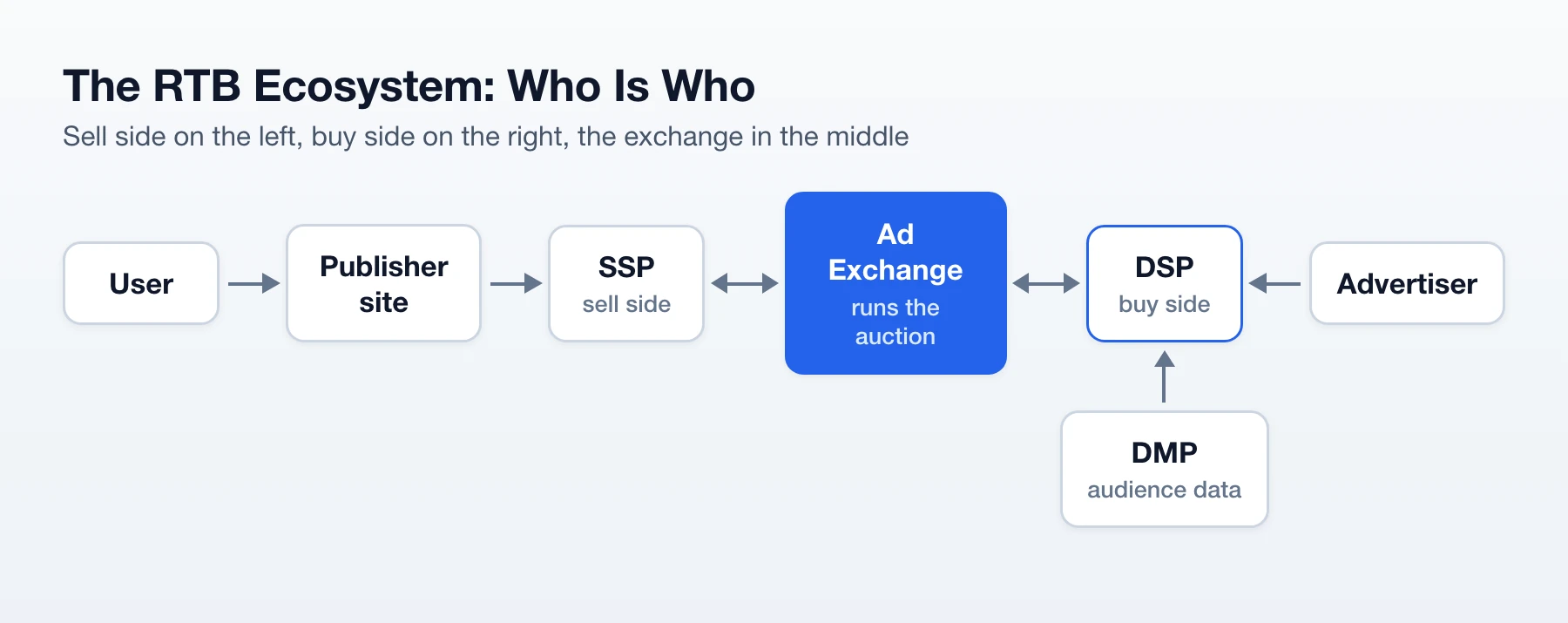
- SSP (Supply-Side Platform) — a platform on the seller’s side (publisher, website owner, or mobile app). Its main task is to sell every available pixel on the screen as profitably as possible. The SSP informs the exchange: “I have a user logged in here from Kyiv, using iOS, reading an article about cars. Who will bid the most to show him an ad?”
- DSP (Demand-Side Platform) — a platform on the buyer’s side (meaning you, the advertiser). This is your main tool, your flight control panel. Here you configure targetings, upload creatives, and set bid limits: “I need men aged 25–35 interested in car electronics, willing to pay up to $0.50 per impression.”
- Ad Exchange — a virtual trading floor where SSPs and DSPs instantly connect with each other to hold an auction.
- DMP (Data Management Platform) — the “brain center,” a data warehouse. A DMP collects, structures, and sells information about users (their demographics, interests, purchase history). It is thanks to the connection between DSP and DMP that the algorithm understands that the user in front of the screen is not just an abstract visitor, but a potential buyer of a business-class apartment.
Timing of the Miracle: This entire cycle—from the moment a link is clicked to the full rendering of the banner—takes about 100 milliseconds. For comparison, it takes a human about 300 milliseconds to blink. The speed of the algorithms is staggering.
2. The Evolution of Auctions: First-Price vs. Second-Price
For a long time, the Second-Price Auction ruled the roost in RTB. Its logic was as gentlemanly as possible: the highest bid won, but the winner paid the price of the nearest competitor plus one cent rather than their own price.
Example: You set a maximum bid of $2.00, and your competitor sets it at $1.50. You win the auction, but only $1.51 is deducted from your balance.
However, the AdTech industry has almost completely shifted to the First-Price Auction. Here, the rules are stricter: whatever you bid is exactly what you pay in case of a win.
For advertisers, this changed the game. Now, simply “flooding the auction with money” has become unprofitable—you can quickly burn through your budget. Bid Shading technologies (smart lowering of bids) have come to the forefront. These are AI algorithms built into modern DSPs that analyze the history of past auctions on a specific website and automatically reduce your bid to the minimum possible level required to win.
3. The Spectrum of Programmatic Buying: RTB and Its Alternatives
Often, the terms “Programmatic” and “RTB” are used interchangeably, but this is a methodological error. Programmatic is fundamentally the automated purchase of advertising, whereas RTB is merely one of its formats (the open auction).
To manage marketing flexibly, it is important for an advertiser to know all four purchasing formats:
| Buying Type | Where do trades take place? | Price per Impression | Inventory Access |
| Open Auction (Classic RTB) | Open exchange for everyone | Dynamic (auction) | Maximum reach, all available websites |
| Private Marketplace (PMP) | Invitation-only closed auction | Dynamic (auction) | Only premium sites for select brands |
| Preferred Deals | Direct deal without an auction | Fixed price | The advertiser has the right of first refusal to buy the impression |
| Programmatic Guaranteed | Direct guaranteed deal | Fixed price | Strictly reserved volume of impressions on a specific website |
Classic RTB (Open Auction) is ideal when you need scale, a quick launch, and flexible price optimization on the fly. If you are promoting a luxury brand and fear appearing next to questionable content, your choice is PMP or Preferred Deals.
4. Data in the Privacy-First Era: What to “Feed” the Algorithms?
The effectiveness of RTB directly depends on the quality of user data. This data is divided into three types:
- 1st-Party Data (Own Data): Information you collected yourself (a pixel on your website, CRM lists, data from a mobile app). This is the most valuable gold in marketing.
- 2nd-Party Data (Partner Data): Essentially, someone else’s 1st-party data shared with you by agreement (for example, an airline exchanging aggregated, anonymized data with a hotel chain).
- 3rd-Party Data (Third-Party Data): Databases purchased from DMPs (providers, telecom operators, major tech platforms).
Market Realities
The world has definitively moved into the Privacy-First era. The phase-out of third-party cookies and strict tracking restrictions from mobile operating systems have forced RTB platforms to evolve.
Today, successful advertisers rely on next-generation contextual targeting (where AI analyzes the semantic content of the page the user is currently reading, rather than their history) and on building their own Customer Data Platforms (CDPs) to utilize their 1st-Party data as effectively as possible in RTB auctions.
5. The Dark Side of RTB: Risks and Protection Methods
It would be reckless to sing nothing but praises for RTB. An open and fast market attracts fraudsters. Advertisers regularly encounter three threats:
- Ad Fraud. Bots simulating human behavior. They scroll pages, click on banners, and let your budgets slip through your fingers. This also includes Pixel Stuffing (when a banner is compressed to a 1 × 1 pixel size and runs on a website invisibly to the human eye) and Ad Stacking (when banners are layered on top of each other, and an impression is counted for all of them).
- Brand Safety. Without proper control, the algorithm might display an ad for your baby food on a forum with aggressive discussions or on a website with pirated movies, which strikes a blow to your brand’s reputation.
- Low Viewability. A banner might load at the very bottom of the page, and the user might close the tab without ever scrolling down to it. But technically, the impression took place, and you paid for it.
How to Protect Yourself?
When working with a DSP, always connect third-party traffic verifiers (such as IAS (Integral Ad Science), DoubleVerify, or Moat). They act as independent judges: they assess banner viewability, block bot impressions, and prevent ads from being displayed on toxic resources.
6. Step-by-Step Manual: How to Launch and Optimize an RTB Campaign
If you are ready to test the power of RTB, use this step-by-step algorithm to minimize risks at the start.
Step 1: Clearly Define Your KPIs
RTB addresses different objectives. Decide right off the bat: do you need reach and brand awareness (metrics: CPM, CTR, Share of Voice) or a performance result (metrics: CPA, CPL, ROI)? Your DSP settings depend on this.
Step 2: Choosing the Right DSP Platform
Not all platforms are equally useful. When choosing a DSP, ask the platform representatives three questions:
- Which SSPs are they directly integrated with (the more direct integrations, the lower the commissions)?
- What fraud protection tools are built-in by default?
- Is there support for auto-optimization algorithms targeting a specific action (CPA optimizers)?
Step 3: Configuring Hygiene Filters
Before uploading creatives, set up Blacklists (lists of sites where your advertising is forbidden—for example, clickbait sites or mobile gaming apps where children often click ads accidentally) and set frequency caps (Frequency Capping). Optimally, no more than 3–4 impressions per user per week; otherwise, you will start to annoy them.
Step 4: Dynamic Creative Optimization (DCO)
Leverage the full power of automation. DCO (Dynamic Creative Optimization) technology allows the algorithm to assemble a banner on the fly for a specific user. For a resident of a rainy city, the system will show a banner with a cozy blanket, while for a user in a sunny region, it will display an offer for a discount on air conditioners.
Step 5: Analytics and Campaign “Cleaning”
For the first few days, do not make any sudden moves—the DSP algorithms need to learn and gather statistics. After a week, conduct an audit: ruthlessly disable platforms that yield a high bounce rate, optimize bids, and scale those audience segments that showed the highest conversion.
Conclusion
Real-Time Bidding is not a “magic button” that will instantly make your business profitable. It is a high-tech, flexible, and rather complex tool. It requires analytical thinking from a marketer, constant work with data, and a willingness to experiment.
The digital landscape has gone fully automated. By mastering RTB algorithms today, you gain direct access to the hearts (and wallets) of your clients, leaving competitors far behind with their outdated methods of manual ad buying.