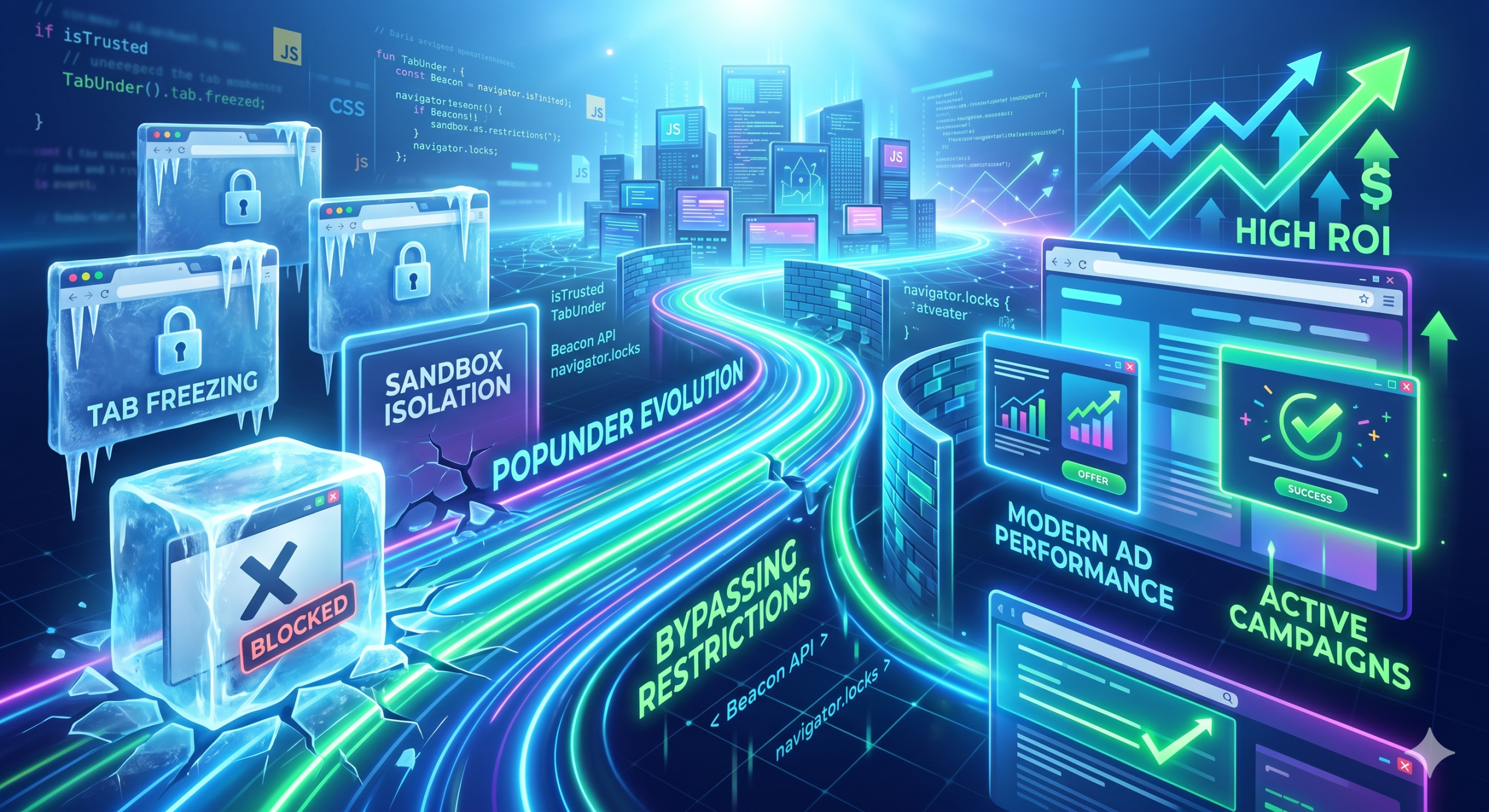
Over the past few years, modern browser engines (primarily Chromium) have made a tectonic shift toward total resource control. If webmasters and ad networks previously fought static filters like AdBlock and EasyList, today’s main enemy of high-quality Popunder traffic is the internal optimization mechanisms of the browser itself.
Algorithms like Tab Freezing and aggressive Sandbox isolation turn what used to be a classic, high-yielding ad format into a generator of “empty” clicks. The window or tab is formally created, but the tracker script inside goes to sleep, the ad network fails to execute, and the advertiser receives zero activity.
Let’s dive into the technical underbelly of these restrictions and explore the workaround strategies that allow media buyers and ad networks to maintain high performance without losing conversions.
Anatomy of the Lockdown: What Happens Under the Hood
To effectively bypass these restrictions, we need to understand the physics of the process at the Event Loop and Page Lifecycle API levels.
1. Tab Freezing and Throttling of Background Threads
When an ad script calls window.open(), the new ad window is usually pushed to the background (Popunder) while the user remains on the original publisher site. For the browser, this newly opened ad tab instantly becomes “hidden” (document.visibilityState === ‘hidden’). Within seconds, Chromium kicks in with aggressive throttling:
Macro-tasks and timers (setTimeout, setInterval) are cut down to just one execution per minute or frozen entirely. Requests via fetch and XMLHttpRequest are paused unless they were initiated in the first few milliseconds. DOM rendering goes on complete pause.
The Result: The user returns to the tab half an hour later, the browser “wakes up” the page, but the offer session has already expired, and the tracker records a bounce. You paid for a click that technically never happened.
2. Sandbox Isolation
Modern ad network widgets are frequently loaded via third-party iframes. If a publisher or a CMS applies a sandbox attribute to the iframe without the allow-popups and allow-popups-to-escape-sandbox flags, a classic popunder script call will immediately throw a DOMException. The browser simply blocks any attempt to create a child context.
Bypass Strategies: From Simple Tricks to Deep Tech
The AdTech market has adapted. Primitive JavaScript clickers have been replaced by sophisticated solutions that account for the inner workings of the V8 engine.
Strategy #1: Anatomically Accurate Trusted User Gestures
Browsers block window.open() unless the event is triggered by an explicit, verified user action (isTrusted === true). The old-school approach involved transparent overlays stretched across the screen: a user clicked anywhere, and a pop-up was triggered.
Today, Chromium analyzes more than just the fact of a click; it evaluates behavioral patterns:
The cursor movement velocity prior to the click.
The exact coordinates of the click (clicks exactly at 0,0 or the geometric center of the screen trigger immediate suspicion).
Multi-touch events on mobile devices.
The Solution: Modern popunder scripts generate dynamic, invisible DOM elements that continuously “follow” the user’s mouse cursor or shift right under the finger during scroll. The click happens on a real, physically valid element during legitimate interaction (e.g., clicking a video player, a “Read More” button, or navigation menu). The browser treats this gesture as 100% trusted and flawlessly allows the new window to open.
Strategy #2: The Tab-Under Technique Instead of Pop-Under
Since background tabs are ruthlessly frozen, engineers flipped the script on the process logic.
At the exact moment of a valid click, the script takes the current active tab (the one the user is actively looking at) and instantly redirects it (via location.href) to the advertiser’s landing page.
Simultaneously, the script opens a new background tab and loads a copy of the original source site into it, returning the user to the exact same state and scroll depth they were just at.
The Payoff: The offer opens in the active window with maximum CPU and network thread priority. Analytics scripts, Facebook/TikTok pixels, and heavy landing pages load instantly. Conversion rates (CR) with this approach often see a 25% to 40% boost compared to a classic “sleeping” popunder.
Strategy #3: Resuscitation via Service Workers and Web Locks API
If utilizing a classic Popunder setup is absolutely necessary, you must prevent the tab from “falling asleep” before the tracker logs the click.
This is where Service Workers come into play. Because workers run in a separate thread and are not directly tied to the rendering of a specific DOM tree, background freezing restrictions hit them much later and more leniently.
Via postMessage, the script inside the popunder sends a signal to the worker: “I’m open, keep the connection alive.” The worker can then use the Background Sync API or hold a virtual lock via navigator.locks.request, forcing the browser to allocate tiny time slices to keep the context alive just long enough to dispatch the network packet (Postback) to the ad network’s server.
Landing Page Optimization: Don’t Lose Bypassed Traffic
Even if an ad network script bypasses Tab Freezing perfectly, a poorly optimized prelander on the media buyer’s side can completely nullify the effort. If your page weighs 15 MB, packs dozens of uncompressed scripts, and goes through three redirects, the browser will freeze the tab halfway through the loading process.
Checklist for an “Indestructible” Landing Page:
Compress Everything: Keep critical CSS inline and minimize JS. Your First Contentful Paint (FCP) must happen faster than 300ms.
Asynchronous Pixels: All tracking counters and analytics must initialize via async or defer. If a tracker script hangs during initialization, the tab goes into hibernation without counting the lead.
Leverage the Beacon API: To send telemetry data from the landing page (e.g., page views or unique clicks), use navigator.sendBeacon(). This method guarantees that the browser will transmit the data to your server even if the tab is closed or aggressively frozen a split second after opening.
The Bottom Line
Popunder traffic remains one of the highest-volume and most cost-effective verticals, but its technical barrier to entry has grown significantly. Out-of-the-box, public-domain scripts no longer yield profits—they crash hard against Chromium’s optimization walls.
Survival and high ROI now rely heavily on an ad script’s capacity to mimic genuine user behavior and exploit browser process prioritization quirks (such as the Tab-Under shift). Partner with highly technological ad networks that update their JS cores regularly, optimize your landing page speeds, and this format will continue to generate highly profitable campaigns.