Short answer: A banner advertising network connects advertisers with many websites and apps that sell space for image ads. You create banners, choose targeting and a bid, and pay per thousand views (CPM) or per click (CPC). Before you launch, compare traffic quality, fraud filters, targeting, reporting, the minimum deposit and the creative rules.
If you are a media buyer or a small advertiser, a banner ad network lets you reach many sites with one account. This guide explains how it works, which banner sizes to prepare, how CPM and CPC compare in numbers and what to settle before you spend the first dollar.
What is a banner advertising network?
A banner advertising network is a platform that collects ad space from many publishers and sells it to advertisers in one place. Publishers are site and app owners. Advertisers are the people who want to show an offer. The network sits between them and handles ad serving, targeting, stats and billing.
Without a network, you would contact each site, agree on a placement, send files and track results one by one. With an ad banner network, you set up one campaign and it runs across many placements.
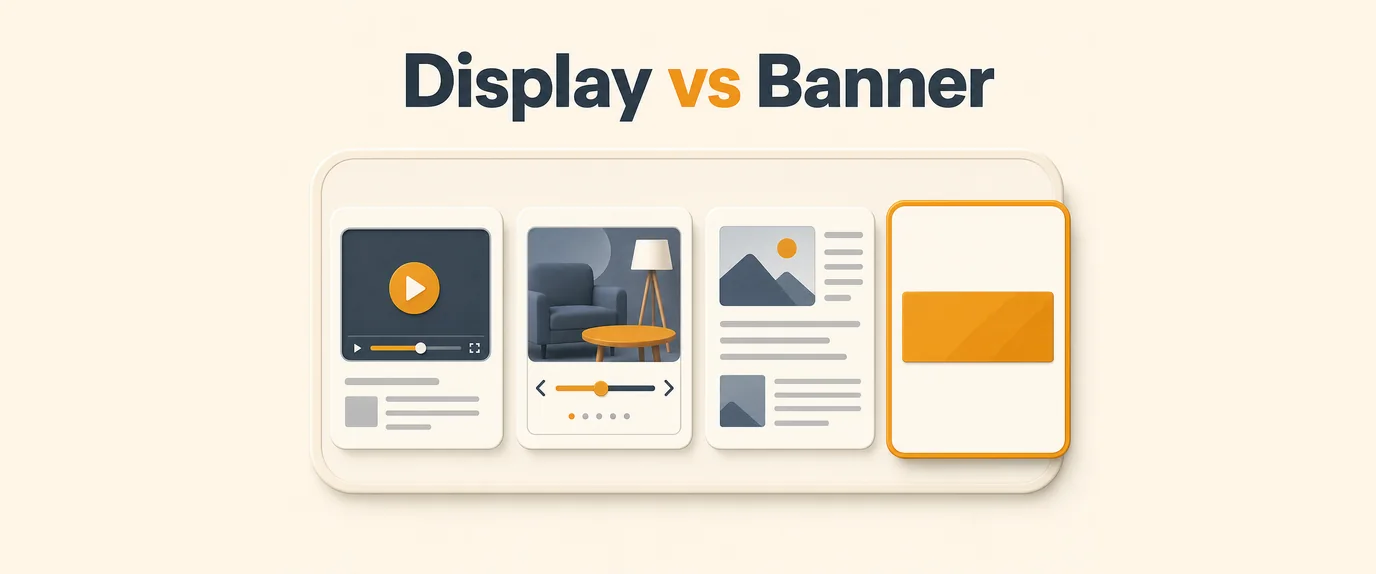
Banner ads are part of display advertising. A display advertising network sells image, animated or HTML5 ads on web pages and in apps, and the terms “banner network” and “display network” often mean the same thing in practice. Some networks also sell other formats, such as native ads and smartlinks, from the same account.
How buying works on a banner ad network
Many networks sell inventory in an auction. A typical flow:
- A user opens a page that has an ad slot.
- The page sends an ad request with data such as the country, device and page type.
- Advertisers whose targeting matches the request place bids.
- The winning bid is chosen and that advertiser’s banner is shown.
All of this happens in a fraction of a second. For the auction in detail, read our guide to real-time bidding in marketing.
CPM and CPC in numbers
Two pricing models are common:
- CPM (cost per mille): you pay for every 1,000 impressions, whether people click or not.
- CPC (cost per click): you pay only when someone clicks the banner.
The arithmetic below uses made-up prices to show how the two relate. They are not market benchmarks. Take a $100 test budget, which is also the minimum deposit at GTaro Ads. At a $2 CPM it buys 100 / 2 × 1,000 = 50,000 impressions. If 0.1% of those impressions are clicked, that is 50 clicks, so each click effectively cost $2.00. At a $0.10 CPC the same $100 buys 1,000 clicks, however many impressions it takes.
The two models meet at one click-through rate: a $2 CPM costs the same per click as a $0.10 CPC only when 2% of impressions are clicked (2 / (1,000 × 0.10) = 0.02). Below that rate, CPC buying is cheaper per click. CPM still fits brand reach and tests of how many people see your banner, and CPC fits cases where you want visits and a fixed cost per visit.
In both models, the bid you set decides how often you win the auction, and the final price depends on competition for that audience. A small first test with the same banner and targeting under both models shows which one works for your offer; the network’s rules say how it charges.
Banner sizes and formats
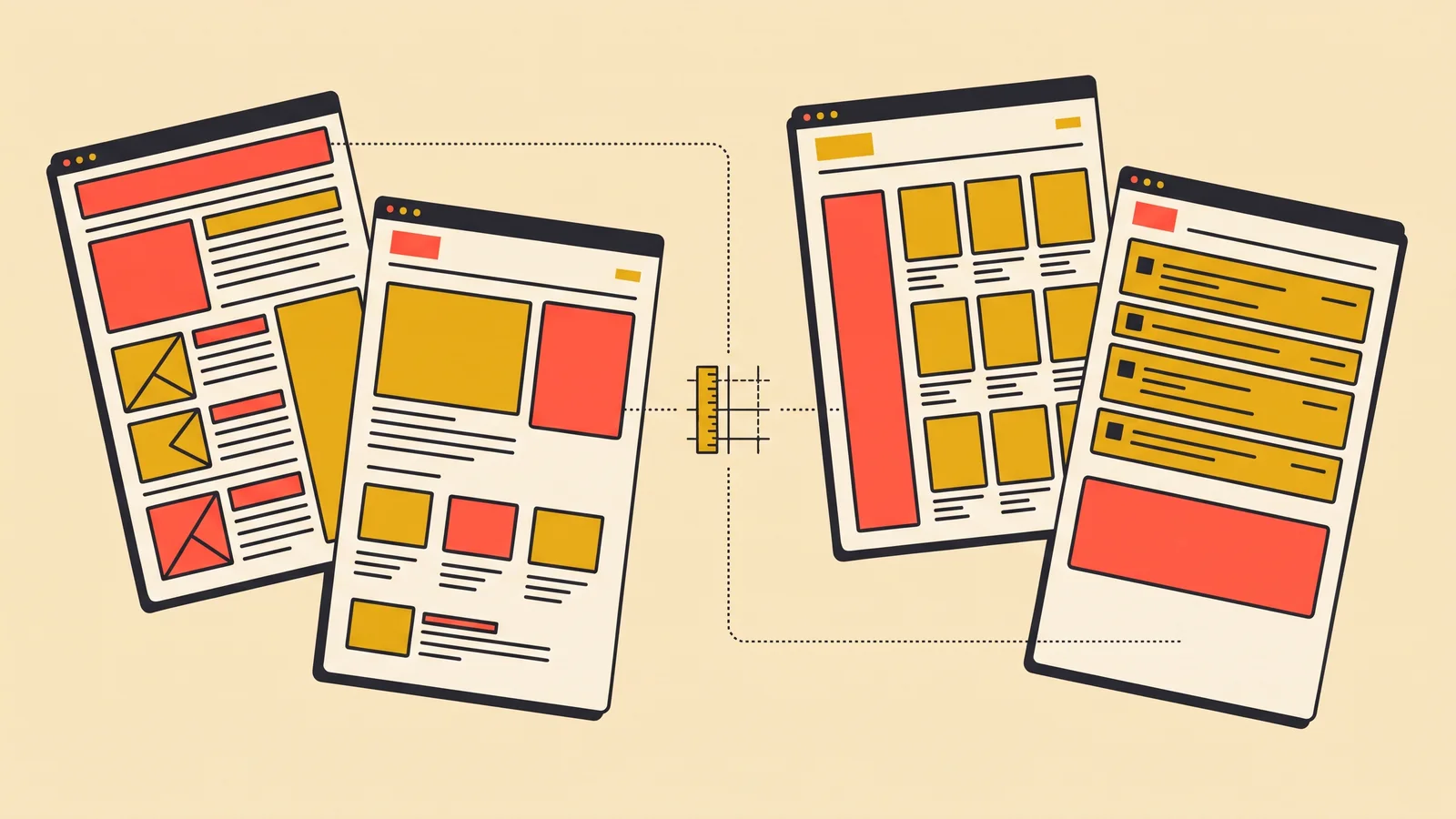
Banners come in fixed sizes measured in pixels. The IAB, the trade body for digital advertising, lists these units in its 2017 New Ad Portfolio guide, together with the maximum file weight for the initial load and for later loading (subload). The guide is from 2017, so use your network’s current size list as the final word:
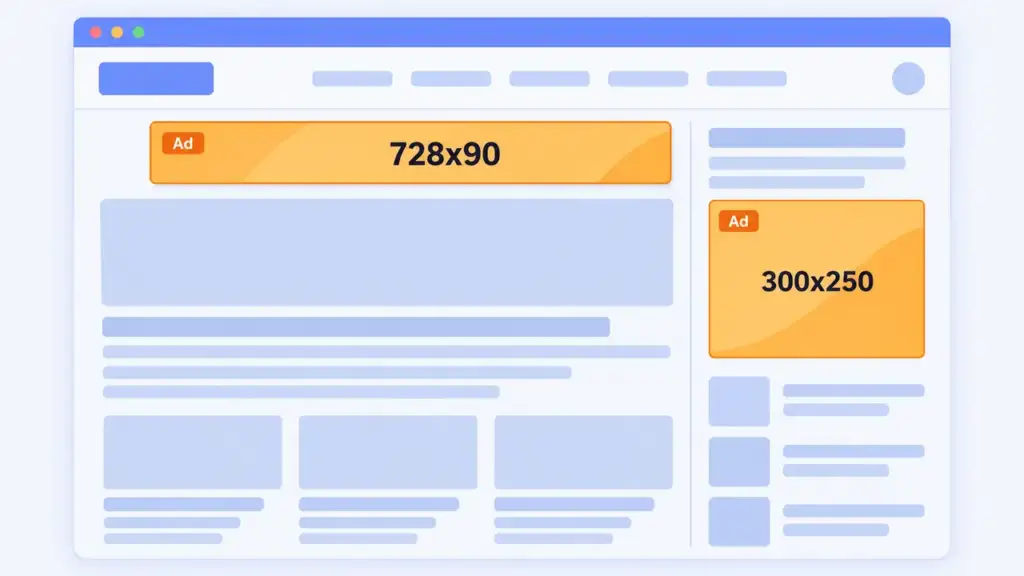
| Name | Size (px) | Max initial load | Max subload |
|---|---|---|---|
| Smartphone banner | 300×50, 320×50 | 50 kB | 100 kB |
| Leaderboard | 728×90 | 150 kB | 300 kB |
| Super leaderboard | 970×90 | 200 kB | 400 kB |
| Billboard | 970×250 | 250 kB | 500 kB |
| Medium rectangle | 300×250 | 150 kB | 300 kB |
| Large rectangle | 300×600 | 200 kB | 400 kB |
| Skyscraper | 160×600 | 150 kB | 300 kB |
| Portrait | 300×1050 | 250 kB | 500 kB |
File weights come from the IAB table for publishers that had not yet moved to flexible-size units. Besides size, you choose a file type:
- Static image: JPG, PNG or GIF. Easy to make and quick to load.
- Animated: a short GIF or similar loop. It draws the eye but must stay light.
- HTML5: an interactive or animated banner packed as a small web package.
Every network sets its own file-weight limits and accepted types, so read its creative requirements page before you design. A 320×50 banner has the tightest budget in the table, 50 kB for the initial load, which is a good reason to keep every file small.
A practical start is 300×250, 728×90 and 320×50: standard IAB sizes that cover most desktop and mobile slots. Add 300×600 and 160×600 once the first results come in.
Mobile and desktop use different units. For mobile traffic, the IAB smartphone banner sizes are 300×50 and 320×50. For desktop, the table above gives 728×90, 970×90, 970×250, 300×250, 300×600 and 160×600. Check the weight limit of every size against your own files before you upload.
What to settle before you launch
Settle these before you add money.
Traffic quality
Where does the traffic come from: websites, apps or both, and which countries? A network that lets you see results by placement or source lets you cut weak traffic later. One that shows only totals gives you little control.
Fraud filters
Invalid traffic (IVT) is traffic that does not meet quality criteria, for example non-human traffic such as bots and spiders. The Media Rating Council (MRC), which sets measurement standards, separates it into two kinds. General invalid traffic is found by routine checks such as lists of known data-center traffic. Sophisticated invalid traffic is harder to find and needs deeper analysis.
Questions for the network: what does it filter, before and after the auction, and can you get a refund or credit for traffic found invalid? Look for ads.txt and sellers.json support too. These are IAB Tech Lab standards: ads.txt is a file that a publisher places on its site to list who may sell its ad space, and sellers.json is a file that ad systems publish so buyers can see who is selling the inventory.
Targeting
The options you will actually use are country, device, operating system, browser, language and time of day. A quick test: can you launch a narrow campaign for one country and one device type? If not, you will pay for traffic you do not want.
Reporting
A demo report or a test campaign should show impressions, clicks, spend and your own conversions, split by placement, country and creative. Set up your tracker with a postback or tracking link before the launch, not after.
Minimum deposit and payment methods
Compare the minimum deposit and the ways to pay (card, bank transfer or crypto), and read how refunds and unspent balance work. Start with a deposit you are ready to use fully on a test.
Creative rules
Every network has moderation: banned topics, rules for animation speed, flashing, sound and fake buttons, and a review time. Find out whether the network bans banners that imitate system messages or close buttons.
A 6-step launch checklist
- Set one goal. Choose a single result: visits, sign-ups or sales, and the number that makes the test a success.
- Prepare the landing page. It must match the banner promise and load fast on mobile, with tracking in place before traffic arrives.
- Make three to five banners. Use the sizes from the table, one clear message per banner and a visible call to action, within the file weights.
- Set targeting and bid. Start narrow with one country and one device type, pick CPM or CPC, set a bid and a daily budget cap.
- Submit for moderation and launch. Fix any rejection reason, then start with a small test budget.
- Read, cut and scale. When the first data arrives, open the report by placement, pause weak placements and banners, and raise the budget only on what meets your goal.

Common mistakes
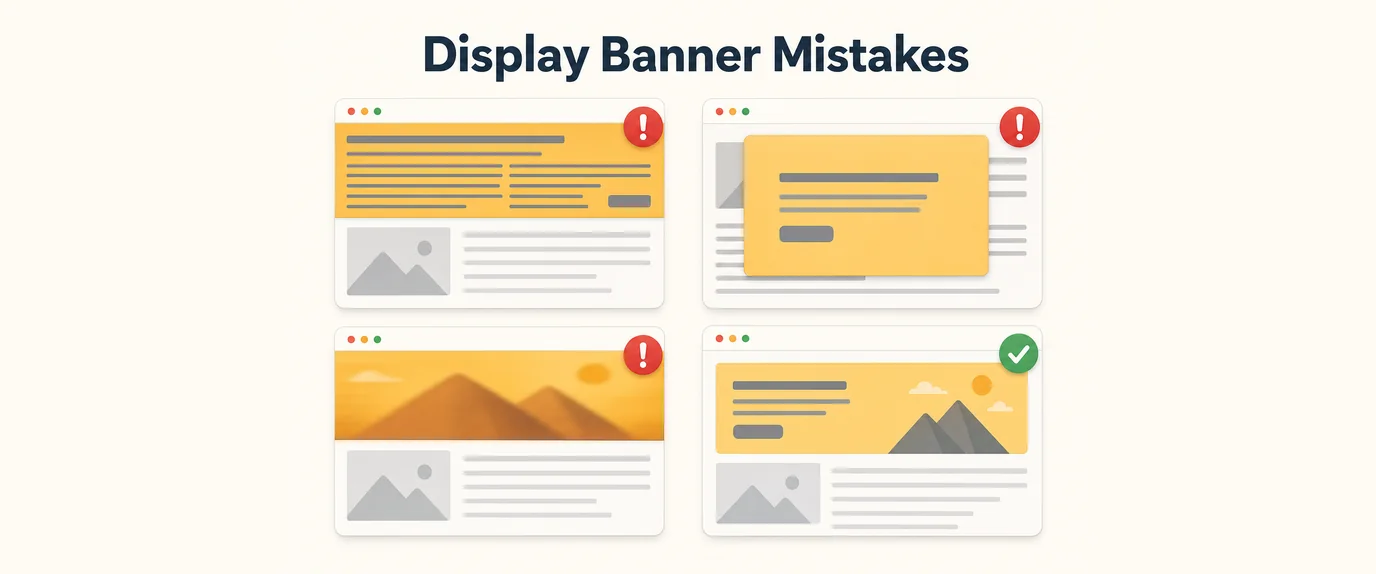
- Launching wide. Ten countries and every device at once make the data impossible to read.
- Using one banner. Banners wear out, and one banner gives no comparison.
- Judging by clicks only. Clicks are not sales; look at conversions from your own tracker.
- Skipping the landing page. A good banner that sends people to a slow or unrelated page wastes the click.
- Ignoring placements. One poor source can use up most of the budget, so block it.
- Not reading the rules. A rejected banner or a paused account costs days.
- Changing everything at once. Change one thing per test: the banner, the bid or the targeting.
Banners on our exchange
On our exchange, banner ads bring a small share of the volume. Most of it comes from pop and push, so judge a banner test on its own numbers and do not expect banner traffic to behave like pop or push traffic. We have no breakdown by banner size or by mobile and desktop that we can share, so the size advice above comes from IAB standards, not from our reports.
How much to spend on a first test
Test with a small budget, but not a token one. In our experience $100 is the minimum for checking a traffic source on one offer, and $300 per offer gives a clearer picture. A made-up example: at a $2 CPM, $100 buys 50,000 impressions and $300 buys 150,000. At a 0.1% click-through rate that is 50 clicks against 150, and a few conversions out of 50 clicks tell you very little.
Test as many networks as you can, and come back to retest. What did not work today may work tomorrow, because traffic quality and competition change, so a single weak result is not a reason to remove a network for good.
What GTaro Ads offers
GTaro Ads works with advertisers and publishers. The company reports 230+ countries and 10B+ monthly ad requests (its own figures). Advertisers deposit from $100 and set their own bid. Payment methods are USDT (TRC20, ERC20, Polygon, TON), USDC (Polygon, Solana), BTC, bank card and bank transfer. Formats are banner, native and smartlink. For in-content placements, see our page on native ads.
FAQ
What is a banner advertising network?
A platform that sells banner ad space from many websites and apps to advertisers. You run one campaign in one account and the network shows it across its placements.
What is the difference between CPM and CPC?
With CPM you pay for every 1,000 times your banner is shown. With CPC you pay only when a user clicks it. At a $2 CPM and a 0.1% click-through rate, one click costs $2.00 (a made-up example).
What are the most common banner ad formats?
Common IAB sizes include 300×250, 728×90, 160×600, 300×600, 970×250 and the mobile 320×50. By file type: static image, animated GIF and HTML5.
How do I avoid fake traffic on a display advertising network?
Ask which fraud filters the network uses, look for ads.txt and sellers.json support, and review results by placement. Pause sources with many clicks and no conversions.
How much should I deposit to start?
Use the network’s minimum and treat it as a test budget. GTaro Ads advertisers deposit from $100.