High-ticket LeadGen verticals—such as Mortgages, Solar Installations, Personal Loans, Wealth Management, and Commercial Insurance—face severe friction when deploying direct-to-app advertising campaigns. Running direct app install campaigns on major social and search networks exposes media buyers to hyper-competitive ad auctions, inflated Costs Per Install (CPI), and severe attribution blind spots caused by privacy frameworks.
Direct-to-app user flows force cold users through immediate app store installs before establishing value or trust. In high-ticket sectors where consumer consideration cycles require education and intent validation, forcing an immediate app download leads to high drop-off rates and low-quality lead submissions that clutter sales call centers.
Web-to-App Funnel Architecture solves these operational bottlenecks. By routing programmatic Native and In-Feed traffic through interactive, educational web pre-landers before prompting an app download or web-application submission, performance marketers lower CPIs, overcome attribution delays, and pre-qualify high-intent leads at scale.
1. The Strategic Failure of Direct-to-App Campaigns in High-Ticket Verticals
In impulse-driven verticals like casual gaming or e-commerce, direct-to-app install campaigns can be effective. However, applying direct-to-app buying strategies to complex, high-ticket services creates severe operational friction.
[Direct-to-App Flow]
Cold Native/Social Ad ──► App Store Listing ──► Heavy App Download ──► Complex Onboarding ──► 85%+ Drop-Off

[Web-to-App Flow]
Native Contextual Ad  ──► Interactive Pre-Lander ──► Qualification Quiz ──► App Store / Deferred Link ──► High-Intent Lead
Core Structural Bottlenecks of Direct-to-App Funnels:
- Invasive Privacy & Attribution Obfuscation: Apple’s SKAdNetwork (SKAN) and Android Privacy Sandbox obfuscate user-level attribution data, delaying conversion reporting by 24 to 72 hours. This attribution lag prevents automated bidding algorithms from making real-time bid adjustments on placement inventory.
- The “App Store Drop-Off” Chasm: Requiring a cold prospect to exit their current reading experience, navigate to the App Store, sign in, and download a 100 MB+ application creates a massive conversion barrier. Up to 70% of clicks drop off before launch.
- Call Center Resource Waste: Direct app installs often attract curiosity clicks. When unqualified users complete simple in-app forms without understanding the offer requirements, sales teams waste valuable human capital calling dead leads.
- Inflation of Auction CPIs: In-app install ad auctions are saturated with venture-backed apps competing for the same user pools, driving CPIs up to $15–$45+ in Tier-1 markets.
2. Web-to-App Pre-Lander Architecture: Intent Building & Warm-Up Mechanics
Native advertising excels at capturing passive, content-consuming readers on premium publisher sites. The key to converting this traffic lies in deploying Contextual Web-to-App Pre-Landers that educate users and build intent before prompting an app installation.
┌────────────────────────────────────────────────────────────────────────┐
│                   Web-to-App Pre-Lander Layer                          │
│                                                                        │
│  [Native Editorial Hook]                                               │
│            │                                                           │
│            ▼                                                           │
│  [Educational Article / Calculator] ──► Establishes Need & Authority  │
│            │                                                           │
│            ▼                                                           │
│  [Interactive Micro-Quiz]          ──► Captures Qualifying Criteria    │
│            │                                                           │
│            ▼                                                           │
│  [Deferred Deep Link CTA]          ──► Routes Pre-Qualified User to App│
└────────────────────────────────────────────────────────────────────────┘
High-Converting Web Pre-Lander Formats:
- Interactive Financial Calculators: Allows prospects to calculate potential savings (e.g., “Calculate Your Monthly Solar Savings” or “Estimate Mortgage Refinance Rates”). By interacting with dynamic slider tools, users invest cognitive effort, raising intent before downloading the app to view their full report.
- Editorial Investigation & Comparison Guides: Positions the offer as an objective editorial review comparing top financial platforms or insurance providers. This editorial framing aligns with the native host site’s tone, reducing ad skepticism.
- Multi-Step Qualification Quizzes: Uses progressive disclosure (asking 4 to 6 simple questions, such as credit score range, property ownership, and annual income) to validate lead criteria before serving the app download CTA.
3. Technical Attribution Architecture: Deferred Deep Linking Mechanics
A critical requirement of Web-to-App funnels is preserving attribution data across the web-to-store boundary. When a user completes a qualification quiz on a web pre-lander, their responses and attribution metadata (click_id, campaign_id, subid, quiz answers) must pass seamlessly into the app runtime post-install.
[Native Ad Click]
       │
       ▼
[Web Pre-Lander] ──► Save Parameters (`click_id`, `quiz_data`) to First-Party Storage
       │
       ▼
[Deferred Deep Link via MMP] ──► Generate One-Time Attribution Token / Match Fingerprint
       │
       ▼
[App Store / Play Store] ──► User Installs Application
       │
       ▼
[App First Launch] ──► SDK Queries MMP ──► Restores `click_id` & Auto-Fills Onboarding Form
Step-by-Step Technical Execution:
- First-Party Parameter Capture: Upon landing on the web pre-lander, custom JavaScript extracts all tracking tokens (
click_id,zone_id,utm_source) and stores them inwindow.localStorageandIndexedDB. - MMP Deferred Deep Link Generation: When the user clicks the “Download App to View Results” CTA, the web pre-lander calls a Mobile Measurement Partner (MMP) SDK endpoint (e.g., AppsFlyer, Adjust, Singular, Kochava) to generate a dynamic deferred deep link containing the captured web parameters.
- Probabilistic / Deterministic Matching: The MMP creates a matching profile using privacy-compliant deterministic tokens or first-party session keys.
- App Runtime Hydration: Upon first launch post-install, the app initializes the MMP SDK, fetches the deferred deep link payload, and automatically populates the user’s quiz responses and
click_idinto the app’s onboarding flow and CRM backend.
4. Lead Qualification & Filtering: Eliminating Unqualified Traffic
In high-ticket LeadGen, traffic volume is secondary to Lead Quality. Paying for app installs or leads that do not meet strict advertiser underwriting criteria burns capital rapidly. The Web-to-App layer acts as an automated filter.
[Raw Native Traffic] ──► [Web Quiz Filter] ──┬──► Qualified Lead (Income > $75k)   ──► App Install & Priority Rep Call
                                             └──► Unqualified Lead (Income < $30k) ──► Diverted to Alternative Monetization (Smartlink)
Qualification & Filtering Frameworks:
- Hard Filtering Logic: Configure quiz logic to disqualify leads that do not meet basic criteria (e.g., credit score under 600, non-homeowners for solar offers, unsupported geographic ZIP codes). Disqualified users are gracefully diverted to secondary affiliate offers or monetization Smartlinks rather than being routed to the main app install.
- Two-Step SMS / OTP Phone Verification: Validate phone numbers at the web pre-lander stage using One-Time Password (OTP) SMS checks before redirecting the user to the App Store. This eliminates fake phone numbers before a rep ever attempts outreach.
- Real-Time API Pre-Qualification: Ping advertiser CRM or credit scoring APIs asynchronously during the quiz flow to verify applicant data before prompting the app download.
5. Performance Comparison: Direct-to-App vs. Web-to-App via Native
Data compiled across high-ticket financial, solar, and insurance campaigns illustrates the cost efficiencies achieved by deploying Web-to-App funnel architecture:
| Campaign Metric | Direct-to-App Social Campaigns | Web-to-App Native Funnel Architecture | Performance Delta |
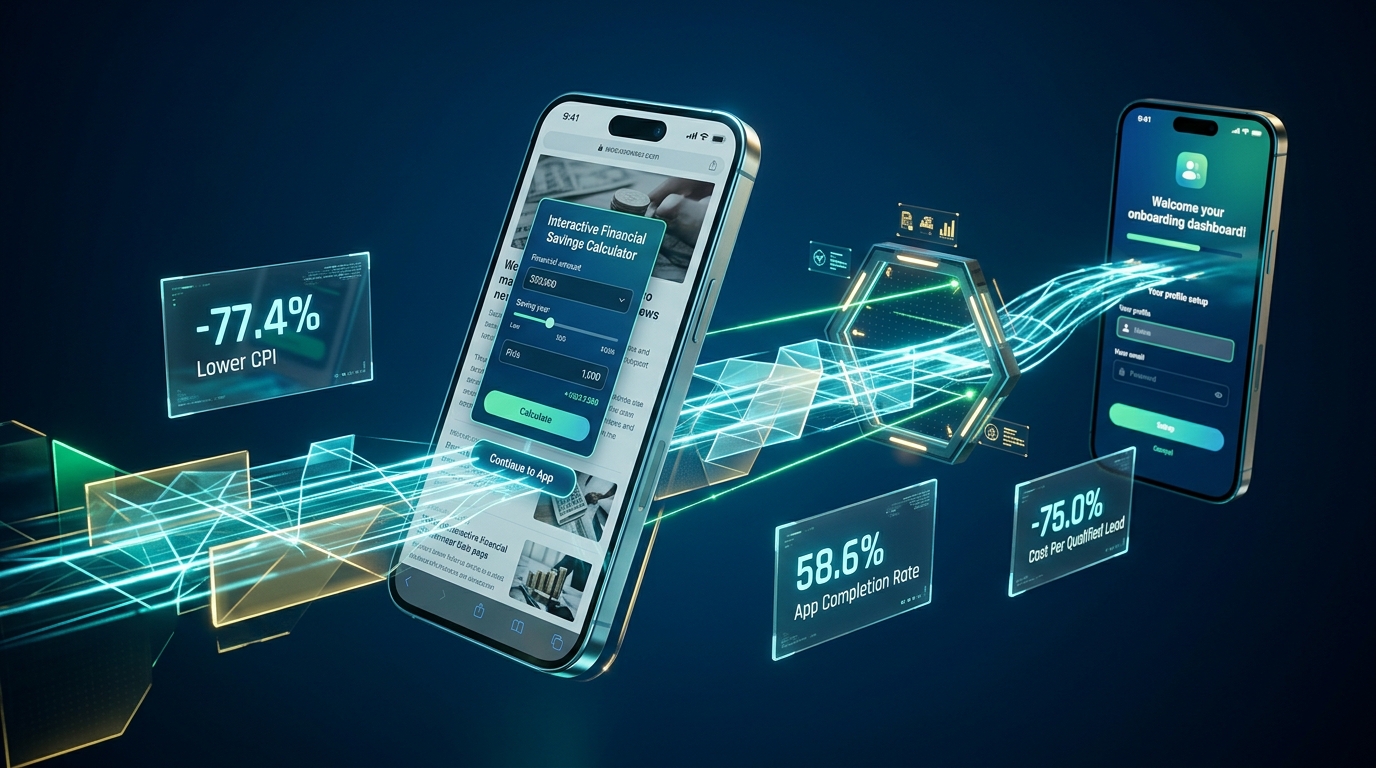
| Average Cost Per Install (CPI) | $18.50 – $42.00 | $4.20 – $9.50 | -77.4% Reduction in CPI |
| Click-to-Install Conversion Rate | 8.5% (App Store Drop-Off) | 28.4% (Pre-Qualified Install) | 3.3x Higher Conversion Yield |
| Install-to-Completed Application Rate | 14.2% | 58.6% (Pre-Filled Data Sync) | 4.1x Higher Onboarding Completion |
| Unqualified / Dead Lead Ratio | 42.0% (High Bounce) | < 4.5% (Strict Web Filtering) | -89.2% Wastage Reduction |
| Cost Per Qualified Lead (CPQL) | $185.00 Baseline | $46.20 | -75.0% Acquisition Cost |
| Attribution Data Latency | 24 to 72 Hours (SKAN) | Real-Time S2S Web Postbacks | Instant Campaign Optimization |
| 90-Day LTV Return on Ad Spend | +24% | +168% | +144% Margin Expansion |
6. Implementation & Launch Roadmap
Follow this operational framework to deploy Web-to-App funnels for high-ticket offers:
- [ ] Develop Editorial / Calculator Pre-Landers: Build fast-loading, mobile-optimized HTML pre-landers featuring interactive sliders or 5-question qualification quizzes.
- [ ] Integrate MMP Deferred Deep Linking: Set up dynamic link generation via your Mobile Measurement Partner to pass web query parameters (
click_id,subid) into the app environment. - [ ] Configure Web-Layer Qualification Logic: Implement conditional logic inside the quiz form to divert unqualified users to alternative Smartlinks.
- [ ] Deploy S2S Conversion Postbacks: Fire real-time Server-to-Server postback events at the web pre-lander stage (e.g.,
Quiz_Completed,Phone_Verified) to feed real-time auto-optimization rules on the ad network. - [ ] Implement App Onboarding Data Hydration: Program the mobile application to read deferred deep link payloads on first launch, auto-populating fields to eliminate manual user typing.
- [ ] Set Up Auto-Rules for Publisher Pruning: Establish automated bidding rules to pause publisher placement IDs where the Web-to-App pre-lander CTR falls below 15% or where lead verification fails.
By replacing direct app store links with Web-to-App Native Funnels, performance marketers eliminate attribution delays, lower CPIs, filter out low-intent prospects, and deliver high-converting, pre-qualified leads to sales teams at a fraction of traditional acquisition costs.
Conclusion
Direct-to-app campaigns work for impulse-driven products, but they break down in high-ticket verticals like mortgages, solar, personal loans and insurance. Cold users are asked to install a heavy app before they trust the offer. The result is expensive installs, delayed attribution and call centers full of unqualified leads.
A Web-to-App funnel fixes this by moving education, qualification and verification to the web layer, before the app store step. Each stage of the funnel removes a specific bottleneck:
| Funnel Stage | What Happens | Bottleneck Removed | Key Signal to Track |
|---|---|---|---|
| 1. Native Editorial Hook | Contextual ad matches the tone of the publisher site | Ad skepticism and cold-traffic resistance | Pre-lander CTR (pause placements below 15%) |
| 2. Calculator / Comparison Pre-Lander | User interacts with a tool or guide and builds intent | Low consideration and no value established | Engagement rate, slider interactions |
| 3. Qualification Quiz + OTP | 4-6 questions, hard filters, phone verification | Dead leads and fake numbers reaching sales reps | Quiz completion rate, Phone_Verified postbacks |
| 4. Deferred Deep Link via MMP | click_id and quiz data pass through the app store | Attribution loss across the web-to-store boundary | Match rate, install-to-open rate |
| 5. App Onboarding Hydration | App auto-fills the form from the payload | Onboarding friction and manual re-entry | Install-to-application completion |
| 6. S2S Postbacks + Auto-Rules | Real-time events feed bidding and publisher pruning | The 24-72h SKAN reporting lag | CPQL, 90-day LTV ROAS |
The data supports the model. Across the campaigns compiled in this article, Web-to-App funnels cut CPI by 77.4%, lowered cost per qualified lead by 75%, and reduced unqualified lead ratios from 42% to under 4.5%. For performance marketers, the takeaway is to stop buying installs and start buying pre-qualified intent. Put the education, the filter and the attribution on the web, and send only ready users to the app.
FAQ
1. What is a Web-to-App funnel?
A Web-to-App funnel sends ad traffic to an interactive web pre-lander (a calculator, quiz or editorial guide) before asking the user to install an app. The pre-lander builds intent and qualifies the lead, so only high-intent users reach the app store.
2. Why do direct-to-app campaigns underperform in high-ticket verticals?
Mortgages, solar, loans and insurance require trust and education before commitment. Forcing a cold user into an immediate app install causes high drop-off, inflates CPI and fills call centers with low-quality leads.
3. How does deferred deep linking preserve attribution data?
The pre-lander stores parameters such as click_id, subid and quiz answers in first-party storage. It then generates a deferred deep link through a Mobile Measurement Partner (MMP) like AppsFlyer, Adjust, Singular or Kochava. After install, the app’s SDK retrieves this payload on first launch and restores the data.
4. How does the web layer filter out unqualified leads?
Hard-filter quiz logic disqualifies users who fail basic criteria, such as credit score, property ownership or ZIP code. OTP phone verification and real-time CRM or credit API checks add further validation. Disqualified users are diverted to alternative offers or monetization Smartlinks.
5. Which metrics should I monitor after launching a Web-to-App funnel?
Track pre-lander CTR, quiz completion rate, phone verification rate, click-to-install conversion, install-to-application completion, cost per qualified lead (CPQL) and 90-day LTV ROAS. Fire server-to-server postbacks at each web stage so ad network auto-rules can optimize in real time