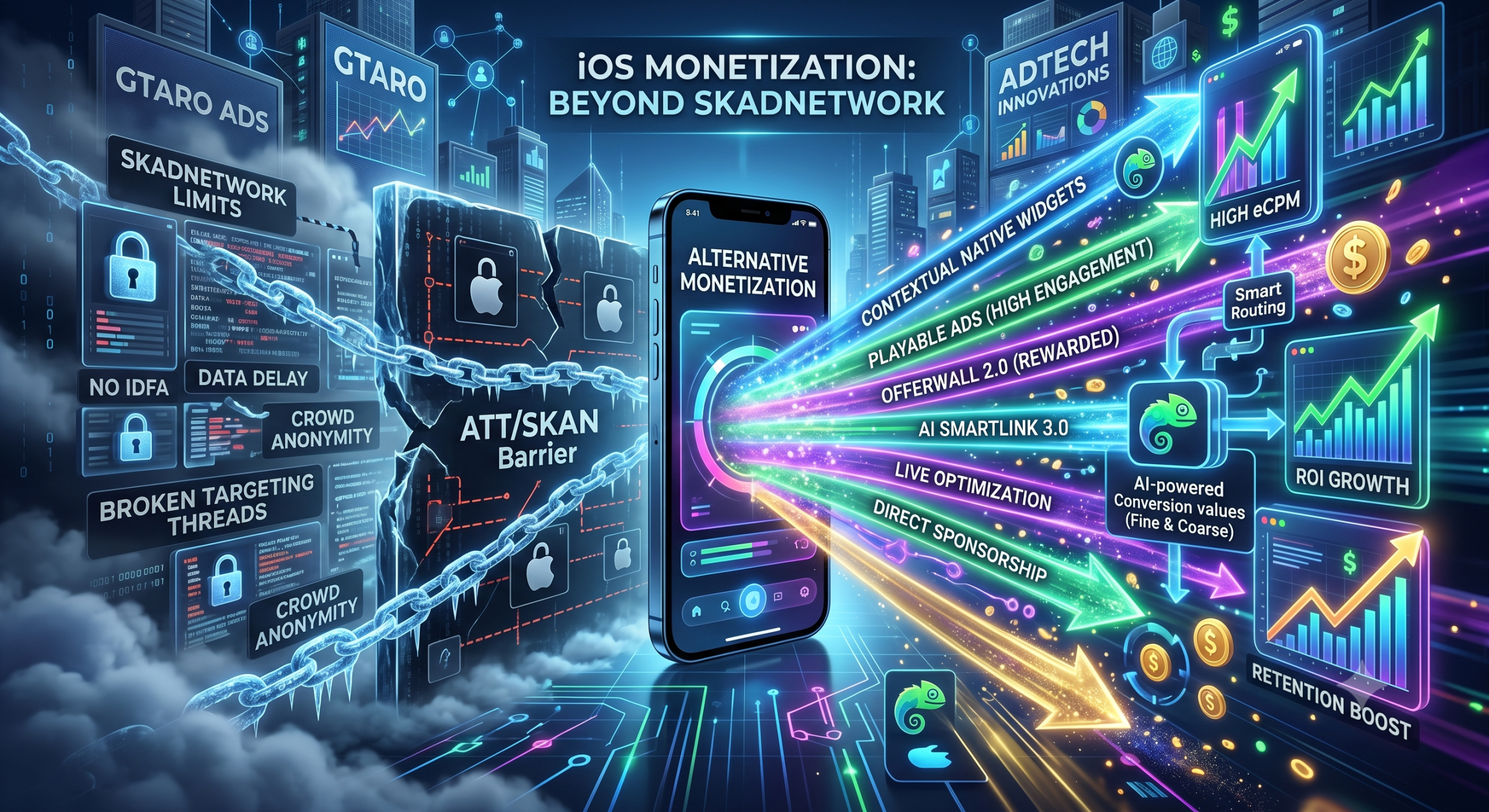
Let’s be honest: the era when you could lazily integrate AdMob or AppLovin into an iOS app, throw in some standard interstitial banners, and sit back to watch the eCPMs roll in is not just over—it has been completely buried in concrete. Apple’s privacy push under the App Tracking Transparency (ATT) banner has evolved from the shocking release of iOS 14.5 into a rigid ecosystem ruled by the SKAdNetwork framework, mandatory Privacy Manifests, and the latest curveball: AdAttributionKit (AAK), which targets alternative app stores and clamps down hard on fingerprinting.
When DSPs and ad networks lost the legal ability to track IDFAs and build cross-app digital profiles, the value of classic banner inventory on iOS plummeted. Why should a major advertiser pay a premium $15–$20 CPM in your habit tracker or photo editor if the network’s algorithm cannot even tell whether that specific user made a purchase in the target app?
But panicking, tearing your hair out, and switching your product entirely to a strict subscription model (which is already causing subscription fatigue among users) is a flawed strategy. The way out is to rebuild the very DNA of your monetization, shifting away from blind programmatic buying toward a contextual reality and alternative ad mechanics.
Why Classic Programmatic Ad Revenue is Crashing on iOS
The chief culprit behind declining ad revenues is the concept of Crowd Anonymity and the multi-tiered postback delays baked into Apple’s logic. Unless your app generates tens of thousands of daily installs from a single traffic source, you hit rigid “privacy thresholds.”
As a result, instead of granular tracking data, the ad network receives:
- A blank value (
null) or a highly diluted coarse value (low,medium,high) instead of a precise conversion value (Fine Value). - Anonymized data with an artificial 24-to-72-hour delay (and up to several weeks across multiple conversion windows), completely breaking real-time campaign optimization.
This is devastating for traditional ad formats:
- Traditional Banners (320×50): These have turned into a “dead zone.” Their CTR balances on the edge of statistical insignificance, and eCPMs on iOS in certain standard categories have actually managed to drop below Android levels.
- Aggressive Video Interstitials: They still pull in some cash, but at what cost? In an environment where Day 1 User Retention is already a brutal uphill battle, forcing a user to watch a 30-second unskippable video for a sketchy strategy game or mobile lottery is a direct hit to your own LTV.
If ad network algorithms can no longer target the individual, the ad placement itself must captivate through the app’s context or its engaging mechanics.
Top 4 Alternative Formats Saving IAA Economics
1. Curated Native Feeds and Micro-Commerce
Instead of relying on an external network’s algorithm to guess your user’s hidden desires, leverage the immediate context. Native ads should blend into the app’s interface and primary use case so seamlessly that the line between content and advertising blurs.
How it works in practice: Imagine you run a calorie-counting and recipe app. Instead of a standard banner at the bottom of the screen, you integrate a dedicated “Recommended Ingredients for This Recipe” block, allowing users to buy them with one click via a local e-commerce integration.
- Why it works in the privacy era: Advertisers buy this inventory not because they stalked the user across the web, but because of absolute audience alignment. Conversion rate (CR) skyrockets due to situational hyper-relevance. You are selling context, and Apple cannot block context.
2. Interactive Demos and Playable Ads
A full-screen format that invites the user to actively play a quick mini-game or test a micro-version of another app (built on HTML5/MRAID) directly within the current user session, rather than passively staring at a video.
- The power of the format: Since blind targeting lowers precision, the creative has to sell itself from the very first second. Playable ads hook users instantly through gamification. A high Engagement Rate completely compensates for the lack of an IDFA. Advertisers (especially in Mobile Gaming, Fintech, and EdTech) are willing to pay significantly more for these interactions on a CPI/CPA basis, as only the most motivated users reach the final click.
3. In-App Audio Ads (Background Audio Advertising)
A format unjustly ignored by most utility and lifestyle apps. Short audio messages (10–15 seconds long) play at moments when the user is interacting with the app but their visual focus is shifted (e.g., during a workout in a fitness tracker, while generating a report in a finance app, or during meditation and navigation).
- Pros for UX and revenue: Audio ads take up zero screen real estate and never interrupt the user interface. They don’t trigger the intense annoyance of a sudden pop-up video, and they beautifully monetize long sessions. The key is using premium SDKs that check whether the user is already blasting Apple Music or Spotify to prevent a chaotic audio overlap.
4. Rewarded 2.0 and Customized Offerwalls
Classic offerwalls (“download this app to get 100 coins”) were long considered a sign of low-tier apps. But in the harsh realities of SKAN, the format has been reborn. Modern Offerwall 2.0 is a native task hub where users are invited to take a short brand quiz, register for a free webinar, or test a partner company’s feature.
[User] ➔ Wants to unlock a premium feature for 24 hours
             │
             ▼
[Native Offerwall] ➔ Offers a choice: Watch a Playable demo OR Take a mini-quiz
             │
             ▼
[The Result] ➔ Happy user (saved money), Publisher gets a high eCPM, Advertiser gets a clean lead
Because the trigger is entirely voluntary, it protects user retention, and the explicit value exchange smooths over any potential friction.
Technical Guide: Taming Conversion Values for SKAN and AdAttributionKit
If you continue to work with major programmatic media networks, your primary job as a developer is to extract maximum utility from conversion value transmission. Stop using default SDK settings that only fire off a basic install signal. You need to map out a comprehensive Conversion Value Map.
In the latest iterations of Apple’s protocols, you get three conversion windows and two value tiers: fine (Fine — from 0 to 63) and coarse (Coarse — low, medium, high). Your analytics team must design a clear matrix to predict LTV based on the user’s first 24–48 hours inside the app.
An Effective Event Mapping Matrix:
- Low Level (Low / Fine Values 1–15): The user completed onboarding, customized their profile, or enabled push notifications. This is a baseline signal that the app won’t be uninstalled in 5 minutes.
- Mid Level (Medium / Fine Values 16–40): The user shows high engagement—visiting a core section more than 3 times, sharing content, adding their first item to a cart, or opening the app on Day 2.
- High Level (High / Fine Values 41–63): Direct commercial triggers. Starting a trial, making an in-app purchase, or clicking a high-ticket ad offer.
Crucial Nuance: Fire your updatePostbackConversionValue() or equivalent AdAttributionKit methods the exact millisecond a predictive event occurs. The quicker the network’s algorithms receive a medium or high signal before the first anonymity window closes, the faster the programmatic system understands: “Aha, this traffic source brings premium users, let’s bid higher on this publisher.” As a result, higher-paying ad fill flows directly into your app.
The Zero-Party Data Strategy: Gather Intel Yourself
Since Apple made it incredibly easy for users to deny tracking via the system-level ATT pop-up (which roughly 80% of users mindlessly decline), collect your data legally inside the product. This is called Zero-Party Data—information that users share entirely of their own free will.
- Implement Interactive Onboarding Quizzes: Ask the user right out of the gate: “What are your main goals?”, “What is your experience/income level?”, “Which topics do you care about?”
- Build an Internal Interest Graph: Save this data locally on your server. You aren’t passing it to third-party trackers for cross-app profiling (which would violate App Store guidelines), but you are using it to request specific, tightly categorized ad campaigns from your network or direct partners.
A fully fleshed-out interest profile built during onboarding allows you to sell contextual placements at a premium flat rate (Direct Sponsorship), bypassing Apple’s restrictive infrastructure entirely.
The Final Frontier: Pivoting to Affiliate Marketing and Direct Deals
If the iOS ecosystem is built to squeeze the life out of classic programmatic ad networks, the logical evolutionary step is to minimize your reliance on them. If your app boasts a stable core of highly engaged users—even a modest 5,000–10,000 DAU—you can pivot to direct brand partnerships.
Identify companies whose products organically complement your app without competing with it:
- Running a personal finance app? Partner directly with a digital bank to feature their cash-back debit cards via affiliate links.
- Managing a workout calendar? Integrate exclusive promo codes for a local sportswear brand.
With this setup, you completely eliminate your dependence on unpredictable ad network SDKs, bypass hidden middleman commissions, and most importantly, Apple’s privacy logs become irrelevant—to the App Store, these are just standard text or graphic assets living inside your own app’s content.
The Bottom Line
Trying to wring revenue out of an iOS app using old playbooks is a guaranteed way to tank your unit economics. Apple’s protective barriers have forced the industry to grow up.
The developers and publishers winning today are those shifting their focus away from blind programmatic targeting and toward integration quality and contextual relevance. Experiment with native feeds, engage users with playable formats, and map out granular Conversion Values for AdAttributionKit. Do this, and your IAA revenue will steadily climb, no matter how hard Cupertino decides to tighten the screws.