If in the early 2020s we fought relentlessly for the dopamine in a user’s brain—optimizing colors, headlines, and psychological triggers—then in May 2026, the battlefield has fundamentally shifted. We are no longer fighting for human attention; we are fighting for the “bandwidth” of their personal AI agents.
With the mass adoption of autonomous digital intermediaries—ranging from wearable hardware like the Rabbit R1 and Humane Pin to hyper-advanced, deeply integrated versions of Siri, Google Assistant, and Meta’s ecosystem—the human is no longer the primary decision-maker for daily digital tasks. These AI assistants now act as sovereign gatekeepers. They decide for themselves which notifications are worthy of their owner’s attention, which options to present, and which promotional messages belong in the digital shredder.
1. The AI Agent as “The Great Filter”
In traditional performance marketing, you could force a user to see an ad by buying prime real estate. But in 2026, a personal assistant possesses omniscient context about the user. It knows their exact monthly budget, their current micro-needs, their health data from wearables, their upcoming calendar, and even their biometric stress levels.
The End of Irrelevant Interruption:
If you try to sell a generic “weight loss course” to a user whose AI dietician has already designed a meal plan and ordered groceries, your ad won’t even render on the screen. The agent intercepts it, recognizes the redundancy, and quietly blocks it to preserve the user’s cognitive load.
Historically, aggressive formats like Popunder and clickunder ads relied on overwhelming the user’s browser to force a human impulse reaction. In the B2A era, algorithms do not have impulses. They have logic. B2A Marketing is the meticulous process of optimizing your offer’s underlying architecture so that the AI agent mathematically perceives it as a high-utility, verified resource for its owner. If the agent deems it useful, it passes the offer through the filter.
2. From Creative to Structured Data: The Machine-Readable Offer (MRO)
An AI agent does not care about the contrast ratio of your call-to-action button, the emotional storytelling of your video, or a juicy, clickbait headline. It evaluates options programmatically, stripping away brand bias and evaluating pure parameters.
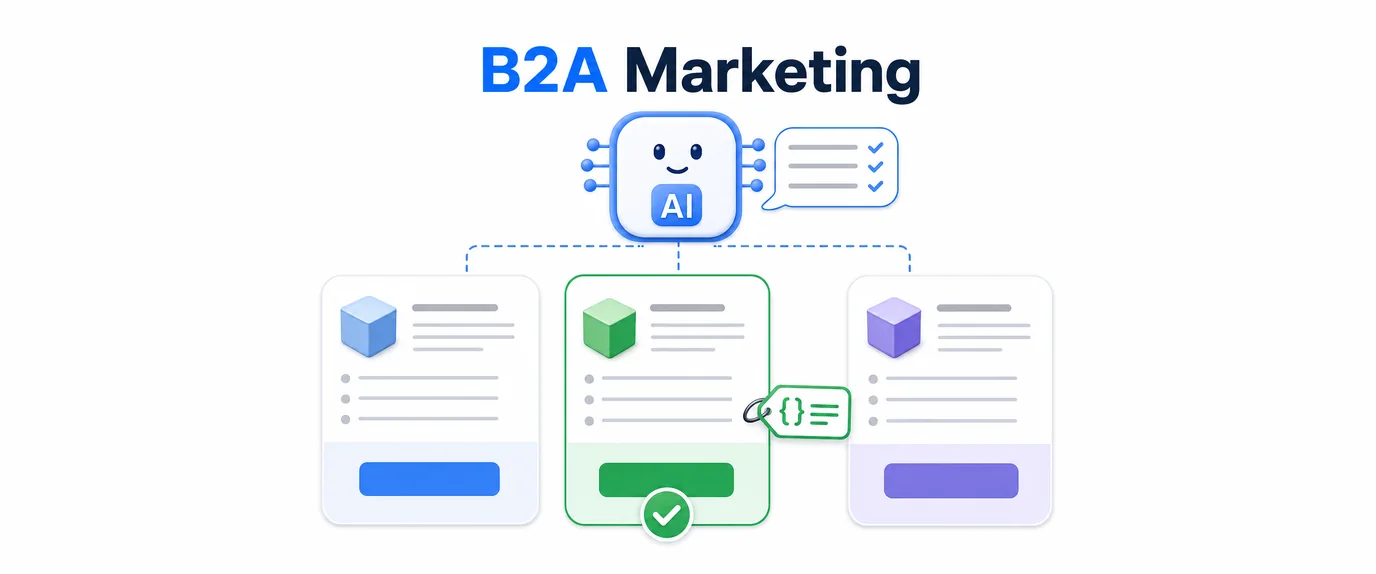
To pass the assistant’s strict “customs check,” affiliates, media buyers, and brands have shifted entirely away from purely visual web design to the Machine-Readable Offers (MRO) format. Where traditional Banner advertising targets human eyes with images and GIFs, MROs target machine logic with code.
The Three Pillars of an MRO:
- API-First Content & Semantic Schemas: Instead of a traditional HTML landing page filled with persuasive copy, you provide a structured JSON-LD file or direct API endpoint. This file contains precise, unambiguous product characteristics, pricing matrices, inventory levels, and return policies. The agent reads the code, not the design.
- Mathematical Proof of Utility: AI agents demand objective evidence that your offer solves the user’s specific, current task better than the alternatives (e.g., “This insurance policy provides identical coverage to the user’s current plan but is 15% cheaper based on their exact driving history”).
- Trust Score & KYA (Know Your Agent): Verification is now handled via decentralized blockchain protocols (Proof of Trust). The agent scans public ledgers to confirm the mathematical authenticity of your reviews, the transparency of your merchant history, and the security of the transaction. If your Trust Score is low, the agent will filter you out, regardless of how cheap your product is.
3. Strategies for “Convincing the Machine”
How do you get an autonomous algorithm to select and recommend your offer over a competitor’s? You must speak its language and align with Answer Engine Optimization (AEO).
- Semantic Optimization (Meaning over Keywords): We no longer stuff landing pages with long-tail keywords. We optimize for “meanings” and entity relationships. If an assistant is tasked with finding the “best family vacation,” it analyzes the deep metadata of your proposal—checking safety ratings, flight layover times, and allergy-friendly restaurant proximity.
- Contextual Camouflage: Just as classic Native Ads were designed to blend seamlessly into a publisher’s editorial content to bypass human skepticism, B2A offers must blend seamlessly into the user’s data context. The winner is the offer that snaps perfectly into the user’s current life scenario exactly as logged by their calendar and financial apps.
- Agent Pinging and Negotiation: When utilizing formats like Push Ads, you are no longer buzzing the user’s phone directly. You are pinging the agent. The agent receives the push payload in the background, evaluates the offer against the user’s current status, and decides whether to summarize it for the user or dismiss it.
- Incentives for the Ecosystem: By 2026, decentralized protocols emerged where advertisers offer a micro-bonus (in utility tokens or compute credits) not just to the end-user, but to the agent’s processing ecosystem for priority data evaluation. This acts as a legal, transparent equivalent to priority search listing.
4. The Smartlink as the “Seller’s Agent”
In this new ecosystem, traffic routing has also evolved. A modern Smartlink is no longer just a script that redirects a browser. It functions as an autonomous “Seller’s Agent.”
When an AI assistant browses the web for a solution, it connects with your Smartlink via the Agent-to-Agent (A2A) protocol. In milliseconds, the user’s agent securely transmits its requirements (e.g., “Need a crypto exchange, user has $500 liquidity, requires KYC within 5 mins”). The Smartlink instantly evaluates its database of MROs, selects the exact offer that matches those parameters, and sends the structured data back to the assistant. The negotiation happens machine-to-machine, completely invisibly.
Comparison: B2C Marketing (2024) vs. B2A Marketing (2026)
| Parameter | B2C Marketing (2024) | B2A Marketing (2026) |
| Primary Target | Human Emotion & Impulse | AI Agent Logic & Parameters |
| Core Tool | Visual Creatives (Images, Video, Copy) | Structured Data (JSON, APIs, XML) |
| Main Barrier | Banner Blindness & Ad Blockers | Algorithmic Filters & Low Trust Scores |
| Conversion Mechanism | Manual Click on a Link | Assistant Voice Recommendation / Auto-execution |
| Optimization Focus | SEO & Conversion Rate Optimization (CRO) | Answer Engine Optimization (AEO) & Data Fidelity |
Detailed Summary: Marketing for Intermediaries
B2A marketing in 2026 is a profound acknowledgment that humans have permanently delegated their power of daily choice to algorithms. We are no longer shouting through megaphones in a crowded digital town square; we are submitting a perfectly formatted, mathematically sound resume to an infinitely strict, hyper-rational executive assistant.
Key Strategic Takeaways for the Future:
- The Technological Shift in Talent: By 2026, top-tier affiliate teams and media buying agencies are half-composed of data engineers. The technical ability to “feed” clean, structured offer data to external AI agents through specialized A2A gateways has become vastly more critical than the ability to design pretty landing pages.
- Reputation is Literally Code: Your ad network and domains must maintain a pristine “Agent Trust Score.” If your offers are frequently flagged by AI assistants as spam, logically inconsistent, or “low utility,” your entire brand will end up on a global, federated neural network blacklist. Once the machines label you as inefficient, no human will ever see your ads again.
- Lead Generation Through Absolute Utility: In the B2A world, the conversion happens due to cold logic, not emotional impulse. If a user’s AI agent simply states through their earpiece, “I found a better, verified flight option for you that saves $120. Shall I confirm the booking?” and the user casually replies “Yes” without ever looking at a screen or seeing an ad—that is the perfect, zero-click arbitrage of the future.
The Verdict
In 2026, your client is no longer just a person; it is their digital “Self.” If you rely on tricking human psychology, your campaigns will be blocked at the perimeter. Learn to sell to the assistant by providing structured, verified, and undeniable utility, and you will gain frictionless access to the human, effortlessly bypassing all traditional visual competition.
FAQs
1. What is B2A (Business-to-Agent) Marketing in the context of AI?
B2A Marketing refers to the strategic framework where businesses optimize their messaging, product data, and offers to be easily read, understood, and prioritized by autonomous personal AI assistants acting on behalf of human users.
2. Why are personal AI assistants so critical for marketing in 2026?
Personal AI assistants now act as the primary interface between the user and the internet. They heavily influence purchasing decisions by autonomously filtering out irrelevant noise, comparing complex parameters in milliseconds, and only recommending offers that strictly align with the user’s exact preferences, budget, and real-time context.
3. How does B2A fundamentally differ from traditional B2C marketing?
Unlike B2C (Business-to-Consumer), which targets human psychology, emotions, and visual attention directly, B2A focuses on machine logic. It bypasses emotional persuasion entirely, focusing instead on making product specifications, pricing, and availability perfectly readable and actionable for the AI systems making the actual decisions.
4. What role does structured data play in B2A Marketing?
Structured data (like JSON-LD, schemas, and direct API feeds) is the actual “language” of B2A. It strips away ambiguous marketing copy and helps AI assistants accurately and instantly interpret product details, ensuring the agent can confidently verify the offer’s relevance and recommend it to the user.
5. How should brands adapt their traditional SEO strategy for B2A?
Brands must shift from keyword-centric SEO to GenAI Engine Optimization (GEO) or Answer Engine Optimization (AEO). This means organizing data into machine-readable formats, eliminating vague claims, ensuring real-time API availability, and building a high mathematical “Trust Score” so agents recognize the brand as a reliable, verified source of utility.