Short answer: How much does native advertising cost? Typical native campaigns pay about $0.20-0.50 per click or $5-15 per 1,000 impressions, according to industry benchmarks reported by MGID in 2026. Tier 1 countries, premium publishers and competitive verticals such as finance cost more. Many networks let you start with a $100 deposit, but a useful test usually needs several hundred dollars.
Checked: October 2026
There is no fixed price list for native ads. Almost every network sells traffic through an auction, so your price depends on who else is bidding for the same audience. This guide shows the typical ranges, what pushes them up or down, and how to plan a test budget before you spend real money.
Native advertising pricing models: CPC, CPM, CPA
Native networks charge in three main ways.
CPC (cost per click). You pay only when someone clicks your ad. This is the default model for native. Taboola and MGID, for example, both bill on a CPC basis. CPC is the safest choice for a first test, because you do not pay for impressions that nobody looks at.
CPM (cost per 1,000 impressions). You pay for views, whether people click or not. CPM can work out cheaper once you have a creative with a strong click-through rate (CTR). With a weak creative, it burns budget fast.
CPA (cost per action). You pay for a sale, a lead or an install. It sounds ideal, but few self-serve native networks offer pure CPA. MGID, for one, states that it does not offer a CPA model. Where you see “CPA” in a native cabinet, it is usually an automatic bidding tool that still charges per click.
What to pick for a test: start on CPC. Move a campaign to CPM only after you know its CTR, and compare the effective cost per click on both models.
If you are new to the format, our guide to native advertising types and benefits explains how native ads differ from banners and pop traffic.
What affects native ad costs
The same ad can cost five times more in one campaign than in another. These are the main factors.
- GEO. Tier 1 countries (US, UK, Canada, Australia, Western Europe) cost the most because advertisers there pay more per customer. Tier 2 and Tier 3 countries in Asia, Africa and Latin America are much cheaper, with lower buying power.
- Device. Mobile usually brings more volume at a lower CPC. Desktop often costs more but can convert better for complex offers.
- Placement. An in-feed ad inside an article, a recommendation widget under it and an in-app placement all price differently. Premium news publishers cost more than small content sites.
- Vertical and competition. Finance, insurance and health attract many bidders, so prices rise. Entertainment and content offers usually pay less.
- Creative and CTR. On most auctions, an ad that gets more clicks wins more impressions at the same bid. A good headline is one of the cheapest ways to cut your cost.
- Timing. Competition grows before holidays and during big sales seasons, and many networks get more expensive late in the year.
Native ad cost by GEO and placement
Networks rarely publish full price lists, so the table below collects public reference points. These are guides from network help pages and benchmarks, not a price list, and your real price comes from the auction.
| Source | What it covers | Reported price | Note |
|---|---|---|---|
| MGID blog, 2026 | Industry benchmark, all GEOs | $0.20-0.50 CPC, $5-15 CPM | Broad market range, not MGID rates |
| Taboola help center | Suggested starting bid | $0.20-0.70 CPC (reported) | Minimum allowed bid is $0.01 |
| Outbrain | Suggested starting bid | $0.65-0.85 CPC (reported) | Premium publishers |
| Dianomi, US and Canada | Premium finance audience, Tier 1 | $3.50 CPC (reported) | Top of the market |
| Dianomi, Malaysia, Indonesia, Thailand | Premium finance audience, Tier 2/3 | S$0.30, about $0.23 CPC (reported) | More than 10x cheaper than the US |
Two things stand out. First, the gap between a broad network and a premium finance network is huge, so “average native CPC” means little without the GEO and vertical. Second, the gap between Tier 1 and Southeast Asia on the same network is more than ten times.
Placement matters too. In-feed ads placed between paragraphs and recommendation widgets under an article reach people in different moods, and they are priced differently. See native ad formats explained: in-feed, in-content and recommendation widgets for how each one works.
For comparison, WordStream’s 2026 data reported by MGID puts the average Google Search click at about $5.42 and a Meta click at about $0.78. Native is usually cheaper per click than both, but its visitors are earlier in the buying journey.
Minimum deposits and test budgets
Getting started is cheap. Running a test that tells you something is not.
Typical minimums (reported by the networks):
- MGID: $100 minimum deposit, with $650 or more recommended for testing, and a $50 minimum campaign budget.
- Outbrain: $20 minimum daily budget per campaign. Its getting-started guide suggests $100-150 a day, or 3-5 times your CPA goal.
- Taboola: minimum bid of $0.01, but it reportedly suggests starting at $0.20-0.70 per click to get enough traffic.
A low minimum bid does not mean you will get traffic at that price. Bids at the floor usually lose almost every auction.
How to calculate a test budget:
Test budget = bid × clicks per creative × number of creatives
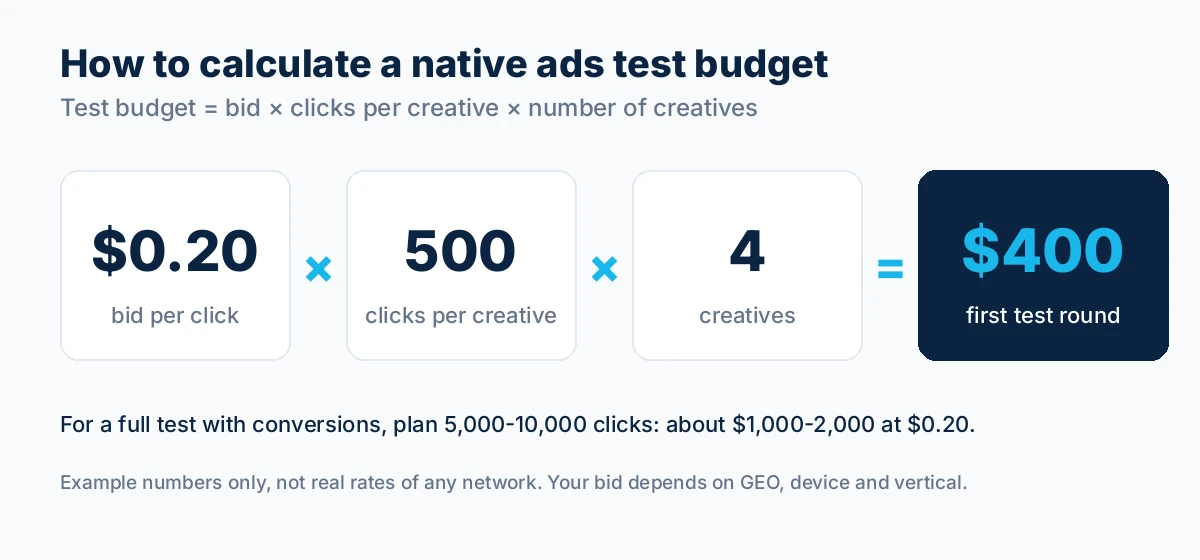
Here is an example with made-up numbers, not real rates of any network:
- bid: $0.20 per click;
- clicks per creative: 500 (enough to see a stable CTR and first conversions);
- creatives: 4.
$0.20 × 500 × 4 = $400 for the first round.
If you need conversions, not just clicks, plan for more. MGID suggests 5,000-10,000 clicks for a full test. At $0.20 per click, that is $1,000-2,000. So the real answer to “what is my native ads budget” is: decide how many clicks you need to judge an offer, then multiply by a realistic bid for your GEO.
How much does native advertising cost per month?
After the test, the monthly cost of native advertising depends on one number: how many profitable clicks you can buy. There is no subscription and no monthly fee on self-serve networks. You top up a balance and the auction spends it.
A simple way to plan a month:
- Take your daily budget per campaign.
- Multiply it by the number of campaigns you keep running.
- Multiply by 30.
Example with made-up numbers: 3 campaigns × $30 a day × 30 days = $2,700 a month. If your average click costs $0.20, that buys about 13,500 clicks.
Native advertising rates also change inside the month. A campaign that starts at one CPC often gets cheaper as you cut weak placements, and more expensive when you raise bids to win more volume. So set a monthly cap, review the numbers every week, and move money from campaigns that lose to the ones that pay back.
For small advertisers, a few hundred dollars a month is enough to run one or two GEOs. Large brands buying Tier 1 traffic on premium publishers can spend that in a day.
How to lower your native advertising costs
You cannot set the market price, but you can pay less than the average buyer.
- Test headlines and images. A higher CTR wins more impressions at the same bid. Our guide to best practices for writing high-converting native ads covers what to test first.
- Use white and black lists. After the first few hundred clicks, cut placements that send clicks without results and raise bids on the ones that convert.
- Split campaigns by GEO and device. One campaign for US mobile and another for US desktop lets you set a fair bid for each instead of overpaying on the cheaper one.
- Use dayparting. If conversions come in the evening, lower bids or pause at night.
- Control frequency. The same person seeing the same ad ten times rarely clicks the tenth time. Cap frequency and refresh creatives every few weeks.
- Change bids step by step. Cut or raise a bid a little at a time. A sharp cut can drop a campaign out of the auction and you lose the data it had.
When a campaign is profitable, scale it slowly. Our article on how to buy native ads traffic and scale campaigns explains how to grow volume without breaking the numbers.
Native ads on GTaro
GTaro Ads sells native traffic on CPC and CPM. There is no CPA model.
- Placements: native widgets and in-feed ads on websites, plus in-app placements in Telegram Mini Apps.
- Bids: you set your own bid. Your price comes from the auction, not from a fixed rate card.
- Deposit: from $100.
- Payment methods: USDT (TRC20, ERC20, Polygon, TON), USDC (Polygon, Solana), BTC, bank card and bank transfer.
- Moderation: up to 2 hours.
- Reach: traffic from 230+ countries.
To start a test, buy native traffic on GTaro.
FAQ
How much do native ads cost per click?
Industry benchmarks reported by MGID put native CPC at about $0.20-0.50. Tier 3 countries can be much cheaper, while premium Tier 1 finance traffic can cost several dollars per click.
Is native advertising expensive?
Per click, native is usually cheaper than search or social ads. The real cost depends on conversion: cheap clicks that do not convert are expensive. Judge native by cost per sale or lead, not by CPC alone.
What is a good CPM for native ads?
Reported benchmarks put native CPM at about $5-15. A “good” CPM is one that, with your CTR, gives an effective cost per click below what you would pay on CPC.
Can I buy native ads on CPC?
Yes. CPC is the standard model for native. Taboola and MGID bill on CPC, and GTaro offers both CPC and CPM.
What budget do I need to test native ads?
Many networks accept a $100 deposit. A meaningful test usually takes a few hundred dollars: multiply your bid by the clicks you need per creative and by the number of creatives. For a full test with conversions, plan for 5,000-10,000 clicks.