Classic banner blindness is not just progressing—it has officially entered a terminal stage. In today’s reality, where endless feeds of ultra-short videos, aggressive recommendation neural networks, and terabytes of information noise overload the brain every single minute, retaining attention has become the primary and most expensive scarce resource on the market.
A harsh psychological phenomenon has emerged—doomscrolling immunity. This is the subconscious ability of the user to instantly filter out, devalue, and completely ignore any standard marketing markers: bright badges, neon arrows, perfect smiling stock faces, and buy-it-now call-to-actions.
The average person spends only about 0.3–0.5 seconds on the initial, subconscious evaluation of content before their finger makes another swipe across the screen. If your ad creative in a native network, teaser feed, or push notification does not pierce this protective barrier within the first fractions of a second, you are simply sponsoring empty impressions and burning your budget. Legacy tricks—primitive clickbait or fake system error messages—no longer work. They cause nothing but automatic irritation and the instant closing of the tab.
To survive and achieve a high CTR, you must utilize directed attention synthesis technologies. Below is a detailed breakdown of how the laws of visual psychology operate and which mechanics allow you to break the patterns of mindless feed scrolling.
1. The Neurobiology of Digital Indifference: Why Standard Triggers Are Dead
For a long time, internet marketing relied on the concept of visual shock. It was believed that if you showed a person something maximally bright, high-contrast, or screaming, their attention would be captured. This approach has been completely demolished by the evolution of the user experience. The brain of the modern user is oversaturated: it sees absolutely everything daily—from wild neural network generations to shocking headlines. As a result, the emotional threshold of perception has spiked significantly, and the subconscious has built a powerful mental shield.
When a person is in a state of doomscrolling—the monotonous, semi-automatic scrolling of a screen—their focus of attention is directed not at finding interesting content, but at quickly cutting out excess noise. This process occurs at the level of subcortical brain structures (in the reticular formation) before the information even reaches the neocortex to be consciously processed.
Any object that the subconscious classifies as an ad block is stripped from the focus of attention within milliseconds. This is precisely why perfect glossy photos and professionally polished banners show the worst efficiency. They are instantly recognized as a foreign, selling element and are discarded by the brain’s defense system.
2. The Concept of “Predator Creatives” and Visual Disrupt Technologies
To make the user’s finger stop, a creative must execute a visual disrupt—a sharp, raw, and unexpected shattering of the expected pattern. In the industry, this approach is called creating predator creatives. These are visuals that exploit vulnerabilities in our evolutionary perceptual system and force the brain to hook onto the image at a basic, reflex level.
The Mechanics of Mild Cognitive Dissonance
The brain instantly activates and snaps out of its trance state when it sees objects that violate the familiar logic of the physical world but look completely realistic.
- Example: An object of a familiar shape made of a completely unsuitable, paradoxical material (e.g., a glass hammer or a liquid phone).
- Example: A familiar everyday scenario in which one small detail looks fundamentally wrong (e.g., a person drinking tea from a shoe or holding a knife by the blade).
The user stops scrolling not because they want to buy your product, but because their pattern recognition system stumbles and tries to solve the visual anomaly. While the brain looks for an answer, you gain a precious one and a half seconds to engage them with your copy.
The Zeigarnik Effect (The Incomplete Action Phenomenon)
At the level of ancient instincts, our subconscious strives for symmetry, order, and completeness. Images where dynamic action is interrupted right at its peak, or pictures with broken geometry and intentionally cropped vital parts of the frame, force the gaze to linger.
When we see a knife a millimeter away from an inflatable balloon or a drop that is just about to fall but froze in time, the brain demands the continuation of the sequence. This moment of hesitation gives the text headline a chance to be read.
Native Destruction Over Studio Quality
The highest level of trust and attention today is captured by images that look like they were photographed by an ordinary person on the go using a mediocre phone camera. A slightly blurry focus, imperfect or overly dim lighting, a realistic everyday background (a kitchen table, the interior of an inexpensive car, raw asphalt), a total lack of filters—all of this mimics the personal posts of friends or random snapshots from real life.
This approach completely deactivates the protective filters of banner blindness, as the brain subconsciously identifies the image as safe content from a peer rather than a threat of commercial pressure.
3. Anatomy of a Text Hook: How to Write for Those Who Don’t Read
While the visual sequence is primary in graphic banners, the entire workload falls on micro-copywriting in push notifications and text-and-image native blocks. The user has no time to read long sentences, so the copy must act as an instantaneous mental hook.
The core principle of modern micro-copywriting: the text should not describe the product's benefits, but rather interrupt the user's current thought process, creating an informational vacuum.
The “Open Loop” Mechanic (The Curiosity Gap)
Craft the headline as if the most critical piece of information was accidentally cut off due to a technical glitch or character limits. But forget about legacy old-school clickbait like “Doctors were shocked when they found out…”. The intrigue must be intelligent and logical.
- Bad: “Discover a way to learn English fast right now!” (Formulaic advertising noise, the brain scrolls right past it).
- Good: “At forty, I finally realized why they forced us to learn rules that actually…” (The loop is wide open; the brain demands the phrase be completed, and the click happens out of a subconscious desire to close the gestalt).
Mimicking Personal Context
Instead of abstract appeals and generic phrases, use language that simulates a personal address or the continuation of a recent dialogue. Humans subconsciously react to markers of personal communication. Using icebreaker phrases usually reserved for direct messages instantly yanks a person out of their trance state.
4. Attention Synthesis via Micro-Formats of Content Movement
One of the major technological breakthroughs in fighting digital indifference is the implementation of micro-video elements and dynamic animation directly inside standard content sites and ad grids. The micro-shorts format, whose dynamics are originally calculated to capture the attention of people with short attention spans, literally hacks banner blindness.
Dynamic elements integrated into native blocks allow for consistently high click-through rates that seem completely unachievable for classic static inventory. However, a strict technical rule applies here: the movement must begin within the very first millisecond the block appears on screen.
No long intros, logos, smooth fades from darkness, or pretty transitions. The vector of movement in the frame must either point directly at the user (simulating an approaching object) or sharply shift its trajectory diagonally. This forces peripheral vision to activate, which on an evolutionary level is responsible for an instantaneous reaction to a potential threat or a sudden change in the surrounding environment.
5. A Practical Five-Step Creative Testing Framework
Before launching a massive ad campaign, pushing funnels into rotators, and testing them with real cash, run your creatives through a rigorous verification process using the five-filter method.
- The Blur Test: Blur your creative in an image editor by roughly fifty percent. Does a clear, understandable color spot or high-contrast silhouette remain that visually pops from the background? If the image turns into a uniform gray or pastel mass, it is guaranteed to dissolve in the user’s feed.
- The One-Second Perception Test: Show the finished creative to a person completely unfamiliar with your project for exactly half a second and instantly hide the screen. If they cannot clearly explain what the central object was and what emotion or thought it provoked, the creative is incapable of piercing the audience’s defense barrier.
- The Commercial Noise Filter: Ruthlessly strip away any elements from your images that subconsciously associate with classic ads. Eliminate perfect smiling faces from stock photo sites, bright badges with text like “buy right now”, artificial graphic arrows, and massive brand logos.
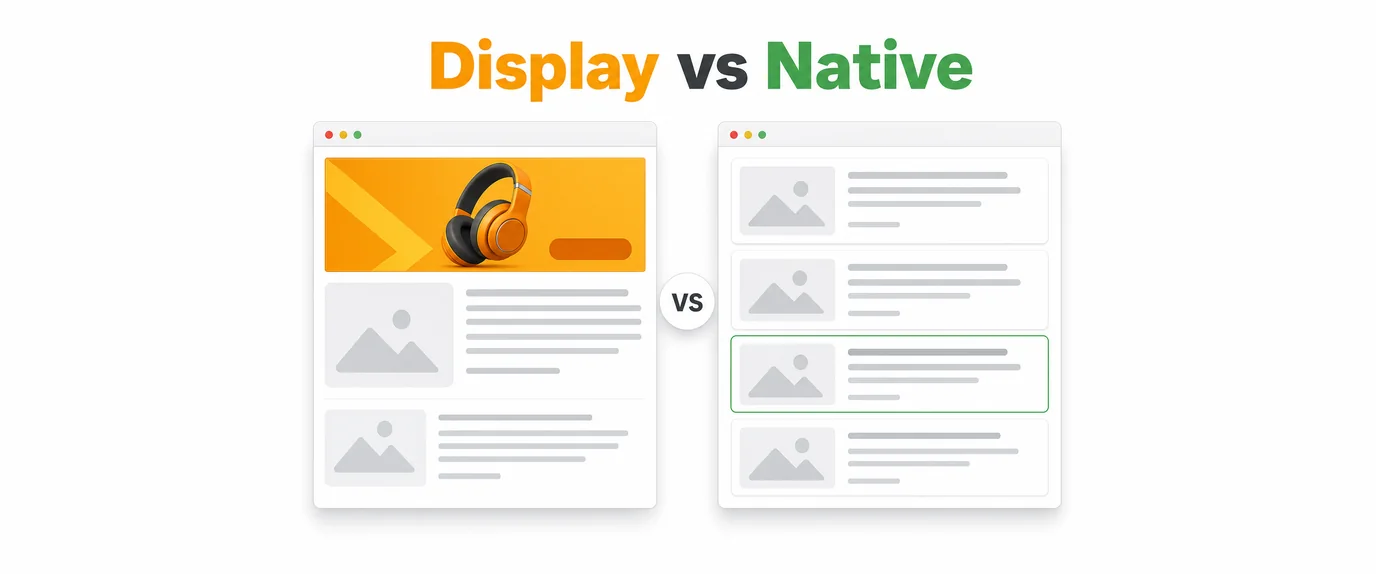
- The Context Conflict Check: Look at how your creative functions against the backdrop of a typical content page. If it mimics the site’s layout too closely, it will blend in completely. If it is overwhelmingly loud, it will trigger immediate rejection. The creative must stand out due to the core substance of its content, not via toxic, neon colors.
- Cognitive Load Assessment: The headline and the image must read simultaneously. If the user has to squint into the details of the picture just to comprehend the meaning of the copy underneath it, the creative is dead on arrival. The image must instantly ask a question, and the headline must promise an immediate answer.
Summary: The New Currency of the Ad Market
The battle for conversions in today’s landscape is not a war of ad budgets or complex server-side technical optimization algorithms. It is a battle for the very first fractions of a second of a living person’s attention.
Those who learn to deeply comprehend the psychology of an info-fatigued user, completely reject exhausted ad templates, and deploy native visual disrupt mechanics will capture the cheapest, cleanest, and most highly engaged traffic, leaving competitors to scrape for pennies on a scorched, blinded advertising field.