In 2026, the image of a media buyer sitting in front of five monitors, feverishly refreshing tracker tabs, has officially become a thing of the past. Manual labor has been replaced by Agentic Media Buying.
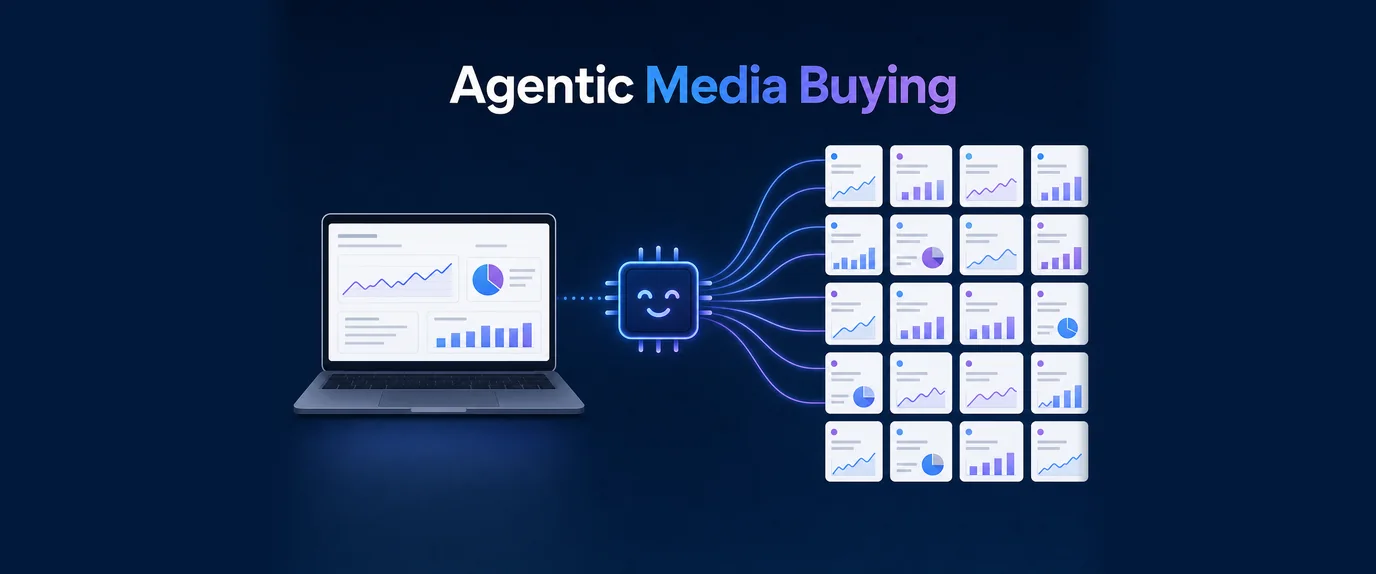
Today, a single professional manages not ten, but a thousand campaigns simultaneously. They achieve this not through manual effort, but by orchestrating a network of autonomous AI agents.
1. From “Manual” to “Autopilot”: A Paradigm Shift
Traditional buying has always been limited by human resources. A person could physically monitor 20–30 funnels at most. Beyond that, errors became inevitable: missing an ROI drop, forgetting to stop a fraudulent placement, or failing to update a burnt-out creative in time.
The 2026 Agentic Model solves this by dividing roles:
- The Buyer: Formulates the strategy, KPIs, and budgets.
- AI Analyst Agent: Monitors real-time data flow from the tracker.
- AI Operator Agent: Interacts with the ad network’s API to implement changes instantly.
2. The Technical Stack: How the AI Assistant Works
A modern AI assistant is not just a simple script. It is an autonomous language model (LLM) connected to your tools via API.
- Tracker Integration: The assistant analyzes reports every 60 seconds. It understands statistical significance—if a placement drains the budget without conversions, it is blacklisted instantly.
- ROI Management: The AI automatically adjusts bids. If profitability drops, the agent reduces spending without waiting for you to wake up.
- Creative Cycle: The assistant detects CTR decay and automatically swaps creatives in the ad network with new variants from a pre-loaded folder or generates prompts to create fresh AI images on the fly.
Comparison: Manual Buying vs. Agentic Buying (2026)
| Parameter | Manual Buying (2024) | Agentic Buying (2026) |
| Campaign Volume | 10–30 | 1,000+ |
| Reaction Speed | 15–30 minutes | < 1 second |
| Primary Task | Spreadsheet optimization | Strategic creativity |
Detailed Summary: The New Architecture of Media Buying
The transition to the agentic model in 2026 is not just a way to save time; it is a complete reimagining of the human role in the advertising industry. We have moved from the era of “button operators” to the era of “system architects.”
Key Takeaways for Professionals:
- Limitless Scalability: Thanks to AI assistants, physical and temporal constraints have been erased. A single buyer can simultaneously run campaigns across 50 countries in different time zones, maintaining peak efficiency in each 24/7. Your profit is now limited only by your imagination and operating capital, not by the number of hours in a day.
- Focus Shift from Process to Result: AI has taken over all the “dirty” and monotonous work—cleaning placements, checking links, and monitoring ROI. This frees up to 90% of a buyer’s time for what machines still cannot master: creating breakthrough marketing hypotheses, finding unique angles for offers, and conducting deep psychological analysis of the target audience.
- Technological Agility as a Competitive Edge: In 2026, the winner is not the person who found a “golden funnel,” but the one who built the most efficient neural infrastructure around their campaigns. The ability to configure API connections between trackers, ad networks, and language models has become as basic a skill as setting up a cloaking script used to be.
- Security and Precision: In the ultra-high-speed environment of 2026, the human eye is too slow. AI agents eliminate the risk of budget “drain” caused by technical glitches or sudden fraud spikes. The system reacts to data anomalies faster than a tracker page can even refresh in a browser.
The Verdict: Agentic buying is the endgame of automation. You no longer work inside the ad account. You work on it, creating a self-learning organism that generates profit while you focus on the high-level strategic development of your business.
FAQs
What is agentic media buying?
Agentic media buying is a model where AI agents autonomously plan, launch, optimize, and scale advertising campaigns with minimal human intervention, using real-time performance data.
How can one person manage 1,000 campaigns?
By delegating repetitive tasks like bidding, targeting, creative testing, and optimization to AI agents that run in parallel across multiple ad platforms.
What role do AI assistants play?
AI assistants act as execution layers that analyze performance data, make optimization decisions, and continuously adjust campaigns based on predefined goals.
What tools are commonly used?
Typical setups include AI marketing platforms, API-driven ad networks, automation frameworks, and analytics dashboards integrated with LLM-powered agents.
What are the main risks and limitations?
Key risks include data bias, lack of transparency, automation errors, platform policy violations, and reduced human oversight in strategic decision-making.