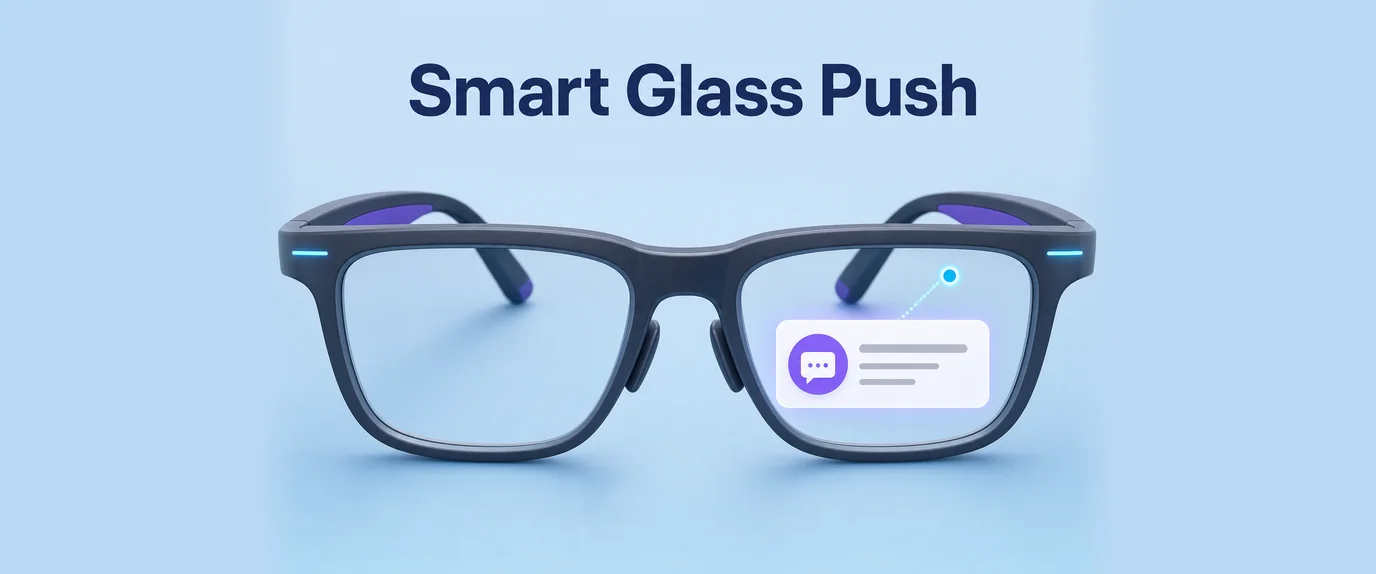
In 2026, ad inventory has officially moved beyond the smartphone. With the mass adoption of Apple Glass, Ray-Ban Meta, and other smart glasses, the human field of vision (FOV) has become the new “main screen.”
However, working with Augmented Reality (AR) requires a fundamentally different approach: while a standard mobile Push is simply annoying, a Push on glasses that obstructs one’s view while crossing the street is a real-life threat. Consequently, the rules for Wearable Ads have become much stricter and more intelligent.
1. From “Interruption” to “Context”
The core difference of Wearable Push is spatial awareness. Ads are no longer fighting for random clicks; they integrate into the user’s current activity.
- Classic Approach: An ad network sends a “20% off coffee” notification to everyone within a 1km radius.
- Wearable Approach: The system detects through the glasses’ sensors that a user has slowed down near a coffee shop and turned their head toward the sign. At that moment, a semi-transparent icon fades in at the corner of their vision. If the user maintains eye contact with it, a coupon unfolds.
This is a transition from intrusive marketing to a Digital Assistant model that offers solutions exactly when they are needed.
2. Technical Standards: The Battle for a “Clear View”
In 2026, ad network moderation introduced strict limits on view-obstruction area. Instead of complex calculations, a simple rule now applies: an ad block cannot occupy more than 5% of the user’s visible space.
Ad platforms automatically analyze creatives for transparency. If your ad has a solid, opaque background or overly large elements, it will be rejected. The primary goal is to create an “information layer” that avoids blind spots and doesn’t hinder the user’s navigation in the physical world.
3. Design Principles in Augmented Reality
For a smart-glass ad campaign to be effective in 2026, designers follow three key rules:
- Transparency and the “Glass” Effect: Using glassmorphism (the frosted glass effect) allows the ad to look like a native part of the glasses’ UI rather than an alien blotch.
- Gaze-tracking Interaction: Notifications react to pupil movement. If a user ignores a Push or looks away, the ad automatically minimizes or “sticks” to the very edge of the lens.
- Hyper-conciseness: In an AR environment, you only have 1–2 seconds of attention. Text is cut to the absolute minimum: one key offer and one clear icon.
4. Dominant Verticals in Wearable Ads
- Local Services (Geo-Offers): Restaurants, gas stations, and service centers. The ad pops up exactly when the user is in the immediate vicinity.
- Events & Entertainment: Information about concerts or events a person is walking past. “Stand-up starts in this bar in 10 minutes; book a table?”
- Real Estate: Glasses highlight houses with available apartments for rent or sale, overlaying the price directly onto the building facade in real-time.
Comparison: Mobile Push vs. Wearable Push (2026)
| Parameter | Mobile Push | Wearable (Glass) Push |
| User Attention | Medium (often ignored) | Maximum (focused) |
| Main Trigger | Time / Interests | Location / Gaze direction |
| Creative Format | Static image + Text | AR-object / Semi-transparent layer |
| Average CTR | 2% – 5% | 10% – 25% |
Detailed Conclusion: The Strategy of the Future
Wearable Ads in 2026 are the “Major League” of media buying, requiring not only technical skills but also a deep understanding of content consumption ethics. We are moving from the era of “buying traffic” to the era of “buying moments of life.”
For the media buyer, this signifies several fundamental shifts:
- Quality over Volume: You cannot “spam” a user on smart glasses. Ad networks will simply block advertisers with low relevance scores. One precise impression in the right location will generate more profit than a million random Pushes.
- Technological Synergy: Success now depends on the combination of “Geo-data + AI-interest analysis + AR-design.” Buyers must work in close coordination with AR interface developers.
- Trust as Currency: If your glass-based ad is useful (showing a discount for the right product at the right time), you gain a loyal customer with massive LTV. If it startles or disorients them, you lose access to that user forever.
Ultimately, those who learn not to block the user’s view of the world, but to organically complement it, will win. Smart glasses give us the opportunity to be present in every step of the customer’s journey—and our task is to make that presence as valuable and invisible as possible.