If you’re a digital publisher, content creator, or ad manager, one of your key performance indicators will always be CPM — Cost Per Mille, or cost per 1,000 ad impressions.
But what exactly makes a “good” CPM? Why do some websites earn just $2 per thousand views while others consistently achieve $20 or more?
This article explores in detail what CPM means, what affects it, how to evaluate your performance, and — most importantly — how to increase your CPM using proven strategies.
1. Understanding CPM
CPM (Cost Per Mille) represents the amount advertisers pay for every 1,000 ad impressions on your website or app.
Formula: CPM=Ad RevenueImpressions×1000CPM = \frac{\text{Ad Revenue}}{\text{Impressions}} \times 1000CPM=ImpressionsAd Revenue×1000
Example:
If you earned $800 from 200,000 impressions,
your CPM = (800 / 200,000) × 1000 = $4.00.
In simple terms, CPM shows how much your ad inventory is worth. The higher your CPM, the more valuable each impression is.
2. Why CPM Is So Important
For publishers, CPM isn’t just a number — it’s a strategic indicator of how the advertising market values your audience.
Here’s why it matters:
- Performance Insight: Reveals how well your ad spaces convert into revenue.
- Benchmarking Tool: Helps you compare different ad formats, placements, or audience segments.
- Revenue Forecasting: Allows you to predict income based on your traffic.
- Negotiation Power: Enables you to set minimum prices when working directly with advertisers.
- Quality Indicator: Reflects the level of advertiser trust in your audience and brand.
3. What Is a “Good” CPM?
There’s no universal number — a “good” CPM depends on multiple factors such as location, industry, ad type, and traffic quality.
By Geography
| Region | Typical Display CPM | Typical Video CPM |
|---|---|---|
| North America | $5 – $20 | $15 – $40 |
| Western Europe | $4 – $15 | $12 – $35 |
| Eastern Europe | $1.5 – $6 | $5 – $12 |
| Latin America | $1 – $4 | $3 – $10 |
| Asia & Africa | $0.5 – $3 | $2 – $8 |
Advertisers pay more for impressions in regions with higher purchasing power and advertiser competition.
By Device
- Desktop: Usually offers higher CPM due to larger ad visibility and engagement.
- Mobile: Lower CPM but higher traffic volume; good optimization can balance the difference.
- Apps and Video: Often generate the highest CPMs when well-targeted and viewable.
By Content Type
| Category | Average CPM | Notes |
|---|---|---|
| Finance / Business | $15 – $40 | High commercial intent |
| Technology | $10 – $25 | B2B and product-driven |
| Health & Fitness | $6 – $15 | Popular with lifestyle brands |
| Education | $5 – $12 | Seasonal variations |
| News & General | $1 – $5 | Large audience, lower targeting precision |
| Entertainment / Gaming | $2 – $8 | Volume-based monetization |
By Ad Format
| Format | Typical CPM | Comment |
|---|---|---|
| Display banners | $1 – $5 | Standard placements |
| Native ads | $5 – $15 | Blends with content, high engagement |
| Video ads | $10 – $40 | Strong branding impact |
| Rich media / interactive | $8 – $25 | Visually engaging, higher value |
4. Key Factors That Affect CPM
Your CPM can rise or fall daily depending on the following:
1. Audience Quality
Advertisers prioritize who sees their ads, not just how many people.
- Loyal, returning users = higher CPM.
- Engaged, organic traffic outperforms paid or low-quality sources.
- Clearly defined audience segments attract more premium campaigns.
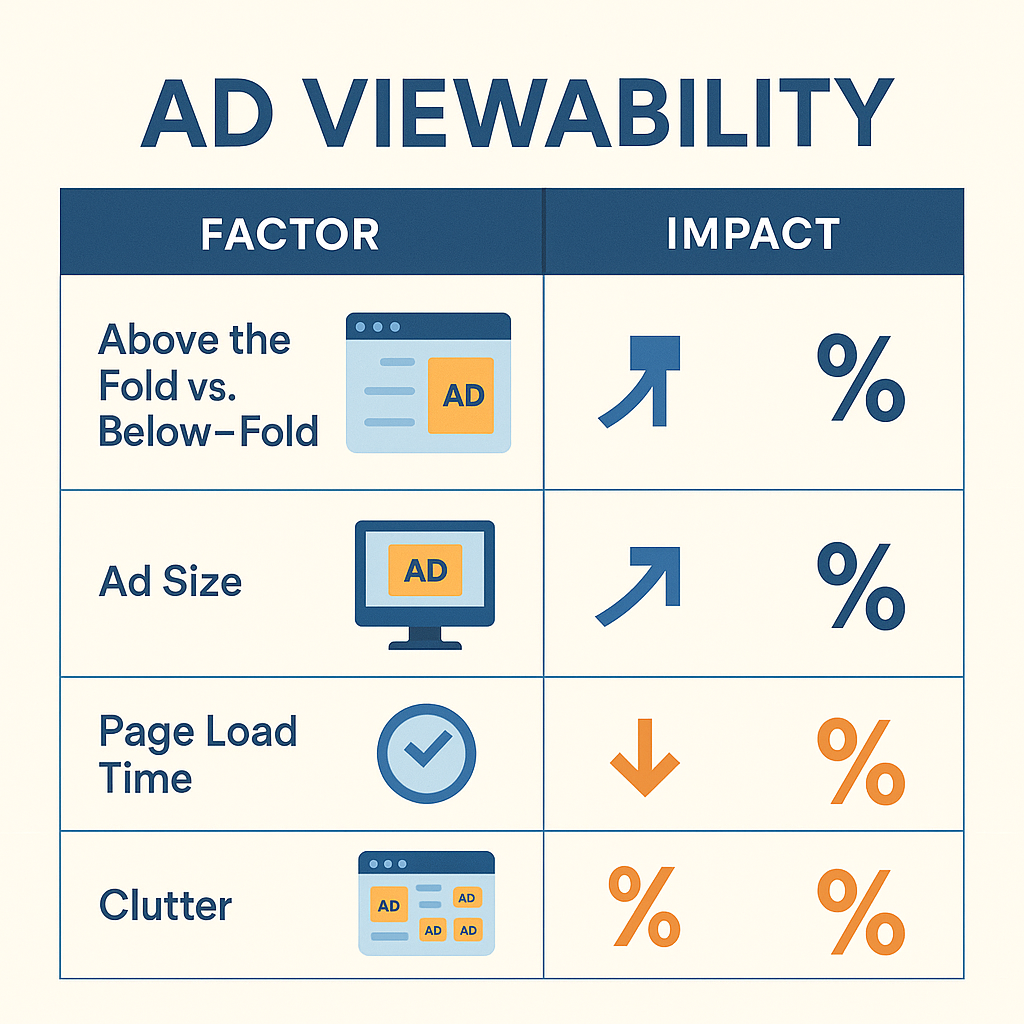
2. Viewability
If users don’t actually see an ad, it doesn’t deliver value.
A high viewability rate (above 70%) improves advertiser confidence and increases CPM.
3. Seasonality
Ad budgets fluctuate throughout the year:
- Highest CPMs usually occur in Q4 (holiday season).
- Lowest CPMs are often seen in January.
4. Ad Placement and User Experience
- Ads above the fold or within engaging content sections perform better.
- Cluttered layouts or intrusive pop-ups can lower both engagement and CPM.
5. Demand and Competition
When multiple advertisers compete for your impressions, the price goes up.
Ensuring your inventory is available to a wide range of demand sources drives CPM growth.
5. Common Mistakes That Lower CPM
Many publishers unknowingly hurt their revenue potential by:
- Placing too many ads on a page, leading to ad fatigue.
- Ignoring mobile optimization.
- Allowing slow site speed, which reduces ad visibility.
- Using generic placements without segmentation.
- Neglecting user experience and content quality.
- Setting prices too low, undervaluing their inventory.
6. Smart Strategies to Increase CPM
Here are practical, safe, and effective methods to raise your CPMs without compromising user experience.1. Improve Ad Viewability
Position ads where users spend the most time:
- Above the fold, within content, or after key paragraphs.
- Use sticky or responsive units that stay visible.
Track and improve your viewability score — advertisers reward that with higher CPMs.
2. Optimize for Mobile
Ensure ads load quickly and adapt to mobile screens.
Fast, clean pages increase user engagement and ad impressions per session.
3. Experiment with Premium Formats
Try mixing formats — display, native, and video.
Video and interactive ads often bring significantly higher CPMs due to visual engagement.
4. Segment Your Audience
Not all traffic has equal value.
Analyze your audience by country, device, or interest, and sell premium segments at higher CPMs.
Example: business readers in the US may bring 5–10× higher rates than casual visitors elsewhere.
5. Enhance Content Quality
High-quality, original, and niche-specific content attracts both users and advertisers.
The more valuable your niche and authority, the more advertisers are willing to pay.
6. Balance Ad Density and User Experience
Avoid overwhelming pages with too many units.
A cleaner layout can increase engagement, reduce bounce rate, and improve CPM over time.
7. Monitor and Adjust Regularly
Track:
- CPM by placement and device,
- Viewability rate,
- Fill rate,
- Session length.
Use data to make informed changes every few weeks — even small tweaks can yield major improvements.
8. Leverage Seasonal Peaks
Plan content and campaigns ahead of high-demand periods (e.g., holidays, back-to-school, major events).
Raising floor CPMs during these times ensures maximum yield.
7. CPM vs RPM vs eCPM
These metrics often get mixed up — here’s the difference:
| Metric | Meaning | Formula | Purpose |
|---|---|---|---|
| CPM | Cost per 1,000 ad impressions | (Revenue / Impressions) × 1000 | Evaluates ad space value |
| RPM | Revenue per 1,000 pageviews | (Revenue / Pageviews) × 1000 | Evaluates page performance |
| eCPM | Effective average CPM | (Total Revenue / Total Impressions) × 1000 | Compares overall ad stack efficiency |
Tracking all three helps publishers understand both micro-performance (CPM) and overall monetization efficiency (RPM).
8. Define “Good CPM” for Your Business
A good CPM is relative to your niche, traffic quality, and strategy.
It’s not about chasing the highest number — it’s about achieving sustainable, consistent growth.
Ask yourself:
- Is your CPM improving each quarter?
- Does it align with your audience’s market value?
- Are user engagement and traffic quality increasing along with CPM?
- Is revenue stable even as you test changes?
If the answer is yes — you’re on the right track.
9. The Future of CPM and Publisher Revenue
The landscape of digital advertising is rapidly evolving. Publishers should prepare for:
- Greater focus on first-party data — audience insights will replace cookie tracking.
- Contextual targeting — relevance and content alignment will matter more than ever.
- Video-first strategies — as global ad spend continues to shift toward video formats.
- Automation and AI optimization — real-time yield management will replace manual control.
- User privacy standards — transparent, non-intrusive ads will drive trust and engagement.
Conclusion: CPM Reflects the True Value of Your Audience
CPM isn’t just a metric — it’s a reflection of how much advertisers value your content and audience.
A “good CPM” isn’t universal. It’s the CPM that:
- Exceeds your current baseline,
- Matches your niche’s potential,
- Balances revenue with user experience, and
- Supports long-term, sustainable growth.
By improving ad viewability, content quality, audience engagement, and strategic planning, publishers can steadily increase CPM and build a more profitable, credible, and trusted digital brand.
Publisher’s Quick Checklist for Higher CPM
| Action | Impact | Priority |
|---|---|---|
| Improve ad viewability | +10–30% | High |
| Use high-quality, engaging content | +15–40% | High |
| Segment audiences & target premium users | +20–50% | Medium |
| Optimize mobile layouts | +10–25% | High |
| Balance ad density | +10–20% | Medium |
| Plan for seasonal trends | +15–35% | Medium |