Introduction
High-monetization niches traditionally attract webmasters: they tend to have higher CPC, more valuable leads, more active advertisers and affiliate programs. At the same time, competition is intense, search engines impose stricter quality requirements, and users have higher expectations.
The task of a modern webmaster is not just to “collect traffic” from expensive queries, but to build a sustainable system: high-quality, expert, useful content → audience trust → conversions and revenue.
Below is a structured guide on how to create content for high-monetization niches while maintaining a high level of quality and preserving the reputation of your website.
1. What Is a High-Monetization Niche?
A high-monetization niche is usually a topic where:
- the cost per click in contextual advertising is high;
- advertisers’ budgets are significant;
- affiliate programs and CPA networks are well developed;
- the average check of products or services is high.
Typical directions include:
- Finance: loans, credit cards, investments, insurance, mortgages;
- Legal: legal services, document preparation, litigation;
- Medicine and health: clinics, dentistry, diagnostics, aesthetic medicine;
- Education and career: online courses, additional education, exam preparation;
- Real estate: buying, selling, renting, mortgages, renovation;
- B2B and SaaS: CRM, marketing services, hosting, cloud solutions;
- Automotive: insurance, leasing, selection, car services.
These niches are characterized by:
- High competition in search and advertising;
- Increased attention to the accuracy and reliability of information;
- The risk of real damage to the user when recommendations are wrong (especially in finance, medicine, and law).
Therefore, it is especially important to balance commercial benefit with real user value.

2. Choosing a Niche and Focus: Sub-Niches Instead of “Broad” Topics
2.1. Why Narrow Your Focus
Trying to cover an entire broad topic (“investments”, “mortgages”, “legal help”) often leads to:
- overly generic, shallow content;
- direct competition with strong brands and big media;
- problems with positioning and a clear USP.
A better approach is to choose a sub-niche and a specific target audience.
Examples:
- instead of “investments” → “investments for beginners / students / freelancers / self-employed”;
- instead of “mortgage” → “mortgage for IT specialists” or “zero-down-payment mortgage for young families”;
- instead of “family lawyer” → “legal help with asset division after divorce”.
Narrowing your niche:
- simplifies keyword selection;
- helps you understand your audience’s pain points and tasks more clearly;
- allows you to create deeper, more relevant, and more helpful content.
2.2. Evaluating Sub-Niche Monetization
When choosing a sub-niche, you should consider not only traffic volumes but also:
- the availability of suitable affiliate programs and advertisers;
- the average order or contract value (higher value often means that even a small but “warm” audience is profitable);
- the type of target action:
- loan or credit application;
- consultation request;
- booking a medical appointment;
- course purchase;
- request for a commercial offer, and so on.
Sometimes a niche with lower search volume but high lead value is more profitable than a “mass-market” topic with hundreds of thousands of impressions.
3. Search Demand and User Intent Analysis
3.1. Classifying User Intent
When working with high-value queries, it is crucial to consider user intent:
- Informational
Queries like: “what is…”, “how to choose…”, “how to apply…”, “how to calculate…”
→ These require detailed explanations, step-by-step guides, and examples. - Comparative / Investigative
Queries like: “which bank is best for…”, “top 10 services…”, “plan comparison…”
→ Reviews, ratings, tables, and analytical breakdowns work best here. - Transactional (Commercial)
Queries like: “apply for a loan online”, “buy insurance”, “book a lawyer consultation”
→ These require landing pages with clear structure, forms, and CTAs.
Content that ignores user intent will:
- convert poorly;
- leave users dissatisfied;
- lose positions in search due to weak behavioral metrics.
3.2. Mapping Intent to Content Format
For each segment of queries you should define the optimal content format:
- informational intent → guides, long-form articles, FAQ, checklists;
- comparative intent → ratings, review articles, tables, case studies;
- transactional intent → landing pages, application forms, calculators, curated offer lists.
In this way, content becomes an instrument for solving user problems, rather than just text packed with keywords.
4. Designing Content Structure

4.1. Requirements for Article Structure in High-Monetization Niches
A high-quality article usually has:
- clear positioning: who the article is for and what it is about;
- a logical structure with headings and subheadings;
- step-by-step blocks (“Step 1”, “Step 2”, etc.);
- examples, schemes, and calculations;
- a conclusion and a clear next step for the reader.
Example of a typical structure for an article “How to Choose an Investment Broker”:
- Who this article is for and what problems it helps solve;
- Briefly: who a broker is, why you need one, and what types exist;
- Key criteria for choosing a broker:
- license and regulation;
- fees and commissions;
- platform and mobile app usability;
- availability of analytics and support;
- additional services.
- An algorithm for checking a broker before opening an account;
- Recommendations for different user goals:
- long-term investing;
- active trading;
- small budgets / beginners.
- A summary comparison table for several brokers;
- A section with offers (affiliate deals) as a logical next step;
- FAQ for typical beginner questions;
- Conclusion: short summary and a clear call to action.
4.2. Content Types That Combine Quality and Monetization Well
- detailed how-to guides and instructions;
- thematic reviews and ratings;
- comparative articles “A vs B”;
- case studies with numbers and real scenarios (“how we reduced loan overpayment”);
- interactive calculators, checklists, document templates;
- niche FAQs, breakdowns of common mistakes.
In all of these formats you can integrate affiliate offers without harming structure or usefulness, as long as you do it logically and transparently.
5. Integrating Monetization Without Losing Trust
5.1. The Principle: Monetization as a Logical Continuation
Commercial blocks should be:
- logically connected to the content;
- relevant to the user’s problem;
- placed in a way that does not interfere with reading and comprehension.
Example:
An article “How to Choose a Mortgage Without Overpaying” naturally leads to:
- mortgage payment calculators;
- forms to apply to several banks;
- lists of current mortgage programs.
The user should see these elements as a useful tool, not as intrusive advertising.
5.2. Transparency and Fair Promotion of Partners
Within an ethical monetization strategy you should:
- clearly separate advertising and affiliate blocks from the main content visually;
- avoid calling a product “the best” if your choice is based only on partnership and not on objective criteria;
- in ratings, describe the criteria for ranking and selection.
This builds trust in your website and, in the long term, increases both conversion rates and audience loyalty.
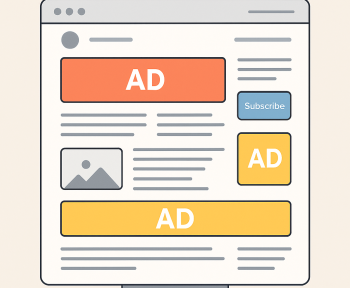
5.3. Moderating Advertising Load
Too many banners, pop-ups, and aggressive CTAs:
- destroy trust;
- damage behavioral metrics;
- may negatively affect organic rankings.
A better strategy is to use a few well-designed, relevant monetization points instead of many random ad elements.
6. Expertise and Reliability: Key Factors in High-Monetization Niches
6.1. Working with Experts
In sensitive topics (medicine, finance, law) it is especially important to:
- involve professionals in creating or reviewing content;
- show information about experts (name, qualification, experience);
- explicitly state that a text was reviewed by an expert (if this is true).
This helps:
- minimize the risk of serious factual errors;
- strengthen user trust;
- increase “expertise signals” of the site from search engines’ perspective.
6.2. Fact-Checking and Sources
Minimum requirements for content preparation:
- verify data using multiple reliable sources;
- keep numbers, rates, conditions, and limits up to date;
- avoid obviously dangerous advice (self-treatment, signing documents without reading, etc.).
Ideally, you should:
- regularly update materials as market conditions change;
- show the date of the last update;
- avoid overly categorical statements where details may vary by country, region, or personal situation.
7. Organizing Work with Authors and Editing
7.1. Creating a Detailed Content Brief
High-quality text in a high-monetization niche rarely appears without a detailed brief. It should include:
- description of the target audience: who they are, their knowledge level, typical questions;
- content goals: what the user should understand or do after reading;
- a list of key questions that the text must answer;
- tone and style requirements: level of formality, use of terminology, the need for examples;
- article structure: required sections, blocks, elements (tables, checklists);
- rules for keyword usage (natural integration, no keyword stuffing);
- planned monetization areas (affiliate blocks, forms, CTAs).
7.2. Editing and Final Review
Before publishing, it is recommended to:
- check the text for:
- logical structure;
- absence of contradictions;
- clarity and readability;
- ensure that monetization is integrated smoothly and does not break the reading experience;
- fact-check critical sections (numbers, rates, legal wording).
8. SEO Strategy That Does Not Destroy Content Quality

8.1. Semantic Core and Content Clusters
A rational SEO approach in high-monetization niches looks like this:
- Build a semantic core that prioritizes queries with clear commercial potential.
- Group queries into clusters:
- informational;
- comparative;
- transactional.
- Design a content network for each cluster:
- a “pillar” or overview article (guide);
- more specific articles covering narrow aspects;
- landing pages for applications and specific offers.
Internal linking helps:
- users move from general to specific questions and back;
- search engines understand site structure and the relative importance of pages.
8.2. Optimizing Without Keyword Overuse
When working with keywords you should:
- use them in titles, headings, first paragraphs, and meta tags—but keep the language natural;
- avoid “broken” and unnatural phrasing for the sake of exact keyword matches;
- focus on completeness, clarity, and logical coverage of the topic.
High-quality content designed for real user problems usually performs well even without aggressive on-page optimization.
9. Quality and Performance Metrics
To understand how well your content simultaneously supports quality and monetization, track:
- Behavioral metrics:
- time on page;
- pages per session;
- bounce and return rates.
- Conversion metrics:
- clicks on affiliate links and CTAs;
- number of applications and inquiries;
- share of target actions from total visitors.
- Financial metrics:
- revenue per 1,000 impressions (RPM);
- revenue per session;
- revenue per content group or cluster.
Based on these data you can:
- double down on the most effective content formats;
- rework underperforming pages (add examples, clarify instructions, change structure and CTAs);
- optimize ad blocks (placement, copy, volume).
10. Common Webmaster Mistakes in High-Monetization Niches
Some of the most frequent mistakes include:
- Shallow content with no real value
Fast rewrites of competitors, generic statements, lack of specifics and practical advice. - Ignoring user intent
For example, showing a landing page with forms and no explanations for an informational query—users leave quickly. - Excessive and aggressive monetization
Too many banners, pop-ups, and CTAs that disrupt reading. - No fact-checking in critical topics
Errors in rates, conditions, or legal wording lead to loss of trust and potential risk. - Little or no content updating
Conditions for loans, tax rules, and legal procedures change frequently, so outdated content quickly loses value. - Trying to optimize only “for search engines”
Keyword stuffing, unnatural phrasing, hidden links—all of this lowers quality and can lead to penalties.
Conclusion
Working in high-monetization niches is not just about picking “expensive” keywords; it is about building a systematic content strategy:
- careful choice and analysis of sub-niches;
- understanding user tasks and intent;
- creating structured, accurate, useful materials;
- careful, logical monetization without pressure;
- ensuring expertise and reliability;
- regular analytics and improvement of existing pages.
With this approach, a webmaster gains more than just traffic from expensive queries: they build a long-term asset—a trusted resource that users come back to and that generates stable revenue.