What Is Mobile Marketing and Why It Matters
Mobile marketing includes any form of communication or advertising that reaches people through smartphones or tablets — in apps, browsers, messengers, or via native device functions (push notifications, SMS, geo-targeting).
Its biggest advantage is personalization in real time: messages reach users at the right place and moment, resulting in higher engagement and conversion rates.
Main Types of Mobile Marketing
1) SMS and MMS Messaging
A direct and reliable channel — nearly everyone opens text messages. Great for notifications, promotions, and transactional updates (like delivery confirmations). MMS allows images and videos. Works across industries, provided the frequency is respectful.
2) Push Notifications (In-App and Browser)
A cost-effective re-engagement channel that relies on user permissions. Personalized, trigger-based pushes can improve retention — but overuse leads to opt-outs. Always fine-tune frequency and timing.
3) In-App Marketing
Banners, pop-ups, paywalls, and in-app messages controlled by CRM systems or remote configuration. Ideal for onboarding, upselling, promoting new features, and monetization.
4) Mobile Advertising and Programmatic
Includes native, video, playable, and interstitial ads on networks and social platforms. Success depends on creative quality and precise targeting. On iOS, campaigns must adapt to privacy limitations and aggregated attribution.
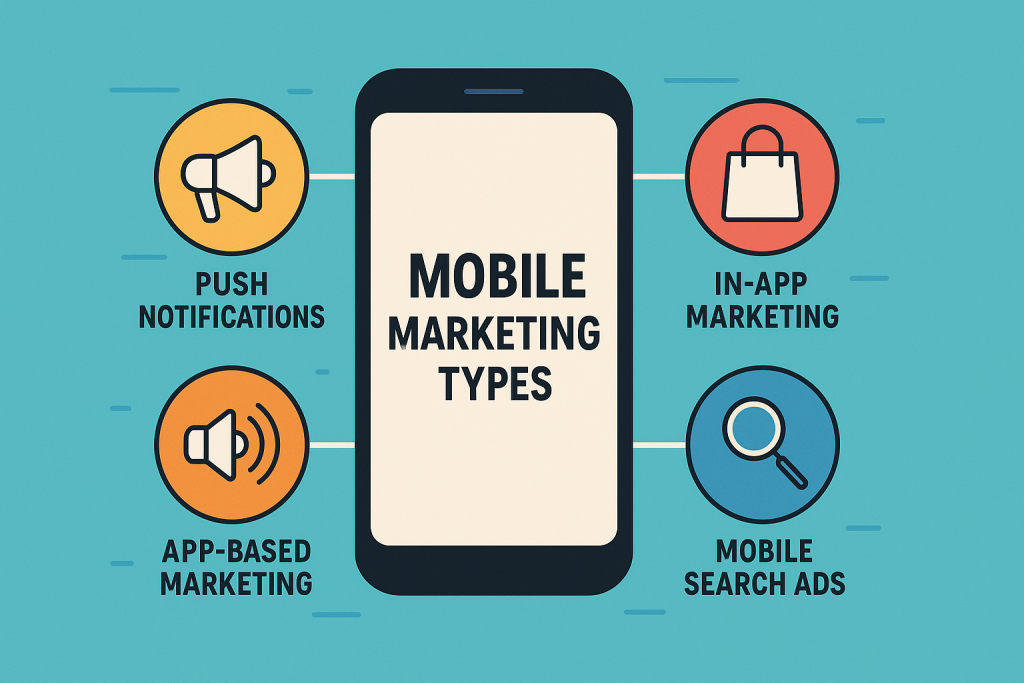
5) Search and App Store Advertising
Search ads in app stores and mobile search results help capture high-intent users. Works best when combined with ASO (App Store Optimization) — optimized metadata, visuals, and conversion-friendly store pages.
6) Geomarketing and Geofencing
Uses user location to deliver relevant offers — for example, “near our store,” “in the airport,” or “within an event zone.” Enhances offline engagement and drives local conversions.
7) QR Codes and Offline-to-Mobile
Printed materials, packaging, or outdoor ads lead users directly to landing pages or apps via QR codes and deep links. A powerful bridge between offline and mobile activity.
8) Social Media and Influencer Marketing
Vertical videos, stories, reels, and user-generated content optimized for mobile-first consumption. Creator partnerships and whitelisting amplify credibility and reach.
9) Mobile Email Marketing
Since most emails are read on phones, mobile-first design is key: short subject lines, large CTAs, and direct deep links into the app improve results.
10) ASO — App Store Optimization
Improves visibility and conversion within app stores: keyword strategy, visuals, localization, review management, and A/B testing. Enhances organic installs and reduces paid acquisition costs.
Building a Strategy: From Launch to Scale
Step 1. Foundation: Analytics, Attribution, and Privacy
- Set up product analytics and a mobile measurement partner (MMP).
- On iOS, plan for SKAdNetwork — aggregated attribution without device IDs.
- Use deep links and deferred deep links to guide users directly to key in-app screens.
Minimal stack: analytics + MMP + CRM/push platform + ASO tools.
Step 2. Pre-Launch (Soft Launch)
- Test in 1–2 smaller markets.
- Validate onboarding and time-to-value.
- Run creative tests and early App Store campaigns.
Step 3. Launch
- Scale winning channels: in-app ads, social media, App Store search.
- Align store visuals (icon and first screenshot) with your top-performing ad creatives.
- Launch core CRM automations: onboarding, reactivation, reminders.
Step 4. Growth
- Expand into new regions and ad formats; integrate geofencing and QR activations.
- Introduce referral programs and influencer collaborations.
- Test paywalls, pricing, and personalized offers.
Step 5. Efficiency
- Run incrementality experiments (geo-tests, holdouts) to measure true ROI.
- Optimize campaigns and conversion windows within privacy frameworks like SKAN.
Key Mobile Marketing Metrics
- Acquisition: CPI, CPA, ROAS (Day 0, 7, 30).
- Product: Activation rate, Retention (D1/D7/D30), session depth.
- Monetization: ARPU, LTV, paywall and trial-to-paid conversion rates.
- CRM: Push opt-in, open and click rates, conversion from messages, unsubscribe rates.
The main balance to track is CAC vs. LTV, with decisions based on cohort and incrementality analysis rather than post-click attribution alone.
Best Practices by Channel
- SMS/MMS: Focus on value-driven or transactional content; add tracking and deep links to in-app destinations.
- Push: Respect opt-in choices and limit frequency; trigger messages based on real behavior.
- In-App: Provide contextual nudges and banners at key points in the user journey.
- Mobile Ads: Rapid creative testing cycles, retargeting, fraud prevention, and brand safety controls.
- Search/ASA: Start with branded and exact-match keywords before broadening campaigns.
- Geo: Offer location-based incentives and limit radius/time windows.
- QR: Keep the path simple: QR → landing/app clip → in-app action.
- ASO: Continuously optimize visuals, localize assets, and manage user reviews.
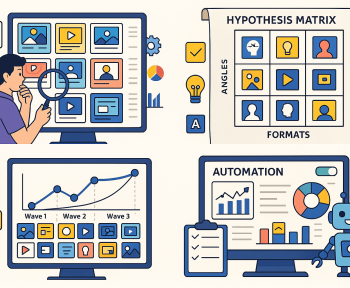
A/B Testing and Creative Discipline
- Structure: Hook (first 2–3 seconds) → clear value → social proof → CTA.
- Process: Launch 5–10 variations weekly, scale winners, and refresh successful ads with new formats or regions.
- Store Alignment: Repurpose your best ad hooks into store icons and screenshots.
Privacy and iOS Attribution
On iOS, user-level tracking is limited, so performance is measured via SKAdNetwork — aggregated data with conversion windows and restricted signals.
Plan your campaign events and postbacks accordingly, ensuring compliance with all privacy standards.
90-Day Launch Plan
Weeks 1–2:
- Set up analytics, MMP, and CRM flows.
- Prepare 3–5 creative concepts with multiple variations.
- Audit your app listing and keyword strategy.
Weeks 3–4:
- Soft launch in test regions; pilot push/SMS automations.
- Run branded and exact-match App Store Search Ads.
Month 2:
- Scale high-performing paid channels; add geofencing and QR entry points.
- Test paywalls, trial offers, and CRM-based reactivation sequences.
Month 3:
- Run incrementality tests, optimize SKAN performance, expand to new geos.
- Finalize a quarterly media and growth plan.
Common Mistakes to Avoid
- Relying on one channel and neglecting ASO or CRM.
- Judging success only by installs or clicks instead of true ROI.
- Overusing push/SMS without segmentation or timing.
- Misalignment between ad creatives and app store visuals.
- Ignoring privacy and platform compliance rules, especially on iOS.
Quick Pre-Scale Checklist
- Analytics and conversion events are correctly tracked.
- SKAN/postback logic verified (iOS).
- App listing optimized and localized.
- Active social and UGC content pipeline.
- CRM workflows: onboarding, reactivation, win-back ready.
- Frequency caps and triggers set for push/SMS.
Final Thoughts
Mobile marketing isn’t just another channel — it’s an integrated system where ad formats, app store optimization, CRM, and user experience support one another. Start with the essentials: analytics, proper attribution, and a strong app listing, then run small, data-driven experiments across ad formats like push and smartlink.
Just as a vehicle benefits from diagnostics to spot issues and tuning to optimize performance, a mobile campaign thrives when its components are monitored and refined. When every element works together, growth becomes faster, smarter, and more sustainable.
Mobile Marketing Essentials
| Mobile Marketing Element | Strategy / Approach | Related Service Example |
|---|---|---|
| Analytics & Attribution | Track performance and guide decisions | Diagnostics |
| Ad Formats | Push, Smartlink, etc., tailored to audience needs | Tuning / Optimization |
| App Store Optimization | Improve visibility and conversions | — |
| CRM & User Engagement | Retain and engage users | — |