Key Takeaways
- Banner Ads now expire quickly due to Banner Blindness 2.0, where users train their brains to ignore repetitive ads within 48 hours.
- Rapid content consumption leads to algorithmic overkill and neural filtering, causing users to view ads as spam after frequent exposure.
- Automated rotation and dynamic chaos become essential; use AI to create multiple ad variations and leverage smart pauses to refresh user engagement.
- Set CTR thresholds and conduct A/B/n testing to optimize ad performance and reduce audience fatigue.
- In 2026, treat your ads as perishable goods; automate and innovate to keep user attention.
Affiliates used to be able to run a single winning creative for weeks. Today, if you haven’t updated your creative set within 48 hours, your CTR (Click-Through Rate) plummets, and your CPC (Cost Per Click) skyrockets.
In 2026, we are facing the phenomenon of Banner Blindness 2.0. The modern user’s brain has learned to instantly recognize advertising patterns—composition, color schemes, and even fonts—and block them before the eye even focuses on the text.
Let’s break down why your ads “expire” so quickly and how automated rotation can save your ROI.
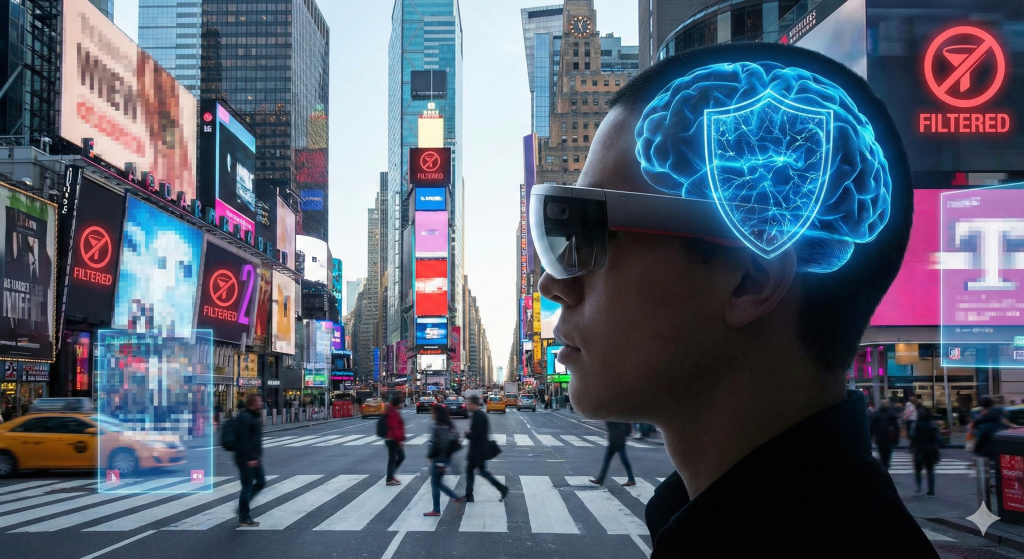
The Evolution of Apathy: Why 48 Hours is the Limit?
In 2026, content consumption is “ultra-high-speed.” TikTok algorithms, Reels, and smart notification feeds have conditioned users to expect constant novelty.
Reasons for Rapid Burnout:
- Algorithmic Overkill: Ad networks (Meta, Google, Push networks) in pursuit of profit show your ad to the same user too frequently in a short period.
- Visual Inflation: Popular approaches (e.g., “doctor with a pill” or “model with a phone”) are replicated by AI in millions of variations. The user has seen them thousands of times.
- Neural Filtering: The brain categorizes specific visual structures (like a push notification frame or a “Learn More” button) as “ignore by default.”
Frequency: Where is the line between “Remind” and “Annoy”?
Frequency is a metric that shows how many times, on average, a single user has seen your ad.
- Frequency 1.0–1.5: The sweet spot. The user perceives the ad as new.
- Frequency 2.0–3.0: The danger zone. If no click occurred, the user subconsciously flags you as spam.
- Frequency > 3.0: The “Death” zone. Your CTR drops by 50-70%, and negative feedback on the ad increases.
The 2026 Formula: Creative Lifespan = (Audience Volume / Traffic Buying Speed) × Uniqueness Coefficient.
The Solution: Automated Rotation and “Dynamic Chaos”
To beat Blindness 2.0, you must stop being predictable. Here’s how top teams do it in 2026:
1. AI-Driven Variability
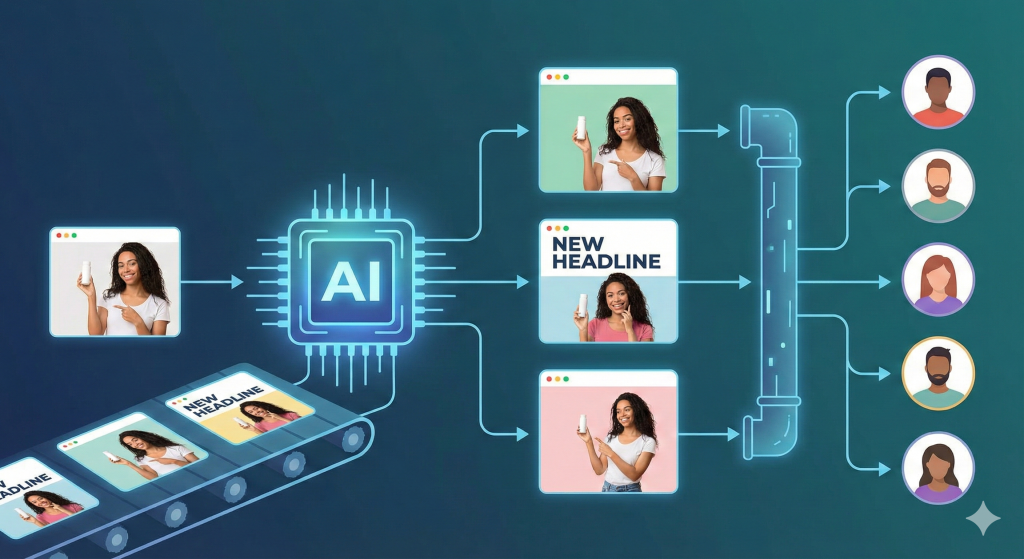
Don’t make one creative. Make 50. Use neural networks to change just one element: the background, button color, model’s angle, or headline. Your rotation system should automatically swap these elements on every second view for the same audience segment.
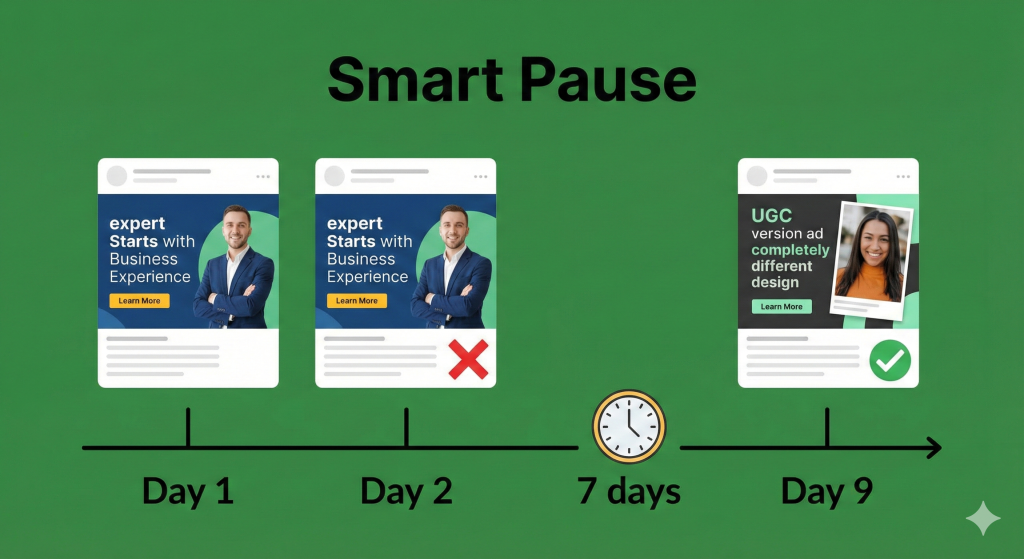
2. The “Smart Pause” Formula
If a user sees an ad twice and doesn’t click—exclude them from that campaign for 7 days. Come back later, but with a radically different visual approach (e.g., switch from an “expert” style to a “UGC review”).
3. Technical Rotation of Domains and Icons
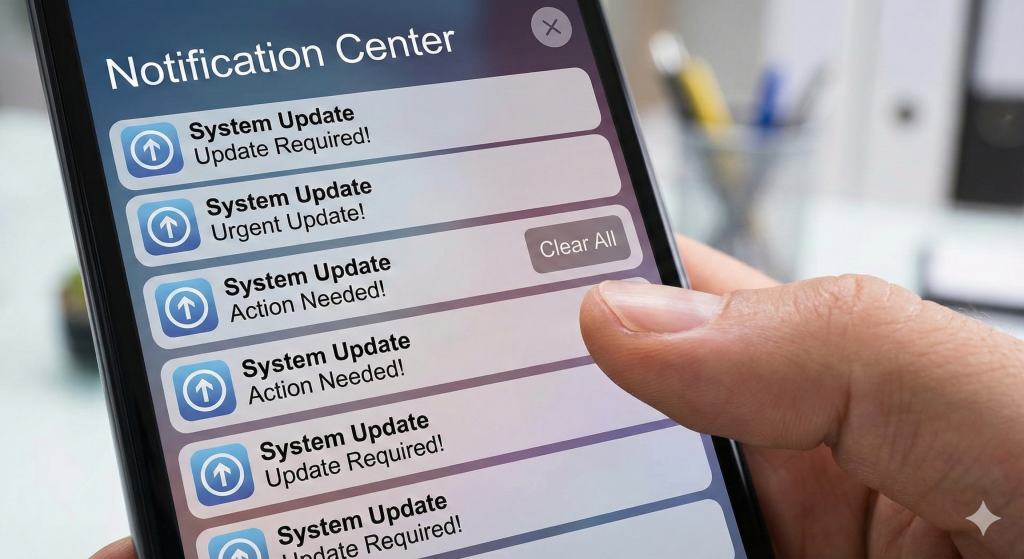
For push notifications, rotating the icon and “sender” name is critical. If a user sees 5 pushes in a row from “System Update,” they stop noticing them. Rotate 10-15 different personas and headline styles within a single offer.
Practical Tip: How to Set Up Rotation
In the GTaro Ads dashboard and modern trackers, use the Auto-Rotation feature.
- Set a CTR Threshold: As soon as a creative’s CTR falls below 0.5% of its average for the first 6 hours, the system should automatically switch traffic to the next variant.
- A/B/n Testing: Test ten variants simultaneously instead of just two (A and B). This dilutes the frequency and helps identify “resilient” patterns.
The Verdict
In 2026, a creative is not a work of art; it is a perishable good. To survive Banner Blindness 2.0, you must move faster than the adaptation mechanisms of the human brain.
Automate your rotation, watch your frequency, and never let a user see the same ad three times.
FAQ Questions & Answers
What is banner blindness and why does it happen?
Banner blindness is a phenomenon where users ignore display ads because they subconsciously perceive them as irrelevant or intrusive. It happens due to overexposure to repetitive ad formats and poor targeting.
Why do my ad creatives only perform well for 48 hours?
Most users engage with fresh creatives initially. After 48 hours, performance drops due to saturation, ad fatigue, and banner blindness, causing diminishing returns.
How can I prevent banner blindness from affecting my campaigns?
Refresh creatives frequently, diversify ad formats, use personalized targeting, and integrate contextual messaging to maintain user attention and engagement.
Does ad placement affect banner blindness?
Yes, ads in predictable or ignored areas (like banners at the top) are more likely to be overlooked. Testing placements and using native advertising can improve visibility.
Are interactive or dynamic ads more effective against banner blindness?
Absolutely. Interactive, animated, or dynamic creatives grab attention longer than static ads, reducing banner blindness and increasing engagement.