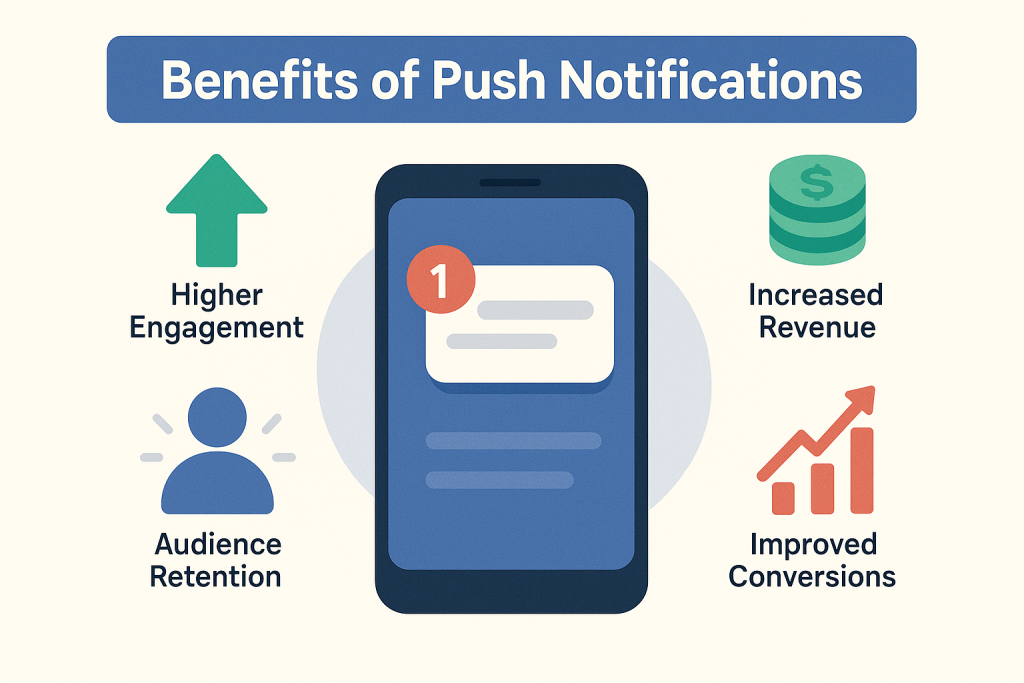
Push notifications have long evolved beyond simple alerts. Today, they’re a strategic growth channel: a source of repeat visits, conversions, LTV, and retention. Below is a detailed guide to the key verticals where push messages deliver the strongest results, complete with segmentation ideas, triggers, sample messages, and success metrics.
Why Push Notifications Matter
- Instant Delivery: They reach users directly on their devices, visible without opening an app or website.
- Contextual Relevance: Target by event, location, time, customer status, and more.
- Cost Efficiency: Almost zero marginal cost compared to performance ads.
- Deep Engagement: Deep links drive users straight to the right screen or funnel stage.
- Omnichannel Power: Work in sync with email, SMS, in-app messages, and call centers.
The key to success is relevance + frequency control. There’s no such thing as a universal “perfect push.”
Framework of an Effective Push Strategy
- Segmentation — funnel stage, recency/frequency (RFM), product interests, payment behavior, device/OS, geo, traffic source.
- Triggers — actions (abandoned cart), inaction (churn risk), events (price drop, new episode), life moments (birthday, payday).
- Personalization — name, favorite categories, dynamic data (price, stock, ETA, exchange rate, match score).
- Testing — A/B title, call-to-action, timing, rich media, deep link.
- Frequency control — daily/weekly limits, prioritize service over marketing pushes.
- Attribution & Metrics — opens, clicks, conversions, retention impact, revenue per 1k pushes, opt-outs, inactive devices.
- Legal Compliance — explicit opt-in, “Do Not Disturb” respect, GDPR/local laws, platform (iOS/Android/Web Push) rules.
Top Verticals and Scenarios
1) E-commerce & Retail
Goals: higher conversions and AOV, recovering unfinished sessions, cross-selling.
- Triggers: abandoned cart/view, price drop/sale, restock alert, limited size, order/delivery status, payday promotions.
- Segments: VIP, dormant users (30/60/90 days), deal hunters, favorite-brand fans.
- Examples:
- “Your Nike Air in size M is back in stock. Reserve now?”
- “15% off your wishlist items until 11:59 PM. Hurry up!”
- Focus metrics: CTR, cart additions, recovered orders, revenue per 1k pushes.
2) Media & Publishing
Goals: boost DAU/MAU, reading depth, subscriber retention.
- Triggers: breaking news, new podcast/video releases, trending topics, episode completions.
- Segments: categories (politics, sports, tech), local news, free vs. paid users.
- Examples:
- “New crypto weekly update — 6-minute recap.”
- “Your team just scored! Watch the highlights.”
- Tip: cap daily volume to avoid fatigue and unsubscribes.
3) Fintech & Banking
Goals: prevent fraud, improve NPS, increase product usage.
- Triggers: transactions, unusual activity, savings goal progress, cashback earned, FX rate alert, card renewal.
- Segments: travelers, investors, payroll clients.
- Examples:
- “Deposit of $750 received. View details.”
- “USD dropped 1.3%. Exchange now?”
- Notes: ensure encryption, strict limits, clear offline alternatives.
4) Travel & Hospitality
Goals: reduce no-shows, increase upsells, improve user experience.
- Triggers: check-in open, gate changes/delays, visa/insurance reminders, room upgrade, early checkout.
- Segments: business vs. leisure, weekend travelers, loyalty tiers.
- Examples:
- “Online check-in open: pick seat 12A for $5.”
- “20% off spa for guests arriving tomorrow.”
- Tip: use geotriggers (airport) and local tips (weather, transport).
5) Q-commerce & Food Delivery
Goals: repeat orders, frequency, lower CAC.
- Triggers: lunch/dinner time, favorite dishes, courier ETA, promo hours, low-stock ingredients.
- Segments: vegetarians, fitness meals, families, night owls.
- Examples:
- “Your courier is 3 minutes away. Is the door open?”
- “Weekly combo: sushi + ramen −18% until 9 PM.”
6) Health & Fitness
Goals: habit building, retention, subscription renewals.
- Triggers: workout reminders, hydration, sleep tracking, progress plateau, goal-based programs.
- Examples:
- “Day 5/21: 12-min bodyweight workout. Start now.”
- “You slept 6h05 — goal 7h30. Tips to improve.”
7) Gaming
Goals: more sessions, monetization, social engagement.
- Triggers: energy refilled, events, PvP challenges, comeback rewards, seasonal passes.
- Examples:
- “You’ve been overtaken in the league! Reclaim your spot.”
- “+50 crystals if you log in before midnight.”
8) EdTech
Goals: course completion, engagement, conversions to paid tiers.
- Triggers: upcoming lessons, deadlines, resume reminders, mentor replies, new modules.
- Examples:
- “24 hours left to submit your project — checklist inside.”
- “Your mentor left feedback — open to view.”
9) Mobility & Transportation
Goals: reduce wait times, increase repeat rides, ensure safety.
- Triggers: surge pricing, unlock codes, battery alerts, parking reminders, popular destinations.
- Examples:
- “Scooter 2 min away. Rent now?”
- “Parking ends in 5 min — extend?”
10) Marketplaces & Social Platforms
Goals: user engagement, liquidity of offers and demand.
- Triggers: new messages, likes/comments, item updates, price changes.
- Examples:
- “3 new applicants for Product Manager position.”
- “Buyer offered $70 for your backpack. Accept?”
11) B2B / SaaS
Goals: feature adoption, churn reduction, upsells.
- Triggers: workspace invites, plan limits, anomalies (errors/incidents), reports ready.
- Examples:
- “API limit reached 80%. Upgrade now?”
- “September sales report ready — open dashboard.”
12) GovTech & Nonprofits
Goals: accessibility, public service awareness, timely actions.
- Triggers: appointment reminders, status updates, alerts, voting, community programs.
- Examples:
- “Your passport is ready. Choose pickup time.”
- “Weather alert: storm warning 6 AM–12 PM tomorrow.”

How to Make Pushes Useful, Not Annoying
- Service > Marketing: Prioritize notifications that solve user needs (status, reminders, security).
- Rich media: Use images, emojis, buttons only to clarify offers, not decorate.
- Deep links: Lead users straight to the target action (checkout, product, video, renewal form).
- Timing: Send during high engagement windows (lunch/evening), respect time zones and quiet hours.
- Fatigue control: Watch CTR/opt-out trends to adjust frequency dynamically.
- Preference center: Let users manage notification types easily.
- Fail-safes: Use silent delivery or fallback channels (email/SMS) for critical alerts.
Sample Templates by Goal
Conversion Recovery (Retargeting):
- “You started checkout but didn’t finish — your 10% discount is reserved for 2 hours.”
- “Last item from your wishlist in stock. Grab it now.”
Feature Activation:
- “New feature: auto bill pay. Enable in one tap.”
Reactivation:
- “We’ve missed you! Fresh deals based on your favorite categories.”
Upsell/Cross-sell:
- “Add MagSafe case to your iPhone 15 order — 20% off today only.”
Service Notifications:
- “Order #14321 — your courier arrives in 2–4 minutes.”
Key Metrics
- Opt-in rate — reach baseline.
- Delivery / Open / View rate — track engagement (on iOS, rely on clicks and follow-up events).
- CTR & Conversion Rate — by main goals (purchase, subscription, lesson completion).
- Revenue per 1k Pushes — normalizes performance across campaigns.
- Unsubscribe / Opt-out / complaints — early fatigue signal.
- Impact metrics: retention (D1/D7/D30), LTV, purchase frequency, AOV.
- Latency metrics: time from push to target action.
Don’t just chase CTR — connect pushes to business outcomes through deep links and event tracking.
Tools & Tech Stack
- Delivery platforms: Firebase (FCM), APNs, Web Push API.
- CRM/CDP: Customer.io, Braze, OneSignal, CleverTap, Leanplum, etc.
- Analytics: Amplitude, Mixpanel, BI dashboards, attribution tools.
- Preferences & consent: in-app/web notification centers.
Implementation Checklist
- Define 1–2 business goals (e.g., “+X% recovered carts”).
- Build event mapping — what triggers each push, what parameters you need.
- Set preferences & frequency caps.
- Launch MVP triggers — service status + 1–2 conversion flows.
- Create a holdout group to measure true lift.
- Scale content matrix by segments/time.
- Clean audiences and update caps regularly.
Common Mistakes to Avoid
- “One push fits all” — no segmentation/personalization.
- Purely promotional pushes — lead to opt-outs fast.
- Nighttime notifications — harm brand trust.
- No deep links — lose users mid-funnel.
- Unsynced systems — duplicate or spammy messages.
- Ignoring legal/platform rules (especially iOS opt-in).
Final Thoughts
Push notifications remain one of the most powerful channels for products where speed, context, and personalization drive growth. The highest ROI comes from e-commerce, media, fintech, travel/hospitality, delivery, health/fitness, gaming, edtech, mobility, social platforms, B2B/SaaS, and government services.
The success formula: triggered messages with real user value, controlled frequency, personalization, and measurable business impact.