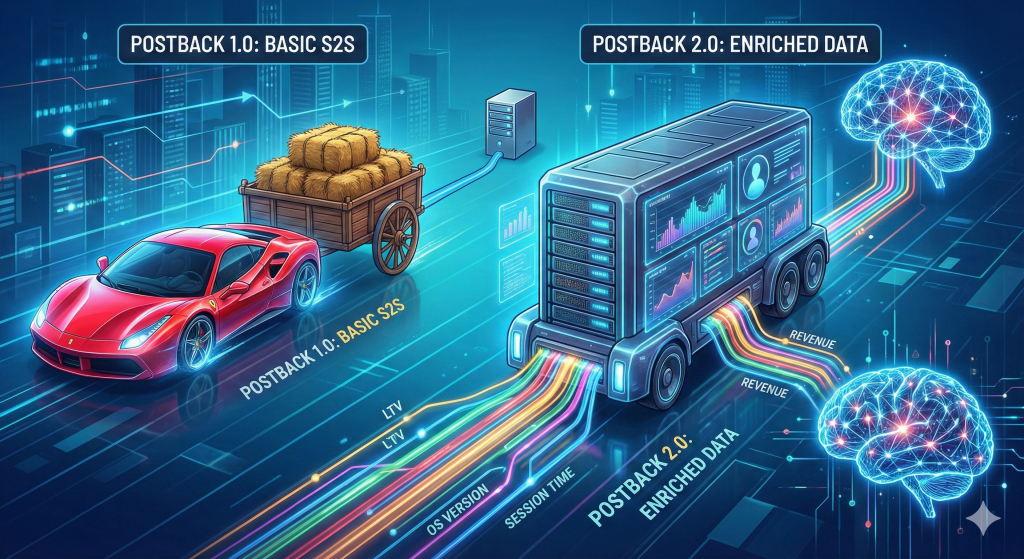
If your Postback is still only transmitting two parameters—click_id and payout—congratulations: you are using a Ferrari to haul hay.
In the early days of affiliate marketing, this was enough to balance the books. But in 2026, where campaign optimization is driven by Machine Learning (ML) algorithms, a binary signal of “conversion happened / didn’t happen” is critically insufficient.
Let’s dive into Postback 2.0 and how to turn your tracker into a high-octane control panel for neural networks.
The Problem with “Empty” Postbacks
A standard S2S (Server-to-Server) postback tells the network: “A user with this ID completed the target action.”
The ad network’s neural network sees this and tries to find similar users. But it misses the most important detail: Was it a high-quality user?
- User A: One $10 deposit from a player who never opens the app again.
- User B: One $10 deposit from a player who spent 2 hours in the app and downloaded 3 more of your offers.
For an old-school postback, these events are equal. For Postback 2.0, they are worlds apart.
What You Should Be Sending: Beyond the Click Price
To ensure that optimization algorithms (like CPA Goal or Smart Optimization) in networks like GTaro Ads work at full capacity, you need to enrich your data. Here are the critical parameters:
1. Value (LTV and Revenue)
Instead of a fixed payout, transmit the actual revenue generated.
Why: This allows the neural network to optimize for ROAS (Return on Ad Spend) rather than just the number of leads. The algorithm will start buying more expensive traffic that yields higher profits and cut off “cheap but empty” traffic.
2. Technical Metadata (OS Version, Device Age)
Transmit the exact OS version (e.g., iOS 19.4.2) and, if possible, the device’s release year.
Why: In Tier-3 countries, the gap in purchasing power between Android 10 and Android 15 is a canyon. The neural network will quickly realize that owners of newer flagships convert 5x better and will reallocate your budget accordingly.
3. Behavioral Markers (Session Duration)
How long did the user spend on the lander before converting?
Why: This is the ultimate anti-fraud signal. If a conversion happens 0.5 seconds after the click, it’s a bot. By passing session time, you train the network to automatically blacklist such placements.
Comparison: Postback 1.0 vs. Postback 2.0
| Parameter | Postback 1.0 | Postback 2.0 |
| Signal | Fact of event | Depth of event + Quality |
| Optimization | By placement (Black/White lists) | By predictive models (Look-alike) |
| Data Sent | status=lead&payout=5 | event=dep&val=50&time_on_site=120&os_v=19.1 |
| Result | Linear growth | Exponential scaling |
Technical Setup: How to Do It
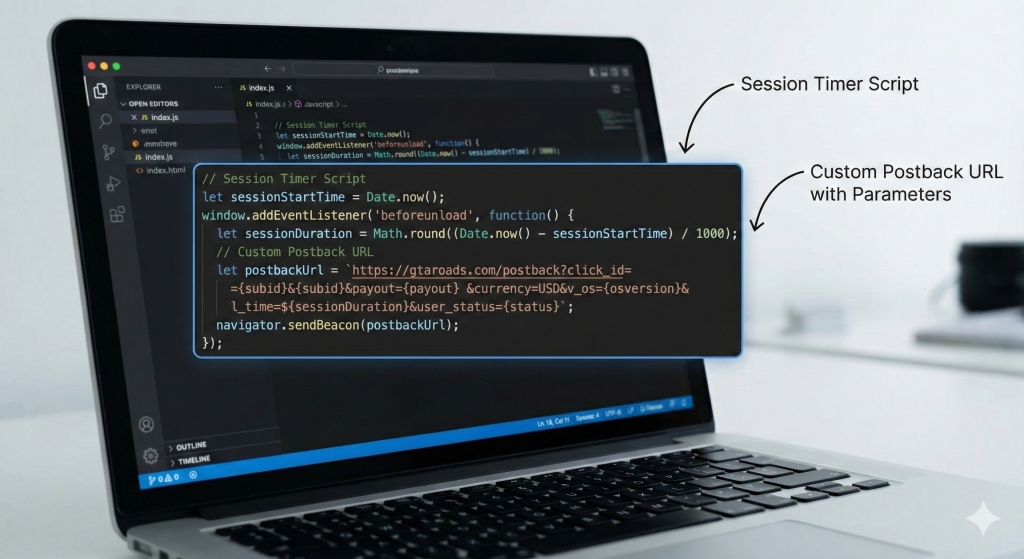
Most modern trackers (Keitaro, Binom, Voluum) allow you to add custom parameters to your postback URL.
Where do you get the data?
- Lander Scripts: Use a simple JS snippet to measure how long a user stays on the page and pass it to the tracker via a
sub_id. - Advertiser API: Negotiate with affiliate programs to pass additional statuses (not just “deposit,” but “re-deposit,” “VIP status,” etc.).
How the Neural Network Uses This Data
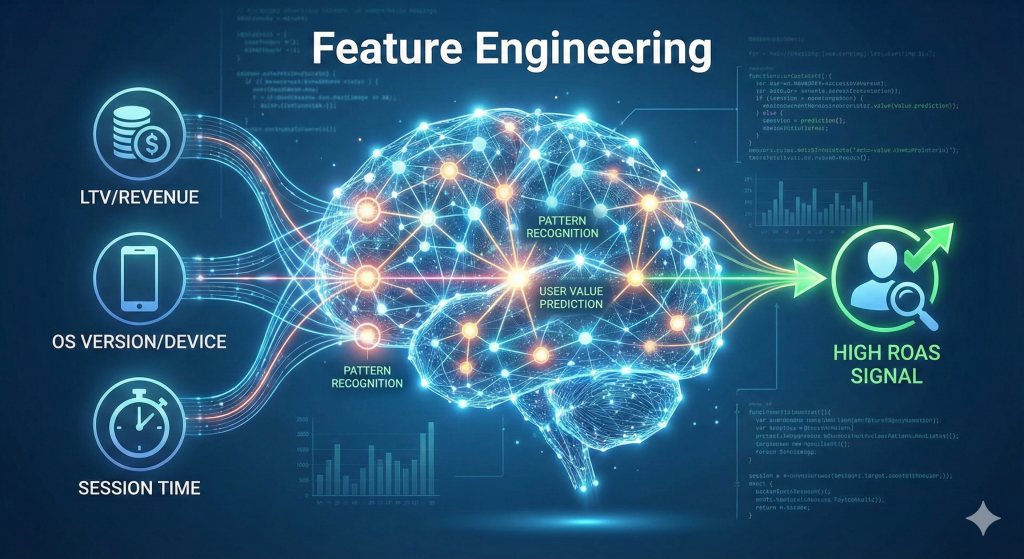
When you pass enriched data, the ad network performs a bit of magic called Feature Engineering. The algorithm builds a multi-dimensional map.
For example, it might spot a hidden correlation:
“Users from Vietnam on Chrome 124 with a session time of over 40 seconds generate 300% more profit.”
Without Postback 2.0, this pattern remains invisible. With it, the neural network will automatically start aggressively outbidding competitors for this specific slice of traffic, skyrocketing your ROI without you lifting a finger.
The Verdict: Data is the New Oil
In 2026, the winner isn’t necessarily the one with the best creative (though it helps), but the one who “trains” the ad network’s algorithms the fastest and most accurately. Switching to Postback 2.0 isn’t an analyst’s whim—it’s a survival requirement.
FAQ
- What is Postback 2.0 and how does it differ from standard S2S?
Postback 2.0 is an advanced server-to-server (S2S) data solution that allows marketers to send more granular conversion events and user-level data, improving accuracy over traditional S2S postbacks, which often provide limited insight. - Why is standard S2S insufficient for precise analytics?
Standard S2S lacks real-time tracking, limited event granularity, and often misses user-level attribution, leading to incomplete analytics and inaccurate marketing decisions. - What benefits does Postback 2.0 offer marketers?
Postback 2.0 provides precise event tracking, real-time updates, better attribution, and enhanced optimization capabilities, allowing marketers to make data-driven decisions with higher confidence. - Can Postback 2.0 integrate with existing marketing platforms?
Yes, Postback 2.0 is designed to integrate seamlessly with major ad networks, analytics tools, and CRM systems, ensuring smooth migration from standard S2S setups. - How can businesses implement Postback 2.0?
Businesses can implement Postback 2.0 by updating their server integrations, configuring advanced event mapping, and collaborating with their analytics or ad partners to ensure full data flow and tracking accuracy.