In affiliate marketing, the question is no longer whether Push and Popunder traffic work. The real question is how to run them: do you put both formats into one campaign, or split them? If you mix them wrong, you can ruin your stats, confuse the algorithms, and burn the budget. If you structure everything correctly, the Push + Pop combo gives you cheap reach and a solid conversion rate.
In this article we’ll cover what makes Push and Popunder different, when it’s worth combining formats, when you should strictly separate campaigns, and how to read the numbers so you don’t fool yourself.
Push vs Popunder: What’s the Difference?

Push notifications
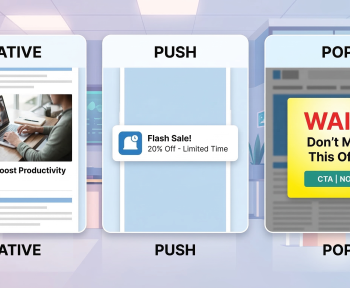
Push is a browser or mobile notification that appears on top of the interface and invites the user to click.
- Appears on top of the interface.
- The user clicks consciously.
- Usually higher CTR but lower volume than pops.
- Traffic is “colder” but often better quality.
Pros:
- Clear click → clear intent.
- You can play with title, icon and image.
- Easier to connect the logic “offer + creative”.
Cons:
- Subscriber bases burn out fast.
- Moderation can be stricter in some networks.
- CPC is usually higher than for pops.
Popunder
Popunder (Pop, ClickUnder) is a page that opens in a new window or tab, or under the active tab after a click on the site.
Pros:
- Huge traffic volumes.
- Very low CPV/CPC, tons of cheap visits.
- Great for broad-funnel offers (sweepstakes, dating, 1-click flow, etc.).
Cons:
- Many “accidental” visits → lots of junk traffic.
- High bounce rate, you need very aggressive landers.
- Mixed with other formats, it heavily distorts your stats.
Golden Rule: Don’t Mix Formats When You Need Clean Analytics
The simplest and most important principle:
If you want a clear picture of each format’s economics, keep campaigns separate.
Push and Pop are priced differently and convert differently. User behavior is different as well: time on site, pages per session, retention. Auto-optimization in ad networks is often tied to traffic type.
If you mix them into one campaign:
- Average CR/EPC becomes “hospital average”.
- You can accidentally kill a Push setup that actually works but is drowned in cheap Pop traffic.
- You can’t properly test landers and pre-landers per format.
So by default, launch Push and Popunder as separate campaigns. Combine them only when you have a clear goal and enough data.
When It Makes Sense to Combine Push + Popunder

Here we’re talking about one strategy, not necessarily one campaign ID in the ad network.
1. Fast testing and raw data collection
Goal: quickly check if an offer, GEO or angle is alive and collect initial statistics.
Launch in parallel:
- a Push campaign;
- a Popunder campaign.
You’re not trying to build perfect ROI yet. You want to see where clicks are cheaper, which format is closer to break even and where you see promising CR.
You can also use hybrid campaigns some networks offer to quickly feed a pixel or Smartlink with mixed traffic, so algorithms can learn faster.
Important: even in hybrid campaigns, always tag the format in your tracking links (for example via sub IDs), so you can break results down later.
2. Scaling an already profitable setup
If you’re already in stable profit on both Push and Popunder — you have working whitelists and blacklists, a winning lander and creatives, and a consistent ROI — you can test a combined campaign.
Create a campaign where formats are mixed, but bids and daily limits are tuned so they don’t kill performance. Use a Smartlink or automation rules that adjust bids and caps based on format and zone.
The idea is to squeeze extra volume from inventory that’s only available in hybrid campaigns, while simplifying operations a bit.
3. Strengthening brand or offer awareness
For some verticals (finance, subscriptions, utilities) it makes sense to use Push as a softer, more conscious contact, and Popunder as a massive follow-up format.
Example flow:
- The user sees or clicks a Push notification with your offer.
- Later, on another site, a Popunder with the same brand or offer hits them again.
Here, formats work together: Push creates the first touch, Popunder closes the funnel and pushes the user to act. Campaigns may be separate, but the strategy is unified.
When You Absolutely Must Separate Campaigns
1. New offer, new GEO, zero statistics
If you’re entering a new GEO, testing a new offer or even a new vertical, you should always separate Push and Popunder.
You need to understand where there is any life at all. It may turn out that Pop brings a lot of cheap but dead traffic, while Push, although more expensive, actually converts. Mixing them might make you conclude the whole setup is bad and kill a format that works.
2. Hard optimization toward specific goals
If your goal is to squeeze every percent from one format — for example to get Push to 120%+ ROI, or make Pop break even on the front end and earn on upsells — then traffic type is a core setting and you must separate campaigns.
Mixing formats confuses auto-rules, breaks LTV calculations per source and makes CPA optimization train on mixed signals.
3. Different funnels for each format
Very often Push performs better with quiz landers, articles and storytelling, while Popunder works better with short, aggressive landers, especially for 1-click or SOI flows.
If you use different funnels or even different offers per format, putting everything into one campaign makes no sense. You won’t understand which “format + lander + creative” combo makes money.
In this case the logical structure is GEO + format + offer or funnel.
4. Different goals for frequency and daily caps
Popunder traffic loves big volumes and high daily caps and can eat your budget in a couple of hours on wide targeting. Push traffic is more predictable, sometimes limited by the subscriber base and often needs frequency caps so you don’t burn the audience.
If you mix formats but want strict frequency control for Push and a lot of volume for Pop, it’s much easier to handle them as two separate campaigns instead of chasing some “average” settings.
Practical Campaign Structure

Level 1: Split by GEO and vertical
Example naming:
- BR – Dating – Push
- BR – Dating – Pop
- MX – Nutra – Push
- MX – Nutra – Pop
Level 2: Split by creative or lander
Inside each format you can duplicate campaigns for different landers or key creatives and label everything in sub IDs (for example: sub1 – format, sub2 – lander, sub3 – creative).
Level 3: Hybrid or combined campaigns
Once you have stable profit, add an extra hybrid campaign like “BR – Dating – Hybrid (Push+Pop)”. Keep the format tags in your tracking link so you don’t lose per-format analytics.
How to Read the Data Without Getting Lost
To keep your decisions data-driven, calculate metrics separately.
- CR, EPC, CPA and ROI per format – Push and Pop must be separated, even inside hybrid campaigns.
- Average cost per lead on offer/GEO level – so you see which format drags results down or boosts them.
- Behavior metrics – time on site, page depth, share of returning users (where analytics is available).
Some quick rules of thumb:
- If EPC Push > EPC Pop and Push CPC is not much higher, it’s worth leaning into Push.
- If Pop EPC is lower but CPA is still the cheapest, keep Pop as your volume workhorse and use Push as a quality add-on.
- If formats bring very different user profiles in terms of upsells or retention, think in terms of LTV, not only front-end conversions.
Common Mistakes With Push + Popunder
- Throwing everything into one campaign for convenience. You don’t know what actually works, and every optimization step is guesswork.
- Judging only by overall stats. The campaign may look negative, while Push alone is profitable and Pop is heavily negative.
- Not tagging the format in tracking links. Even if the network shows the format in its interface, double-tag it in subs, especially when you use a tracker or Smartlink.
- Using the same lander for both formats without tests. Pops often need very fast, lightweight landers with minimum text and maximum hooks, while Push can work fine with longer, story-driven pages.
Quick Checklist: Combine or Separate?
Separate campaigns if:
- You test a new offer, GEO or vertical.
- The goal is precise analytics and fine-tuned optimization.
- You use different landers or funnels for each format.
- You need strict control over daily caps and frequency.
Combine formats (in one strategy or hybrid campaign) if:
- You already have profitable, well-tested setups for each format.
- You want extra volume and simpler operations.
- You use Smartlink or auto-optimization with plenty of data.
- Your main goal is to warm up pixels or algorithms, not to squeeze every last percent of ROI.
Conclusion
Push and Popunder are not competitors but different layers of the same funnel. The biggest mistake is trying to simplify your life by throwing everything into one pot.
A healthy process looks like this: start with separate Push and Pop campaigns to get clean stats, then optimize each format to profit, and finally add hybrid campaigns and combined funnels — without losing per-format analytics.
If you treat both formats as complementary tools instead of rivals, the Push + Pop combo can become one of the most efficient engines for scaling your affiliate campaigns.