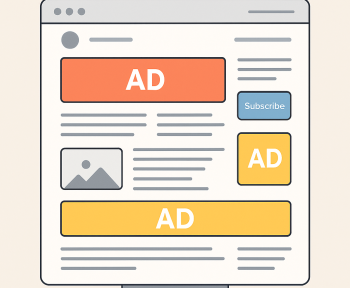
Choosing the right banner ad size is a crucial step in building a successful online advertising campaign. The effectiveness of your message, visibility, and click-through rate (CTR) largely depend on the correct banner ads sizes. Although new digital formats continue to appear, most advertisers in 2025 still rely on several standard advertising banner sizes that have proven to perform best across devices and platforms.
Why Banner Ad Sizes Matter
Accurate banner ad dimensions ensure that your creatives display correctly across various websites, load quickly, and meet ad network requirements. Using the wrong advertisement size can distort visuals, break layouts, or cause rejection from platforms like Google Ads or Meta.
Standard advertising sizes allow you to reuse designs efficiently across publishers and networks, making your campaigns more scalable and cost-effective. In short, understanding standard web banner size options helps you save time and improve ad performance.
8 Most Popular Banner Ad Sizes in 2025
The following table lists the most common banner ad sizes for web and mobile advertising in 2025.
| Rank | Banner Format | Dimensions (px) | Typical Placement | Description |
|---|---|---|---|---|
| 1 | Medium Rectangle | 300 × 250 | In-article, sidebar | The most popular banner ad size; performs well on both desktop and mobile. |
| 2 | Leaderboard | 728 × 90 | Top of page | A traditional website advertising banner size placed above the fold. |
| 3 | Large Rectangle | 336 × 280 | Content areas | A slightly bigger rectangle with stronger visual impact. |
| 4 | Half Page / Large Skyscraper | 300 × 600 | Sidebar | Offers rich visual storytelling and brand exposure. |
| 5 | Mobile Leaderboard | 320 × 50 | Mobile header or footer | One of the most common banner ad sizes for smartphones. |
| 6 | Billboard | 970 × 250 | Top of page | Premium format for maximum visibility and awareness. |
| 7 | Skyscraper | 160 × 600 | Right sidebar | A classic online banner size for sustained visibility. |
| 8 | Square / Small Square | 250 × 250 / 200 × 200 | Apps, sidebars | Compact digital banner sizes suitable for small placements. |

Detailed Overview of Each Format
- Medium Rectangle (300×250) – This ad banner size remains the industry standard in 2025. It’s flexible, easy to integrate, and widely accepted by publishers.
- Leaderboard (728×90) – This standard ad size dominates desktop layouts, providing strong top-page visibility and branding opportunities.
- Large Rectangle (336×280) – A larger version of the medium rectangle, allowing better creative expression and readability.
- Half Page (300×600) – This website banner ad size delivers high engagement through a taller, eye-catching format perfect for visual storytelling.
- Mobile Leaderboard (320×50) – A must-have for responsive campaigns. This ads banner size loads quickly and adapts perfectly to mobile environments.
- Billboard (970×250) – A premium advertising banner size ideal for large-scale brand awareness campaigns on high-traffic sites.
- Skyscraper (160×600) – A traditional web ad size that remains effective for long-term exposure along content pages.
- Square (250×250) – Compact but effective; perfect for side placements and mobile app inventory.
Typical Web Banner Sizes by Platform
| Platform | Recommended Formats | Description |
|---|---|---|
| Google Display Network | 300×250, 728×90, 160×600, 300×600 | The foundation of most standard advertising banner sizes. |
| Facebook / Meta Ads | 1200×628, 1080×1080 | Focus on aspect ratio consistency rather than pixel size. |
| YouTube / Video Partners | 300×60, 468×60 | Lightweight internet banner sizes optimized for video pages. |
| Mobile Apps | 320×50, 300×250 | Typical ad sizes for responsive and fast-loading mobile experiences. |
| E-commerce Websites | 336×280, 970×250 | Designed for maximum product visibility and conversion. |
Standard Advertising Banner Sizes and Aspect Ratios
| Format | Dimensions (px) | Aspect Ratio | Common Use |
|---|---|---|---|
| Leaderboard | 728×90 | 8:1 | Desktop branding and awareness |
| Medium Rectangle | 300×250 | 1.2:1 | Multi-device compatibility |
| Half Page | 300×600 | 1:2 | Visual storytelling campaigns |
| Billboard | 970×250 | 3.9:1 | Premium brand campaigns |
| Mobile Leaderboard | 320×50 | 6.4:1 | Mobile app and site headers |
| Skyscraper | 160×600 | 1:3.75 | Sidebar engagement |
| Square | 250×250 | 1:1 | Compact, secondary placements |
Understanding these website advert sizes and typical web banner sizes helps advertisers maintain sharp, professional visuals across all channels.
Common Mistakes When Choosing Banner Ad Sizes
- Ignoring standard ad sizes and using nonstandard formats that limit reach.
- Forgetting to optimize for mobile, missing key website ads size opportunities.
- Overloading the design with text or visuals, even on ideal web banners sizes.
- Scaling images incorrectly, leading to distorted digital banner dimensions.
Best Practices for 2025
- Design in multiple website advertising banner sizes to support responsive layouts.
- Always check ad network requirements for the correct banner specs.
- Keep file sizes light to ensure fast loading on all devices.
- Use consistent branding across all online banner ad sizes for recognition.
- Test performance metrics of common banner ad sizes before scaling campaigns.
FAQ: Banner Ad Sizes in 2025
1. What is the most common banner size today?
The 300×250 medium rectangle remains the most common banner size used across both desktop and mobile.
2. What are the standard web banner sizes for Google Ads?
The most common banner ad sizes include 300×250, 728×90, 160×600, and 300×600 pixels.
3. Which banner ad dimensions are best for mobile devices?
The 320×50 and 300×250 formats are the most popular banner sizes for mobile screens.
4. What’s the difference between ad banner sizes and advertisement banner size?
Ad banner sizes refer to the various pixel dimensions available, while advertisement banner size often refers to a specific format used in a campaign.
5. What is the best banner size for high visibility?
Billboard (970×250) and Half Page (300×600) banners provide the highest visibility among all digital banner sizes.
6. Do website advert sizes change often?
Not significantly. Standard ad sizes have remained stable for years, though new responsive formats continue to appear.
7. What are typical ad sizes for online display advertising?
Typical ad sizes include 300×250, 728×90, 336×280, and 160×600 – all considered common banner ad sizes globally.
Final Thoughts
Understanding standard ad sizes and popular banner formats allows advertisers to create visually consistent, high-performing campaigns. Whether you’re working with web ad sizes, digital banner sizes, or online banner ad sizes, choosing the right dimensions ensures your message stands out across every screen and platform.