In the world of programmatic advertising, there is an age-old debate: should you strive to enter the “inner circles” of Private Marketplaces (PMP) or embrace the vast horizons of the Open Auction?
Many advertisers mistakenly believe that PMP is always “premium and better,” while the Open Auction is just “remnant traffic and noise.” In reality, the truth is far more nuanced. Let’s break down when it’s time to drop the elitist mask and trust the open market.
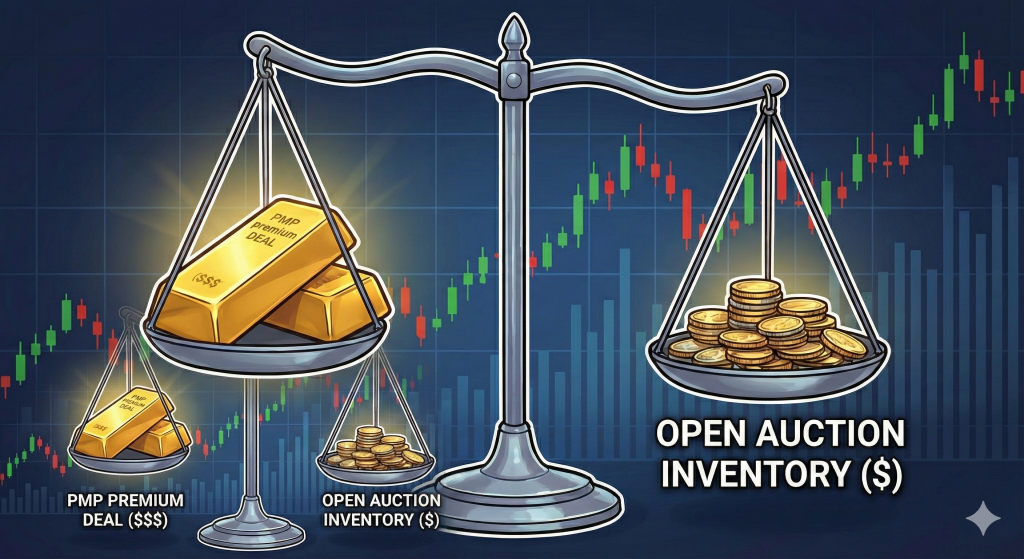
The Basics: Who is Who?
Before diving into strategy, let’s quickly refresh the terminology:
- Open Auction (RTB): The “Wild West” where anyone can bid on any impression. It offers maximum competition, the lowest prices, and massive scale.
- PMP (Private Marketplace): An invitation-only auction. The publisher grants select buyers priority access to their inventory, often at a fixed price or with higher priority via a Deal ID.
Why PMP Isn’t Always the Panacea
PMP is often sold as the “safe and high-quality” way to buy. However, it has a downside that sales reps rarely mention:
- Exclusivity Premium: You pay a markup just for the right to be on the list. Often, the exact same inventory is available in the Open Auction, but at a significantly lower cost.
- Low Fill Rates: In a PMP, you are limited to the inventory of a single or a few publishers. Scaling is difficult—sometimes your budget simply won’t spend because the pool is too small.
- The Quality Illusion: “Private” doesn’t always mean “converting.” You might buy an expensive slot on the homepage of a major news outlet, only to see zero ROI due to banner blindness or poor ad placement.
4 Scenarios Where Open Auction Wins
1. When Your Main Goal is Performance and ROI
If your objective is driving actual sales, registrations, or app installs rather than just “brand awareness,” the Open Auction almost always wins. DSP (Demand Side Platform) algorithms thrive on large datasets. In an open auction, the system has millions of options to find your user at the lowest possible price. In a PMP, the sample size is often too narrow for effective AI optimization.
2. When You Need Massive Scale
If you are launching a nationwide reach campaign, a PMP physically cannot provide the necessary volume. The Open Auction provides access to roughly 90% of all global inventory, allowing you to “catch” your target audience even on niche but high-quality sites.
3. When Working with Limited Budgets
The math is simple. In the Open Auction, the price is determined by the market in real-time. While a PMP might have a $5.00 floor price, you can often find the same audience in the open market for $1.50 – $2.00.
4. Testing Hypotheses
Before committing $10,000 to a direct deal with a publisher via PMP, it’s logical to test their inventory through the Open Auction first. If the metrics (CTR, CPA) look promising, only then should you move to a formal Deal ID.
Comparison: Open Auction vs. PMP
| Feature | Open Auction | Private Marketplace (PMP) |
| Price (CPM) | Low / Market-driven | High (Premium) |
| Reach | Maximum | Limited |
| Targeting | Data-driven | Context-driven (Publisher) |
| Setup | Instant | Requires Deal ID negotiation |
| Transparency | Moderate (needs filters) | High |
The Golden Mean: A Hybrid Approach
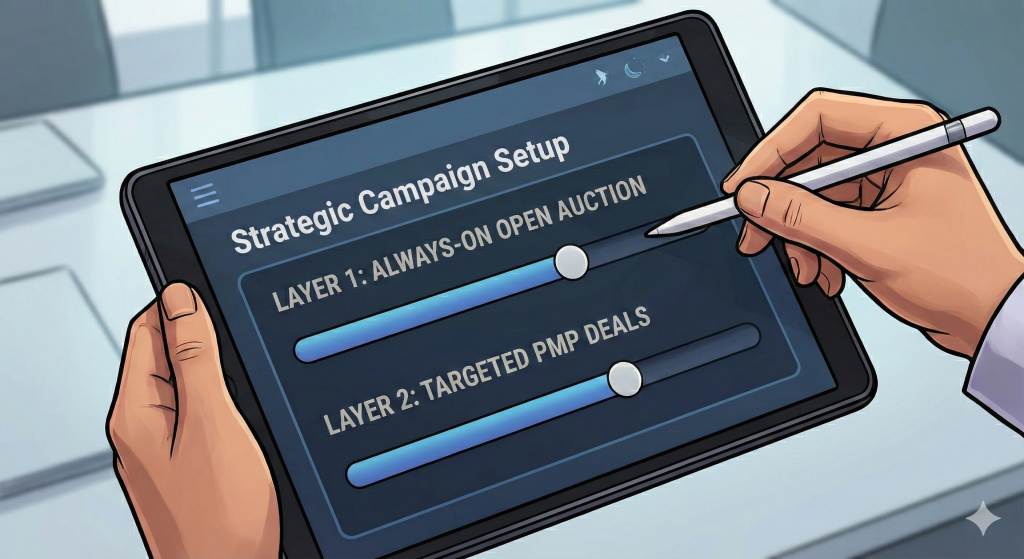
You don’t have to choose just one. The best strategy is a calculated balance:
- Always-on Open Auction: Use this as your foundation for finding conversions and achieving cost-effective reach.
- PMP for Special Tasks: Trigger deals only when you need a specific format (e.g., a site skin or native video) that isn’t available in the general stream.
Pro Tip: To ensure your Open Auction spend stays clean, always use robust Allow-lists and third-party verification tools (like DoubleVerify or IAS) to mitigate ad fraud.
Summary
The Open Auction is more profitable than PMP in the majority of cases involving pragmatic, results-oriented marketing. It offers flexibility, massive data, and fair market pricing. PMP remains a tool for high-level branding and securing truly scarce inventory.