
In 2025 a blog is a revenue engine—not just a content archive. The most profitable formats combine (1) strong commercial intent, (2) diversified monetization, and (3) repeatable publishing systems. Below are eight blog types that consistently earn, with positioning, monetization paths, editorial patterns, SEO guidance, KPIs, tech stack, and risks.
Quick Selection Framework (use before choosing a niche)
Market viability
- Clear transactions exist (purchases, demos, bookings)
- 2 monetization levers (affiliate + services/products/sponsorship)
- Search volume with buying intent (best, vs, pricing, near me)
Defensibility
- Expertise or access (proprietary tests, local vendors, datasets)
- Ability to ship original assets (photos, benchmarks, calculators)
- Email/owned distribution to reduce reliance on algorithms
Operational fit
- Content can be templated (SOPs for “Best X for Y” / city pages)
- You can obtain or generate the required evidence/data
- Reasonable time-to-revenue (<90 days for first income)
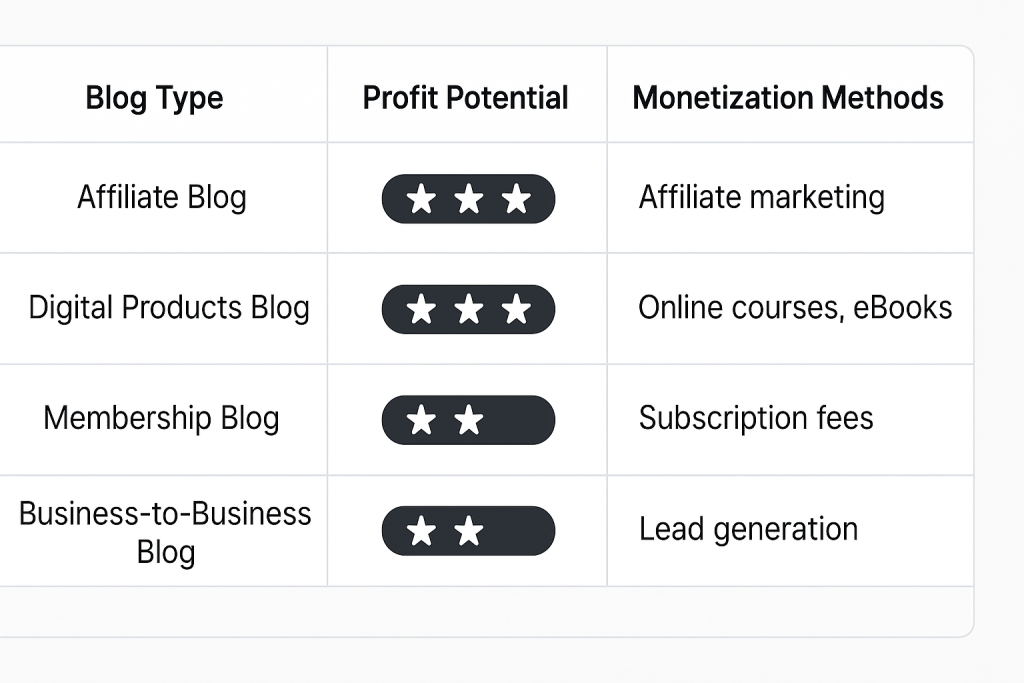
1) Product Review & Comparison Blogs
Positioning: “Independent lab-style reviews for [category] that show exactly how we test.”
Monetization
- Affiliate programs (retailers, direct-to-brand, SaaS referrals)
- Sponsored placements in roundups (disclose clearly)
- Lead-gen to vendors for high-ticket categories (B2B gear, pro tools)
Editorial Patterns
- Evergreen hubs: “Best [Category] 2025”
- Comparison battles: “[Model A] vs [Model B]”
- How we test: methodology page with scoring rubric and weights
- Update cadence: refresh top 10% pages every 4–8 weeks
SEO & UX
- Schema:
Product,Review,AggregateRating,FAQ - Comparison tables above the fold; sticky TOC; jump links
- Add “Why you can trust us” block (team, lab photos, test logs)
KPIs
- SERP CTR, affiliate outbound CTR (10–25% typical for high intent), EPC, RPM
- Returning reader rate (evidence of brand trust)
- % pages with original images/metrics (a quality control proxy)
Risks & Mitigation
- Risk: Commodity “AI summaries.”
Mitigation: publish unique test data, teardown photos, or performance charts. - Risk: Overreliance on one affiliate network.
Mitigation: diversify, negotiate direct deals for higher rev-share.
Lightweight Real-World Examples (for inspiration)
- Niche hardware review sites that publish own photos and measured charts
- SaaS comparison blogs that share feature-by-feature matrices + test projects
Tech Stack
- WP + GeneratePress/Block theme (fast) or Next.js static
- Affiliate link manager (Pretty Links / ThirstyAffiliates)
- Airtable/Notion → HTML tables; Cloudflare Images for originals
2) B2B Solution Blogs
Positioning: “Operational playbooks, calculators, and case studies that increase revenue or efficiency.”
Monetization
- High-ticket leads (consulting, audits, implementations)
- Paid templates (Notion, Sheets, SOP packs), workshops
- Tool sponsorships (monthly placements in applicable posts)
Editorial Patterns
- Playbooks: “Partner Program in 7 Days (SOP + email templates)”
- Case studies: before/after metrics; screenshots of dashboards
- Calculators: CAC, LTV, payback, AB-test sizing
- Buyer’s guides: “RFP checklist for [category] vendors”
SEO & Distribution
- Capture mid/bottom-funnel terms: “pricing,” “RFP,” “implementation,” “migration”
- Programmatic “Template × Industry” landing pages (manual QA)
- Promote calculators via LinkedIn and targeted communities
KPIs
- Blog → demo conversion (2–5%+), pipeline value from content, SQLs/month
- Template downloads per post, newsletter MQLs
Risks & Mitigation
- Risk: Low credibility.
Mitigation: named authors with bios, client quotes/consent, anonymized but specific numbers.
Tech Stack
- Next.js/WordPress + HubSpot/Close for lead capture
- Embedded calculators (React, or Sheets + Apps Script)
- Email automation (ConvertKit, Brevo)
3) Personal Finance & Fintech Blogs
Positioning: “Evidence-based money decisions for [audience], with clear disclosures and tools.”
Monetization
- Financial product affiliates (cards, brokers, robo-advisors)
- Paid spreadsheets (budgeting, rebalancing), model portfolios
- Premium newsletter tier (deep dives, tax checklists)
Editorial Patterns
- “Best investment accounts for [country/residency] in 2025”
- Tax optimization guides (with disclaimers)
- Portfolio reviews: methodologies and rebalancing logic
Compliance & Trust
- Prominent disclaimers: educational, not advice
- Link to sources; avoid promissory language
- Privacy-first analytics, cookie transparency
KPIs
- RPM (often substantially higher than general niches)
- Newsletter open >40%, click 8–15%, free→paid conversion
Risks & Mitigation
- Risk: Regulatory scrutiny.
Mitigation: review wording, avoid recommendations; present frameworks, not prescriptions.
Tech Stack
- Static site/fast WP + privacy-friendly analytics (Plausible/Matomo)
- Gumroad/Lemon Squeezy for digital downloads
- Airtable/Notion databases for product comparisons and rate changes
4) Creator Economy & Skills Blogs
Positioning: “Practical skills that directly earn income for creators and freelancers.”
Monetization
- Cohort workshops, async courses
- Templates (Figma, Notion, Canva), LUTs/presets
- Paid community (Discord/Telegram) with office hours
Editorial Patterns
- Zero-to-one tutorials (e.g., “From first brief to paid UGC in 7 days”)
- Execution packs: “30 Reels prompts for cafés,” “Agency proposal bundle”
- Student case studies with outcomes and artifacts (blur sensitive data)
SEO & Distribution
- Long-tail “how to + tool + niche” queries
- Short-form video (YouTube Shorts/IG Reels) → email capture
- “Resources” hubs that interlink to templates and courses
KPIs
- Blog→email conversion (4–10%); email→purchase (2–8%)
- Community retention, NPS, LTV
Risks & Mitigation
- Risk: Crowded niches.
Mitigation: niche down by industry/use case; prove outcomes via student assets.
Tech Stack
- Ghost/WordPress + Memberful/ConvertKit Commerce
- Lemon Squeezy/Gumroad for digital products
- Circle/Discord for communities
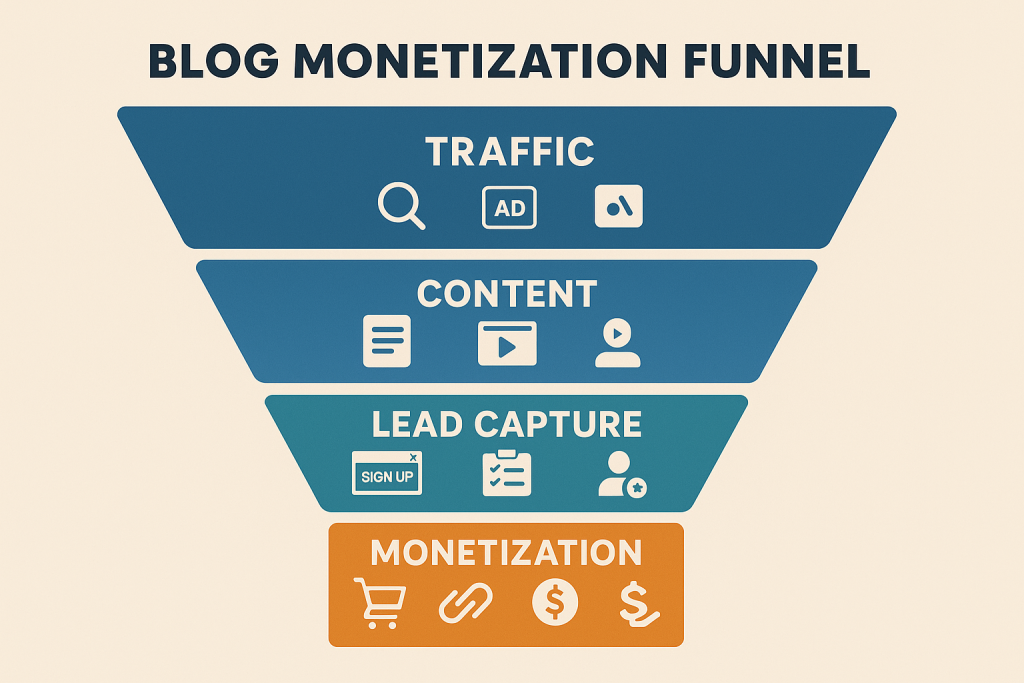
5) Local Lead-Generation Blogs
Positioning: “Trusted local guide connecting residents with vetted providers.”
Monetization
- Sell qualified leads (call tracking + forms)
- Referral/retainer agreements with local businesses
- Sponsored placements in city/service directories
Editorial Patterns
- “Cost of [service] in [City] (2025) + timeline & permits”
- “Top 10 [service] in [Neighborhood]” with selection criteria
- Before/after case studies (photos, videos)
SEO & Ops
- Programmatic city × neighborhood × service pages (editorial oversight)
- Google Business Profile optimization, local citations
- Phone call tracking numbers per page; fast mobile UX
KPIs
- Qualified leads/month, revenue/lead, close rate by partner
- Time-to-first-lead (often <30 days in underserved areas)
Risks & Mitigation
- Risk: Lead quality disputes.
Mitigation: shared CRM view, clear qualification rules, refund policy.
Tech Stack
- WordPress/Next.js + Gravity/Typeform + CallRail
- Airtable CRM for lead routing
- Local photo/video assets (authenticity signal)
6) Niche Health & Wellness Blogs
Positioning: “Narrow, evidence-informed protocols with practical tracking tools.”
Monetization
- Paid programs/plans (PDF/Notion) and trackers
- Affiliate devices (sleep trackers, lights), supplements (careful claims)
- Coaching/telehealth if licensed
Editorial Patterns
- “21/30-day roadmaps” with habit trackers and troubleshooting
- Device comparisons with measurement criteria
- Research explainers translated into practical steps
Compliance & Trust
- Medical disclaimers; cite sources; avoid disease claims
- Show methodology; avoid one-size-fits-all
KPIs
- Program conversion, plan completion rate, repeat visits
- Newsletter growth; coaching consults
Risks & Mitigation
- Risk: Medical claims.
Mitigation: educational framing, references, encourage clinician consultation.
Tech Stack
- Fast site + gated downloads (Lemon Squeezy)
- Notion templates for trackers; simple mobile-friendly PDFs
- Consent-based email onboarding
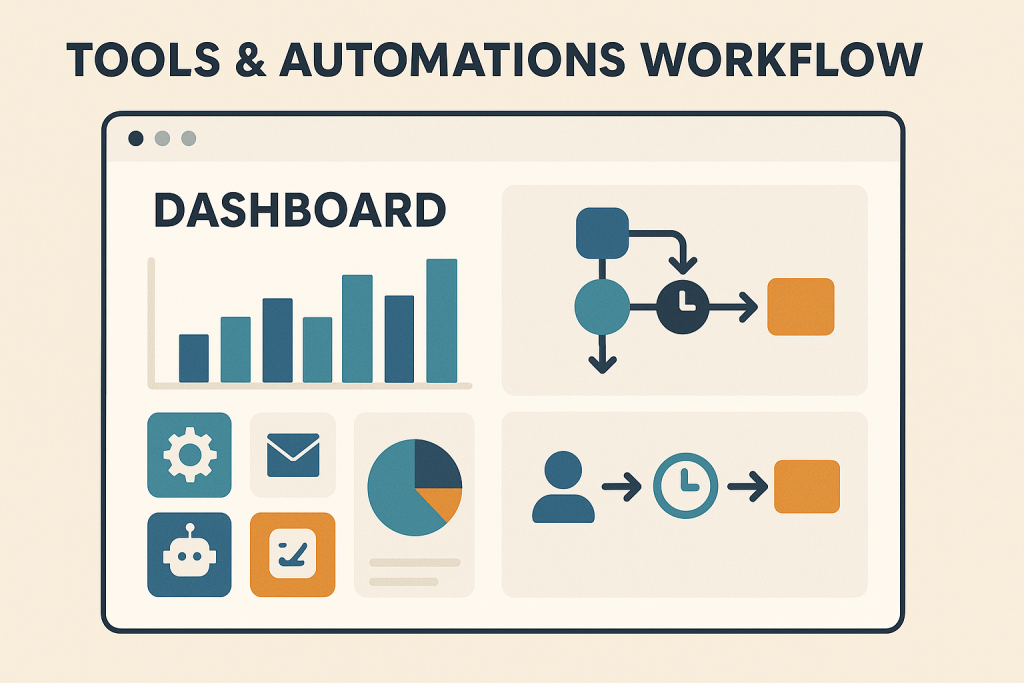
7) Tools & Automations Blogs (AI, no-code, integrations)
Positioning: “Documented workflows that save time or unlock new capability.”
Monetization
- SaaS affiliates (automation suites, AI tools)
- Paid workflow packs/scripts
- Implementation consulting and ongoing retainers
Editorial Patterns
- Step-by-step recipes: “When X happens in Y, do Z and alert Slack”
- “50 automation ideas for [role]” (marketing, ops, finance)
- ROI case studies with before/after time or cost savings
SEO & Distribution
- Target “integration,” “workflow,” “template,” “automation” queries
- Publish GitHub gists/snippets; embed Loom demo videos
- Maintain a searchable playbook directory
KPIs
- Downloads/installs, demo bookings, affiliate MRR
- Time saved per workflow (case study metric)
Risks & Mitigation
- Risk: Vendor API/policy changes.
Mitigation: version pages, changelog newsletter, update SLAs for clients.
Tech Stack
- Docs site (Docusaurus/Next.js) + code snippets
- Airtable/DB for workflow gallery
- Scheduler for demos (Cal.com)
8) Newsletter-First Media (Blog as SEO archive)
Positioning: “Insightful, consistent briefings with a practical edge; the blog is the indexed archive.”
Monetization
- Newsletter sponsors (banner + native spotlights)
- Paid tier for deep dives, templates, datasets
- Affiliate listings in curated tool roundups
Editorial Patterns
- Weekly digest (what changed + what to do)
- Series-based mini-courses (4–6 email lessons)
- Expert interviews with “action items” sections
SEO & Distribution
- Each issue → evergreen blog post with optimized H2/FAQ
- Category hubs: “All [Topic] Briefings”
- Grow via cross-promotions, referral programs
KPIs
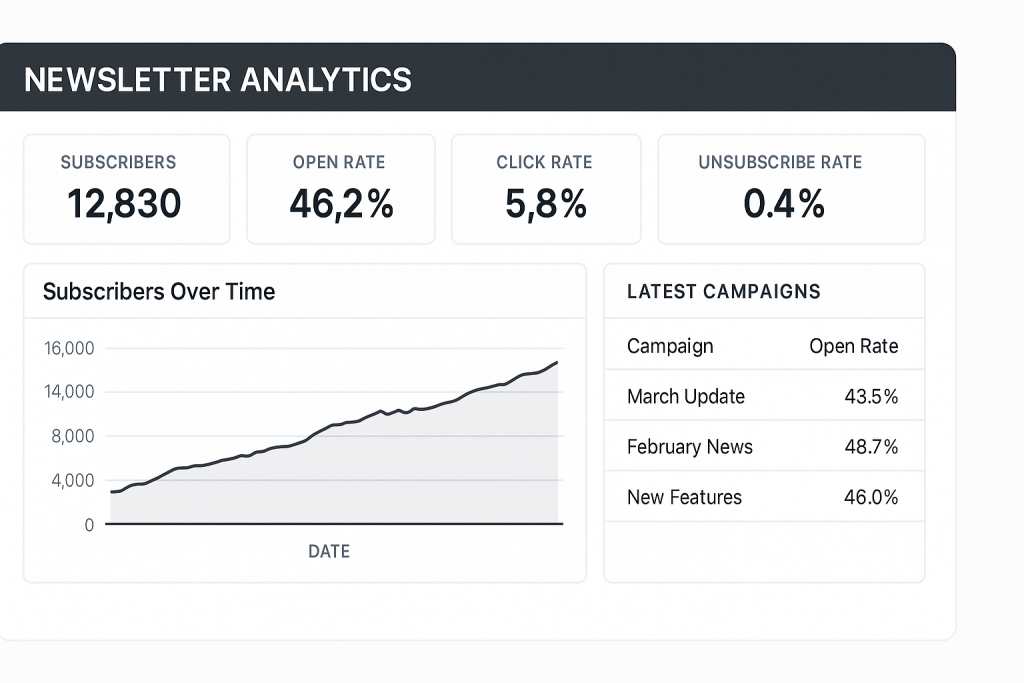
- Open rate (35–55%), click rate (5–12%)
- Revenue per issue, subscriber growth, churn
Risks & Mitigation
- Risk: Burnout/inconsistency.
Mitigation: editorial calendar, contributor program, templated sections.
Tech Stack
- Beehiiv/ConvertKit/Ghost for email + paywall
- Sponsorship management sheet/CRM
- UTM discipline for source attribution
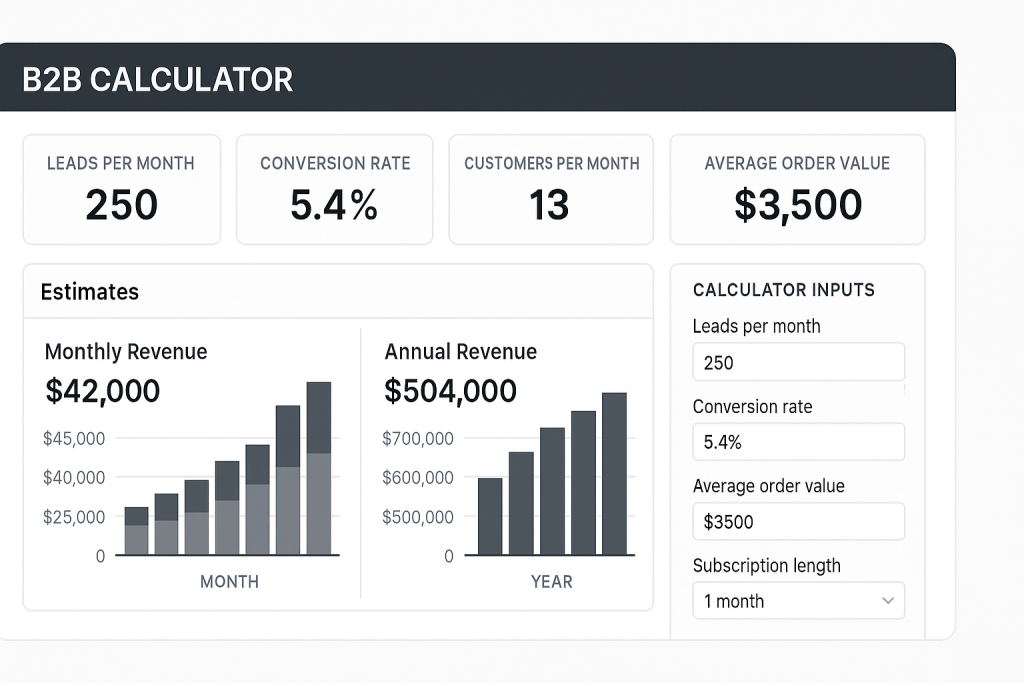
Monetization Mix: Short / Mid / Long Horizon
| Horizon | Primary Levers | Typical Time-to-Impact | Notes |
|---|---|---|---|
| Short (2–6 weeks) | Affiliates, lead-gen, consulting, paid templates | Fast | Requires high-intent topics or existing audience |
| Mid (1–3 months) | Sponsorships, workshops, workflow packs | Medium | Needs consistent output + list growth |
| Long (3–12 months) | SEO scale, communities, licensing | Slower | Compounding returns; defensibility grows |
SEO in 2025: Practical Guardrails
- Human-first specificity: publish original data (photos, benchmarks, call transcripts, quotes with permission)
- Experience signals (E-E-A-T): authorship, methodology, credentials, client logos/quotes (with consent)
- Programmatic, not generic: matrix pages (Persona × Task × Tool × Geo) with human QA
- Internal links: intent-based clusters (hub ↔ spokes); breadcrumbs; “related items” curated, not auto-only
- Answer engines: concise summaries, bulleted takeaways, tables, and FAQ schema for AI-assisted search
Content Operations: Roles, Cadence, and QA
Lightweight team
- Managing editor (calendar, briefs, QA)
- SME author(s) or researcher(s)
- Designer for tables/charts; part-time dev for tools
- Outreach/partnerships (affiliates, sponsors, vendors)
Cadence suggestions
- Reviews/Comparisons: 2–4 core pieces/month + refreshes
- B2B: 2 playbooks or case studies + 1 calculator/month
- Newsletter-first: 4–8 issues/month (some shorter)
QA checklist (per post)
- Meets intent; says something new (data, images, measurements)
- All claims sourced; disclaimers where needed
- Tables readable on mobile; jump links work
- CTAs visible and relevant (email, demo, buy)
- Update date and change log added
Sample Scoring Rubric (Reviews/Comparisons)
| Criterion | Weight | Measurement Method |
|---|---|---|
| Core performance | 35% | Benchmarks or scenario tests with repeatable steps |
| Build/UX | 15% | Ergonomics checklist + defect tracking |
| Reliability | 15% | Return/failure reports, warranty, support audit |
| Ecosystem | 15% | Accessory/plug-in availability, integrations |
| Value | 20% | Price vs nearest alternatives; TCO over 24 months |
Publish this rubric on your methodology page and reference it in each review.
90-Day Launch Plan (ready-to-use)
Weeks 1–2: Foundation
- Pick blog type(s) and sub-niche using the Selection Framework
- Define 20 “money keywords” (commercial intent) + 20 supporting how-tos
- Set up stack: fast theme, analytics (GA4 + Plausible), link manager, email tool
- Create trust pages: About (credentials), Methodology, Disclosure, Contact
- Draft on-page templates (review, comparison, case study, city page)
Weeks 3–6: Core Publishing
- Publish 8–12 core posts (mix of hubs + comparisons/how-tos)
- Launch lead magnet (template, checklist, calculator)
- Integrate 2–3 affiliate programs; track outbound clicks and EPC
- Ship one “flagship asset” (calculator, dataset, or teardown)
Weeks 7–10: Scale & Partnerships
- Programmatic cluster (10–30 pages) with editorial QA
- Outreach for 3–5 sponsorship tests or vendor co-marketing
- Add short videos for top posts (embed and syndicate)
- Implement internal link updates and related posts logic
Weeks 11–13: Optimization & First Product
- A/B test tables/CTAs on top 5 posts
- Launch first digital product (template pack, workshop)
- Refresh top performers; add FAQ blocks based on Search Console queries
- Document SOPs; create an editorial calendar for Q2
Revenue Model Template (fill this in)
| Stream | Price/Rate | Conversion Assumption | Monthly Volume | Est. Monthly Rev |
|---|---|---|---|---|
| Affiliate – Hardware | 4% avg | 2% outbound→purchase | 400 clicks | $X |
| Affiliate – SaaS | $X MRR share | 3% trial→paid | 40 trials | $Y |
| Lead-gen | $50/lead | 30 qualified leads | — | $1,500 |
| Sponsorship (newsletter) | $800/issue | 4 issues | — | $3,200 |
| Digital templates | $39 | 1.5% email→buy | 1,500 subs | $877.50 |
| Workshop | $199 | 2 cohorts/qtr | 20 seats/cohort | $7,960 / qtr |
Adjust the assumptions after 30–60 days using observed CTRs and conversion data.
Minimal Governance: Policies You Should Publish
- Disclosure & Ethics: how you test, handle sponsors, returns/exchanges
- Attribution: image rights, AI usage policy (what’s human vs assisted)
- Privacy: analytics, cookies, email data use (plain English version)
- Medical/Financial disclaimers: for relevant niches
Risks Across All Types (and how to hedge)
- Platform dependency: spread traffic across SEO + email + at least one social channel
- Revenue concentration: cap any single partner to <30% of revenue; add backups
- Stagnation: schedule refreshes, add change logs, solicit reader feedback surveys
- Quality drift: maintain rubrics, peer review, and “stoplight” QA checks
What to Build First (by blog type)
- Reviews/Comparisons: one “Best [Category] 2025” hub + 3 “X vs Y” + methodology page
- B2B Solution: 1 calculator, 1 SOP pack, 2 case studies, 1 landing page for demos
- Finance: tax checklist, broker comparison, budget template, disclaimer page
- Creator Skills: 2 tutorials, 1 idea pack, 1 student case, 1 course outline page
- Local Lead-Gen: 1 cost guide per service, 3 neighborhood pages, vendor intake form
- Health & Wellness: 30-day plan, device comparison, tracker template, sources page
- Tools & Automations: 10 workflows (with gifs), 1 gallery page, 1 services page
- Newsletter-First: welcome sequence (4 emails), weekly cadence, sponsor kit PDF
Final Takeaways
- Profit comes from clear purchase intent + distinctive proof (original tests, tools, case metrics).
- Start with the format that shortens time-to-revenue for your resources:
- Fastest: Reviews/Comparisons, Local Lead-Gen, B2B Solution
- Compounding: Newsletter-First layer for retention and higher LTV
- Build a repeatable system: templates, rubrics, update schedules, and diversified monetization.
Appendices (Copy-Paste Checklists)
Pre-Publish QA (every post)
- Intent satisfied; headline matches search phrasing
- Original photos/data or unique frameworks included
- Table/summary and CTA above the fold
- Schema added; FAQs cover long-tail
- Disclosures and disclaimers (if applicable)
- Internal links to hub/spokes; external reputable sources
- Last updated date + change log
Monthly Ops
- Refresh top performers; improve tables/FAQs
- Add 1 net-new linkable asset (calc, dataset, teardown)
- Outreach to 3 potential sponsors/partners
- Newsletter list hygiene; test subject lines
- Update revenue model with real metrics
Final Thoughts
Profitable blogs in 2025 don’t win by volume—they win by clear purchase intent, defensible proof, and repeatable systems. Pick one or two formats that match your strengths (Reviews/Comparisons, B2B Solutions, or Local Lead-Gen are fastest to revenue), then layer a Newsletter-First engine to compound trust and LTV.
If you do nothing else, do this:
- Choose a tight niche + buyer intent (20 “money” keywords to start).
- Ship proof, not opinions: original photos, benchmarks, calculators, or case metrics.
- Use a standard on-page template (summary → table → deep dives → methodology → FAQs).
- Diversify revenue early: at least two streams (e.g., affiliate + services/templates).
- Own your audience: email list + consistent cadence; blog as the indexed archive.
- Operate like a product team: scoring rubrics, refresh schedules, and clear KPIs.
Focus on one flywheel: a small set of high-intent pages → email capture → a simple offer (template, consult, or demo). When those three links click, scale with programmatic pages (human-QA’d), partnerships, and periodic deep dives. Quality compounds; so do processes.
The Modern Blueprint for a Profitable Blog in 2025
| Focus Area | Core Action | Why It Matters | Next Step |
|---|---|---|---|
| Niche Selection | Choose a focused niche with 20+ high buyer-intent keywords | Ensures fast monetization and clear audience targeting | Validate with keyword tools and competitor scans |
| Content Strategy | Publish proof-based content (photos, tests, data) | Builds defensible trust and higher conversion rates | Replace “opinions” with measurable benchmarks |
| Page Framework | Follow a consistent on-page format: summary → comparison table → deep dive → methodology → FAQs | Simplifies production and improves reader experience | Create a reusable article template |
| Revenue Mix | Start with 2 income streams (affiliate + service/product) | Reduces risk and boosts lifetime value | Add upsells like templates, audits, or consultations |
| Audience Ownership | Build and nurture an email list with a consistent cadence | Protects reach from algorithm changes and compounds trust | Offer a lead magnet and weekly newsletter |
| Operations | Manage content like a product: use rubrics, refresh cycles, and KPI tracking | Keeps performance measurable and scalable | Audit content quarterly; track ROI and conversions |
| Growth Flywheel | Funnel traffic from a few high-intent posts → email opt-in → offer | Creates repeatable, predictable revenue | Optimize these 3 stages before scaling |
| Scale Systems | Expand with programmatic SEO, partnerships, and deep-dive research pieces | Compounds quality and domain authority | Automate templates and QA process for consistency |