When an affiliate marketer hears “Tier-3,” two things usually come to mind: “unlimited traffic for pennies” and “trashy audiences that don’t pay.”
In 2026, this stereotype is costing you money. Regions like Nigeria, Kenya, Vietnam, and Indonesia are no longer the digital periphery—they are massive mobile-first markets with billions of users. Yes, the LTV (Lifetime Value) is lower, but the CAC (Customer Acquisition Cost) is often 50 times cheaper than in the US.
The problem with Tier-3 isn’t a lack of money; it’s the technical barrier between a user’s desire to click and their ability to actually see your offer. Today, we’re breaking down how to crush those barriers using Push notifications and high-performance technical optimization.
The Tier-3 User Reality: Navigating the Digital Jungle
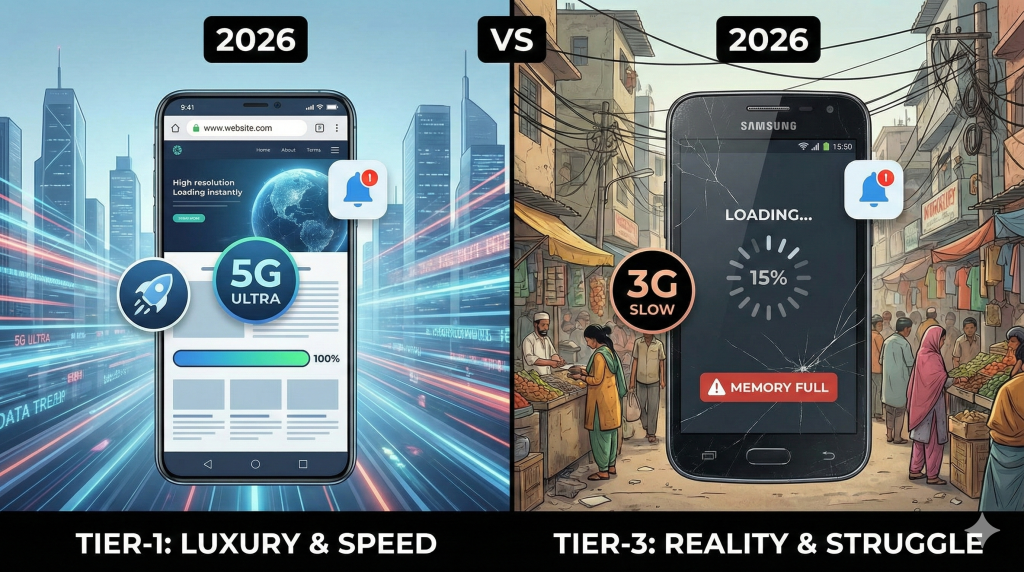
To get a positive ROI in Asia or Africa, you have to step into the user’s shoes. Forget your iPhone 17 Pro and ultra-fast 5G.
Your target audience profile in 2026:
- Device: A 3–4-year-old budget Android (Tecno, Infinix, or an old Xiaomi) with full storage and a struggling processor.
- Connectivity: Unstable 3G/4G. Data is often expensive and sold in small, prepaid bundles. Every megabyte counts.
- Browser: They often use “Lite” browsers like Opera Mini or UC Browser, which aggressively compress traffic and can break complex JavaScript.
The Golden Rule: You aren’t just fighting for the user’s attention; you’re fighting for their smartphone’s limited resources.
Technical Optimization: Speed or Death
In Tier-1, you can afford a heavy React-based landing page with a video background. In Tier-3, if your page doesn’t load within 2.5 seconds, the user is gone. They are used to slow internet, but they won’t wait for your ad.
Your push click “dies” during the “White Screen of Death” phase.
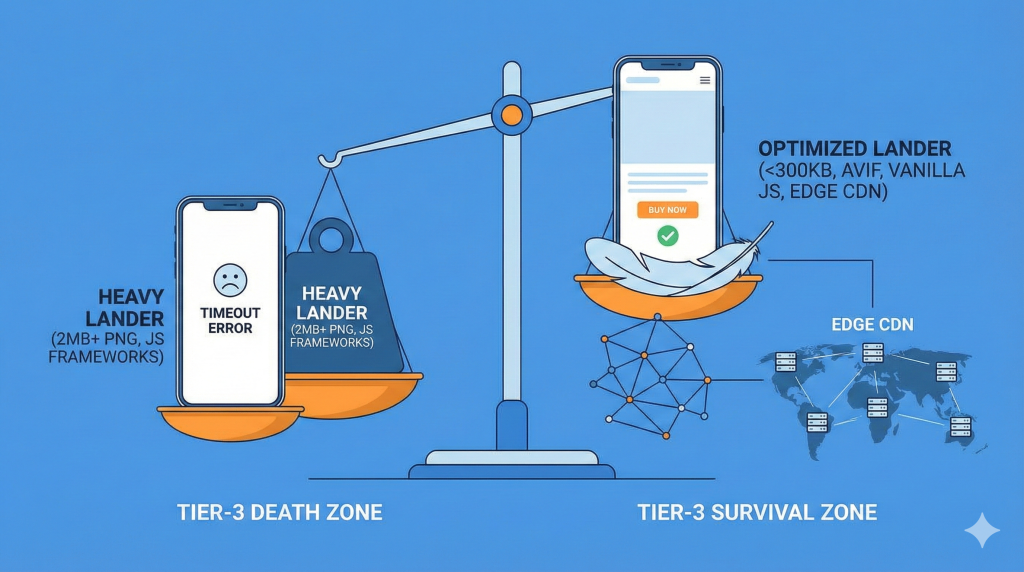
The Survival Checklist for Africa and Asia:
- Extreme Content Diet:
- The total page weight (pre-lander + lander) must not exceed 500 KB (aim for 300 KB).
- No PNGs. Use AVIF or WebP with aggressive compression. A single image should be 30–50 KB max.
- CDN is Your Lifeline:
- Hosting in Europe for traffic in Indonesia is a fatal mistake. The latency (ping) will kill your conversion rate before the page even renders.
- In 2026, you must use Edge Networks (Cloudflare, Akamai, etc.) that cache content on servers physically located in the region (e.g., Johannesburg or Singapore).
- The KISS Principle (Keep It Simple, Stupid):
- Ditch heavy frameworks. Pure HTML + CSS + minimal Vanilla JS works best.
- Check how your lander looks with JS disabled. The “Buy” button should still work.
Push Creative Strategy: Cracking the Cultural Code
Push notifications are perfect for Tier-3 because they are lightweight and native to Android. But what makes them click?
- Localization is Not Just Google Translate:
- In Nigeria, Pidgin English is king. In Vietnam, tonal nuances and proper honorifics are vital.
- Use local currency symbols (₦, ₫, Rp) instead of abstract dollars. This boosts trust by up to 30%.
- Triggers for Emerging Markets:
- Direct Gain / Freebies: Always a winner. “Claim your 5000₦ bonus” (Sweepstakes, Betting).
- Device Anxiety (Utilities): “Your phone is overheating! Clean memory now.” This is evergreen for older Android users.
- Local Authority (Nutra): A photo of a local doctor (or someone who looks like one) converts far better than a European professor.

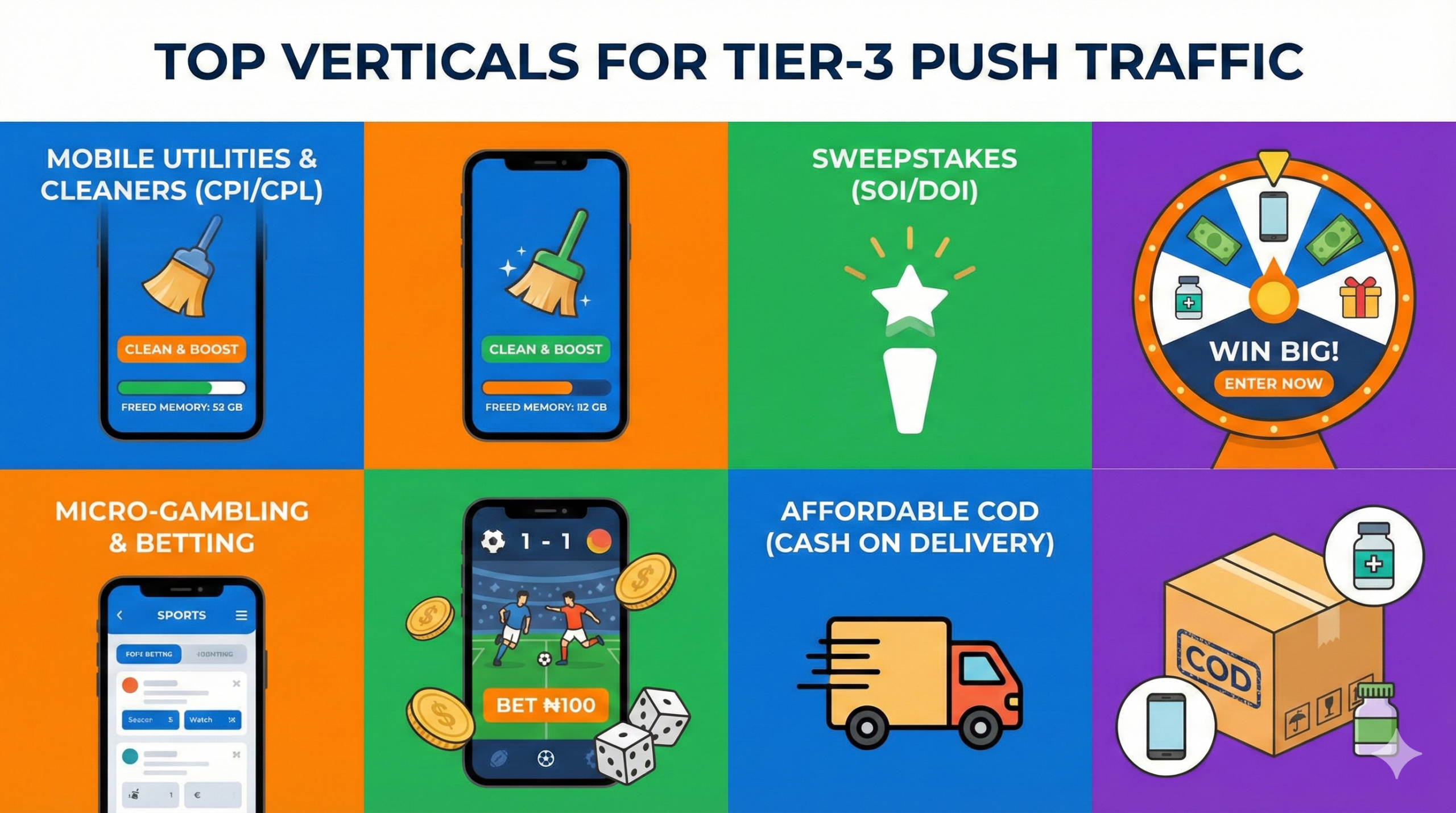
Top Verticals for Tier-3 in 2026
Don’t try to sell crypto investment courses to a villager in Laos. Focus on low-friction, low-ticket offers.
- Mobile Utilities & Cleaners (CPI/CPL): Ideal for Push. Users genuinely worry about their cheap devices’ performance.
- Sweepstakes (SOI/DOI): The hope of winning an iPhone or cash is a massive motivator in low-income regions.
- Micro-Gambling & Betting: Offers with tiny deposits ($1–$2) adapted to local mobile payment systems (like M-Pesa in Kenya).
- Affordable COD (Cash on Delivery): Cheap gadgets or “cure-all” health products with payment upon arrival.
The Verdict: Volume Becomes ROI Only Through Optimization
Running Tier-3 push traffic in 2026 isn’t a “set it and forget it” game. It’s a technical war for every kilobyte and every millisecond.
If your tracker shows 10,000 clicks but only 5 conversions, don’t rush to change the creative. Open your landing page through a local VPN, throttle your speed to “Slow 3G” in your browser’s DevTools, and start a timer. Your answer to “Where is my ROI?” will likely appear on the screen about 15 seconds later. Or, more likely, it won’t appear at all.
FAQ
1. What does “Tier-3 traffic” mean in digital marketing?
Tier-3 traffic refers to visitors from countries with lower advertising costs and CPMs, usually in Africa, Southeast Asia, and parts of South America. While volume is high, quality and ROI optimization require strategic targeting.
2. How can I improve ROI on Tier-3 push traffic?
To maximize ROI, focus on hyper-targeting, optimizing creatives for local preferences, testing different time zones, and using retargeting campaigns to increase engagement and conversions.
3. Which countries in Africa and SE Asia are best for push traffic campaigns?
Countries like Nigeria, Kenya, Vietnam, Indonesia, and the Philippines are high-volume but cost-effective for push campaigns. However, testing is crucial as audience behavior differs across regions.
4. Are Tier-3 push campaigns profitable in 2026?
Yes, but profitability depends on careful campaign management. Leveraging AI-based optimization, geo-targeting, and creative personalization can turn high-volume Tier-3 traffic into a consistent revenue source.
5. What mistakes should marketers avoid with Tier-3 push campaigns?
Avoid treating Tier-3 as purely volume traffic, neglecting local cultural preferences, running campaigns without frequency capping, and ignoring device targeting, as these reduce engagement and ROI.