Mistake #1. Monetizing Low-Quality Traffic as If It Were Premium
What it looks like:
- Sending incentivized / random traffic to:
- expensive CPS offers (purchase, loan application, pricey subscription);
- complex sign-ups with verification, ID, KYC;
- B2B solutions and niche products.
- Expecting conversion rates like from warm paid leads from targeted ads.
- Getting tiny conversion numbers, low EPC, and bans from advertisers and networks.
What’s the core problem
Low-quality traffic is usually:
- weakly motivated;
- often “not the right fit” in terms of interests;
- not ready for complex actions and high-price actions.
Solution: build the right “ladder” of offers
- Simplify the target action:
- instead of a purchase → one e-mail/phone field;
- instead of a long survey → 1–2 clicks (quiz, yes/no);
- instead of a complex registration → simple subscription/light sign-up.
- Switch to offers that tolerate “dirty” traffic:
- sweepstakes, pin-submit, SOI/DOI sign-ups;
- subscriptions, mobile subscriptions (where legal and compliant with rules);
- CPI/CPA offers with a simple action (app install, registration without payment);
- smartlinks from networks tailored to your traffic type (adult, push, worldwide, etc.).
- Build a two-step funnel:
- Step 1. Easy offer → get a contact / cookie / subscription.
- Step 2. Push more expensive offers to already “filtered” users (via e-mail, push, retargeting).
This way you turn a “trash” stream into a filtered flow of leads, which you can treat as an audience, not just random traffic.
Mistake #2. Sending All Traffic to a Single Offer With No Rotation
Symptoms:
- You pick one offer “because people recommended it in the chat”.
- You send everything to it: different GEOs, devices, sources.
- You see that “overall” the traffic is unprofitable and just shut the source off.
But inside this “minus” there are almost always islands of profit:
- in certain GEOs;
- on mobile rather than desktop;
- at night rather than daytime;
- on specific creatives or pre-landers.

What to do:
- Use offer rotation (smartlinks, rotation in your tracker):
- show different offers to the same traffic stream;
- let the system/tracker “learn” and keep what yields the best EPC.
- Build multi-offer landing pages:
- 2–4 offers on one page:
- “Download the app”,
- “Subscribe to the newsletter”,
- “Take a survey and get a bonus”,
- “Get a discount”.
- The user chooses what’s easier or more interesting for them.
- 2–4 offers on one page:
- Segment at least by basic parameters:
- GEO: some countries go to one type of offer, others to local offers or “trash collectors” (contextual teasers, content lockers, smartlinks).
- Device (desktop/mobile): device-adapted landers, different verticals (games and subscriptions work better on mobile, complex forms on desktop).
- Sources: one setup for popunders and clickunders, another for push, a third for teaser networks.
The idea is simple: don’t try to “cover” all the chaos with a single setup. Low-quality traffic turns into money when you break it into segments and match monetization to each of them.
Mistake #3. Not Filtering Bots and Obvious Garbage
Low-quality traffic almost always includes:
- bots;
- auto-redirects;
- accidental clicks;
- users for whom your offer is technically not suitable (wrong device, OS version, carrier, etc.).
Symptoms:
- In the tracker you see many clicks but few landing page views (some users drop off before it loads).
- Lots of bounces on the first screen.
- The affiliate network shaves conversions, hints at “low quality”, or penalizes you.
Why it matters
If you don’t filter out garbage, you:
- ruin your stats;
- ruin your relationships with advertisers;
- dilute your eCPM: real users drown in a mass of bots.
What to do:
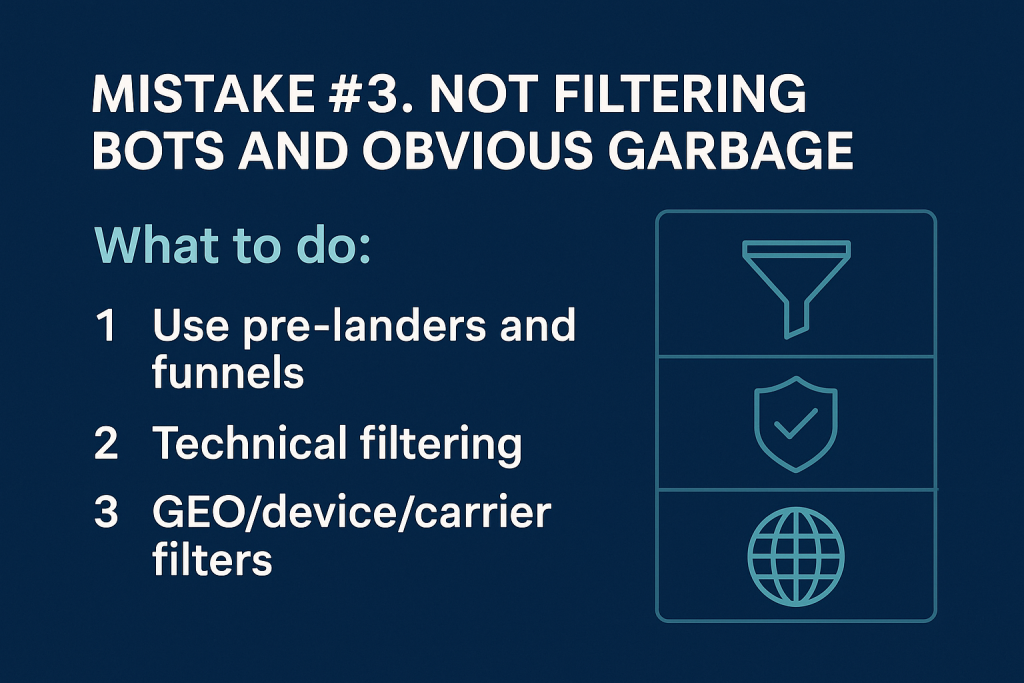
- Use pre-landers and funnels instead of direct linking:
- The first screen should be as light and fast as possible: a quiz, a question, a simple choice image.
- This additionally filters out:
- script-driven bots;
- accidental auto-redirects;
- users with zero interest.
- Technical filtering:
- Cut traffic based on:
- very old / exotic browsers;
- non-target OS and devices;
- suspicious referrers and unusually high click frequency from one IP.
- Use anti-bot scripts or tracker filters (if available).
- Cut traffic based on:
- GEO/device/carrier filters to match offer requirements:
- If an offer pays only for specific carriers/countries — send everything else straight to:
- smartlinks,
- contextual monetization (teaser networks, push subscriptions, interstitials),
- your own “universal” offers.
- If an offer pays only for specific carriers/countries — send everything else straight to:
Result: you don’t waste offer caps and network trust on obvious garbage — you redirect it into less demanding monetization models.
Mistake #4. Trying to Monetize Only Once (No Retention or Post-Monetization)
Classic model:
user → click → one offer → no conversion → “whatever, next”.
This hurts especially with low-quality traffic because:
- very few people convert on the first screen;
- many don’t trust you yet, don’t understand, or don’t have time.
The solution is to squeeze value not from a single click, but over time
- Build a list:
- e-mail;
- Telegram / WhatsApp bot;
- push subscriptions;
- social login (where applicable).
- Build post-monetization flows:
- After the main offer is declined:
- show an alternative (another brand, another format);
- offer a “lighter” action (survey, free content for contact);
- send users to a channel/bot where you can warm them up later.
- After the main offer is declined:
- Use retargeting:
- pixels/tags (FB, Google, others) — collect an audience of visitors;
- warm them up later with more relevant creatives:
- social proof and reviews;
- “last chance” messaging;
- extra benefits, discounts.
- Monetize your list with different verticals:
- If your list contains people with different interests, you can:
- warm some up for finance offers,
- some for nutra,
- some for games or entertainment.
- If your list contains people with different interests, you can:
The mistake is the “no conversion = throw away” approach.
The right approach is to turn an anonymous “trash” click into a subscriber/lead and work with them for weeks and months.
Mistake #5. No Proper Analytics and Systematic Testing
Many people pour traffic like this:
- “I’ll just check the conversions in the affiliate dashboard.”
- “If it feels like a loss, I’ll turn it off.”
The problem is that your gut feeling is almost always wrong, especially with cheap traffic generating thousands of clicks and tiny revenue per conversion.
What you absolutely must do:
- Use a tracker or at least a decent UTM structure:
- source;
- campaign;
- placement/sub-publisher;
- creative;
- pre-lander;
- GEO/device.
- Track the essential metrics:
- EPC (earnings per click);
- eCPM (earnings per 1000 impressions/clicks — depends on your model);
- CR at each funnel step;
- ROI for each funnel/combination — not “on average”.
- Test one change at a time:
- don’t change offer + pre-lander + creative all at once;
- first test different creatives → keep the winners;
- then test different pre-landers → keep the winners;
- then test different offers/smartlinks.
- Cut obvious losers fast and scale winners:
- if after N clicks the EPC is 2–3x below your target — kill that placement/creative;
- anything that consistently performs above average should get priority (more budget, more volume).
The main mistake is working with low-quality traffic “by eye”, without numbers.
Once you see from the data what actually makes money, “trash” traffic turns into a source of cheap leads for your profitable segments.

How to Turn Low-Quality Traffic into Revenue: a Short Checklist
To avoid drowning in theory, here’s a concrete step-by-step plan:
- Audit where you’re sending traffic now:
- Do the offers require actions that are too complex?
- Are they tied to a narrow GEO/carrier/device?
- Simplify the first funnel step:
- use pre-landers, quizzes, short forms;
- funnel at least part of the traffic into a list (e-mail, push, bot).
- Set up rotation and segmentation:
- use smartlinks and/or rotation of different offers;
- split traffic by GEO, device, and source → pick offers for each segment.
- Enable filters and protection:
- filter out obvious bot traffic and non-fit users (wrong countries, old browsers, etc.);
- send traffic unsuitable for “sensitive” offers to less demanding monetization models.
- Set up analytics and testing:
- implement a tracker or at least a clear UTM system;
- track EPC, eCPM, ROI for each setup;
- regularly cut losers and scale winners.
In Conclusion
“Low-quality” traffic is not always about “complete trash”. More often it’s about wrong expectations and the wrong monetization model.
If you stop treating it as “random clicks” and start:
- filtering,
- simplifying actions,
- segmenting,
- working the user through multiple touchpoints,
- making decisions based only on data,
then even the cheapest and “noisiest” traffic stream will start bringing stable, maybe not sky-high, but very pleasant profit.