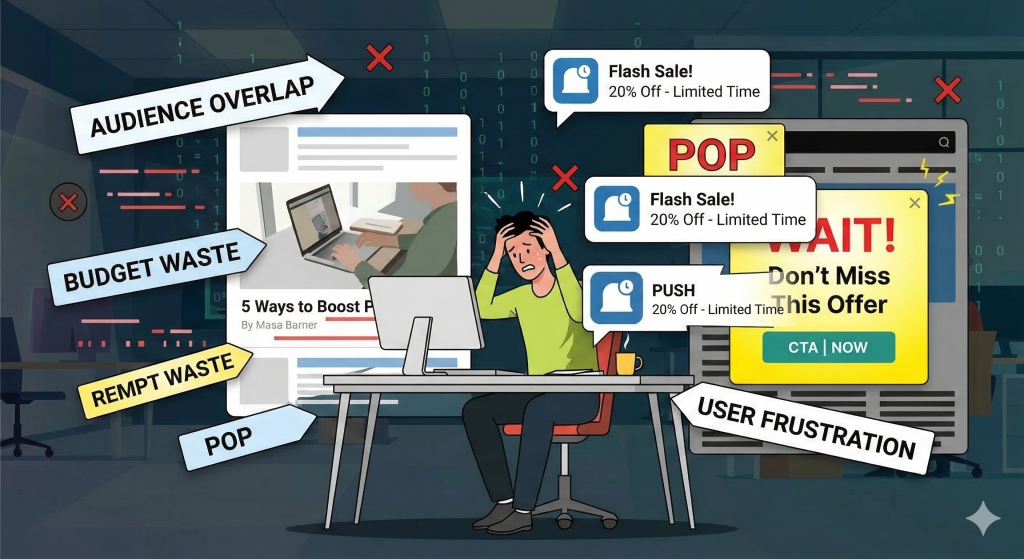
By 2026, ad networks have become smarter, but they still want to sell you as much traffic as possible. Cannibalization happens when you win an auction in a Pop network for a user who clicked your Push notification five seconds ago and saw your Native block a minute before that. You are effectively paying three times for the same intent.
1. Role Distribution: Who’s the Boss?
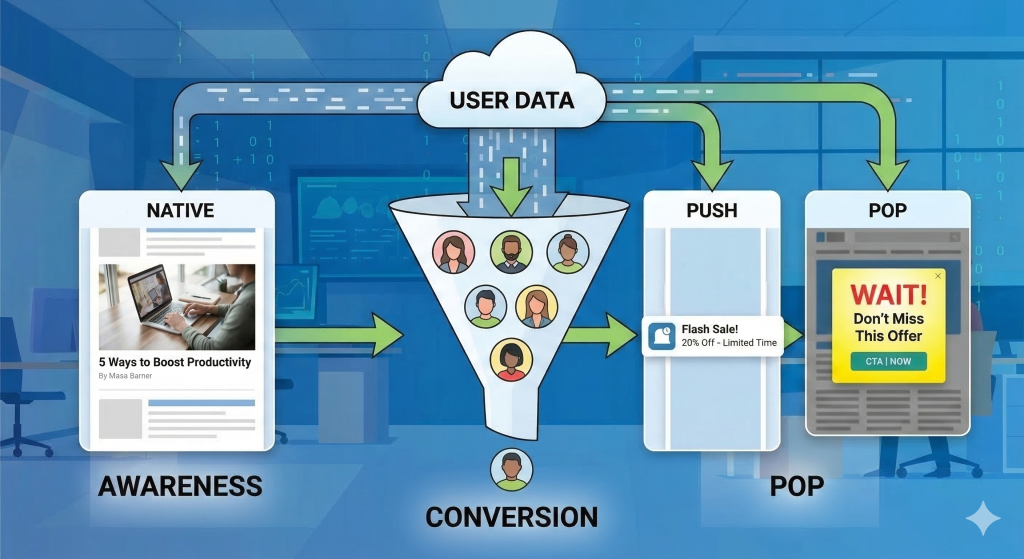
To prevent formats from conflicting, each must cover a specific stage of the funnel. Stop treating them as three identical ways to “just get a click.”
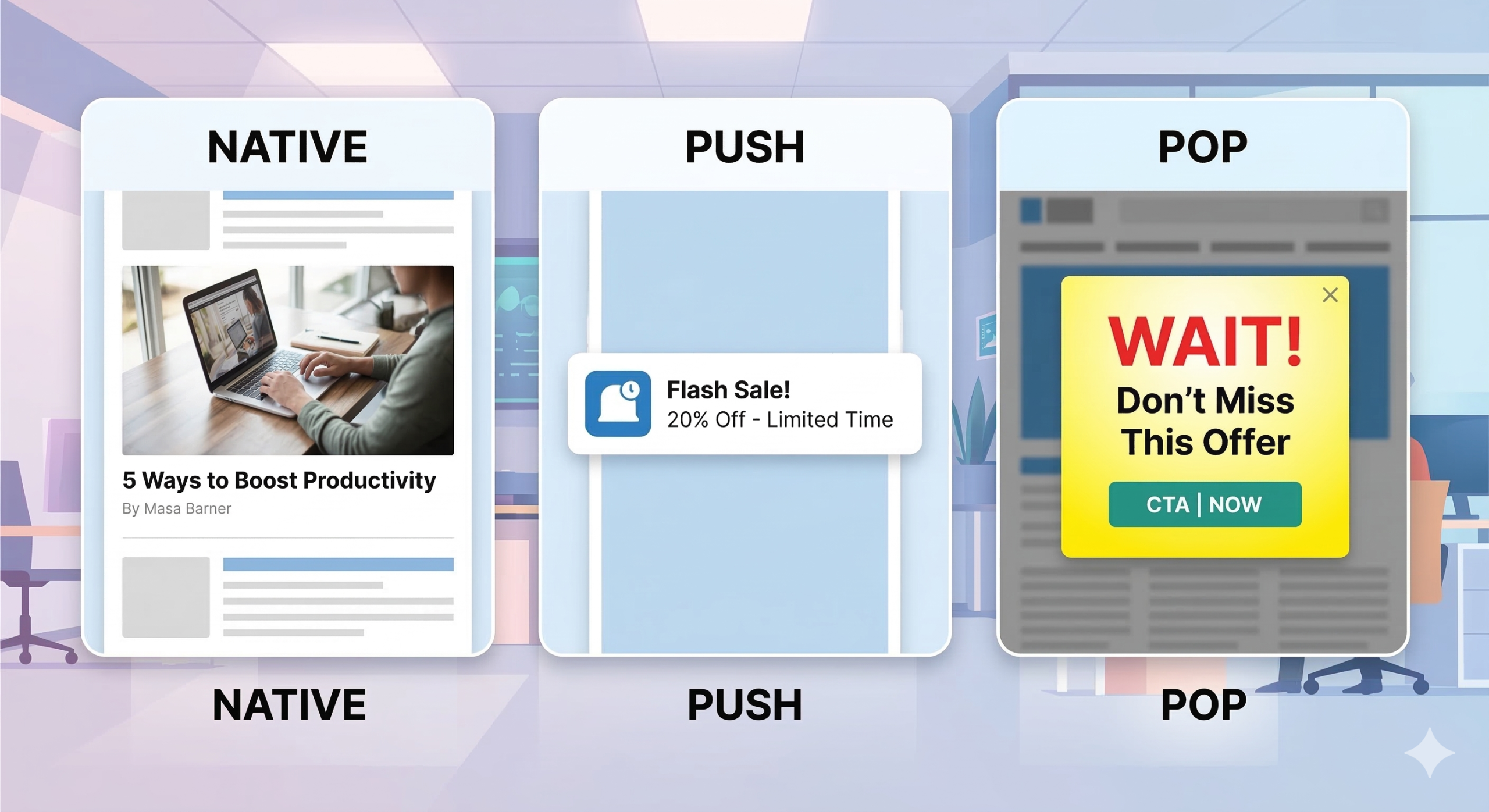
Native (Awareness): This is your “soft entry.” Native should build interest. We aren’t asking for a purchase right away here; we are providing content, value, or an “insider” tip.
Push (The Nudge): Push acts as a trigger. Ideally, the user has already seen your Native ad, and the Push reminds them: “Remember that thing? Only 2 hours left for the discount.”
Popunder (The Final Nudge): Pop is an aggressive format. In a cross-format strategy, it should act as the “last chance” when a user is about to leave the funnel.
2. Unified Frequency Capping
In 2026, top-tier trackers allow you to set a global frequency cap across different sources. If your tool can’t do this, you are bleeding money.
The 1-1-1 Golden Rule:
No more than 1 Native impression, 1 Push notification, and 1 Popunder for a single unique ID within 24 hours. However, it’s not just about the count; it’s about the interval.
The “Chess Order” Strategy:
0 min: User sees the Native ad.
+2 hours: If there was no click on the Native ad, send a Push.
+6 hours: If there was a click but no conversion, trigger the Popunder on exit-intent (when they try to close the page).
3. Format Coordination Table
To avoid fighting over the user, use different “angles” for each format.
Format
Psychological Trigger
Creative Style
Goal
Native
Curiosity / Value
“5 ways to save on…”
Education / Reading
Push
Urgency (FOMO)
“Your coupon expires in 30 min!”
Quick Click
Pop
Shock / Direct Benefit
“STOP! Claim your $50 bonus now”
Registration / Deposit
4. Technical Anti-Cannibalization Stack
How to implement this in practice to avoid overpaying:
Blacklist Synchronization: If a user converts via Native, their ID should immediately (via Postback 2.0) be added to the Blacklist of your Push and Pop campaigns. There is no point in “nudging” someone who has already given you money.
Segment Exclusion: In 2026, ad networks allow for “exclusion audiences.” If a user is “fresh” (seen your ad in the last 30 minutes), you should automatically lower your bid for them in other formats by 80%.
5. The “Single Creative” Trap
A major cannibalization mistake is using the exact same image and text across all formats. The user sees it and thinks, “Not this spam again.”
The Solution: Use visual continuity, not duplication. If the Native ad featured an expert’s photo, the Push should feature a message icon from that expert, and the Pop should be a “video message” from them. This creates a feeling of accompaniment rather than persecution.
Conclusion
A cross-format launch is not about quantity; it’s about orchestration. If you just “turn everything on,” your campaigns will steal ROI from each other. But if you separate them by time, triggers, and value, you achieve a synergy where 1+1+1 doesn’t equal 3—it equals 10.
In the 2026 affiliate world, the winner isn’t the one who screams the loudest, but the one who speaks at the right time.
FAQ
What is cross-format cannibalization? Cross-format cannibalization happens when multiple advertising formats—like push, pop, and native—compete for the same audience, potentially reducing the effectiveness of each channel.
Why launch push, pop, and native simultaneously? Launching all formats together can maximize reach, test performance across channels, and capture user attention at multiple touchpoints, but it requires careful management to avoid cannibalization.
How can I prevent audience overlap between formats? Segmenting audiences, setting frequency caps, and using cross-channel attribution helps reduce overlap and ensures each format reaches distinct user groups.
Which metrics should be monitored for cannibalization? Track impressions, clicks, conversions, and cost per acquisition (CPA) across each channel. Watch for drops in performance when multiple formats are active simultaneously.
Are some formats more likely to cannibalize others? Yes. Push and pop ads often compete directly for immediate user attention, while native ads may complement rather than cannibalize if strategically placed.
Can simultaneous launches improve ROI despite cannibalization risks? Yes, with careful planning. Optimized timing, audience segmentation, and performance monitoring can help achieve higher overall ROI while minimizing negative cross-format effects.