The search landscape is shifting. With Google’s Search Generative Experience (SGE) and AI engines like Perplexity or Gemini, your goal is no longer just to rank #1—it’s to be the primary source for the AI’s summary. To do that, your content must be “digestible” for neural networks.
Here is how to structure your articles to stay visible in 2026.
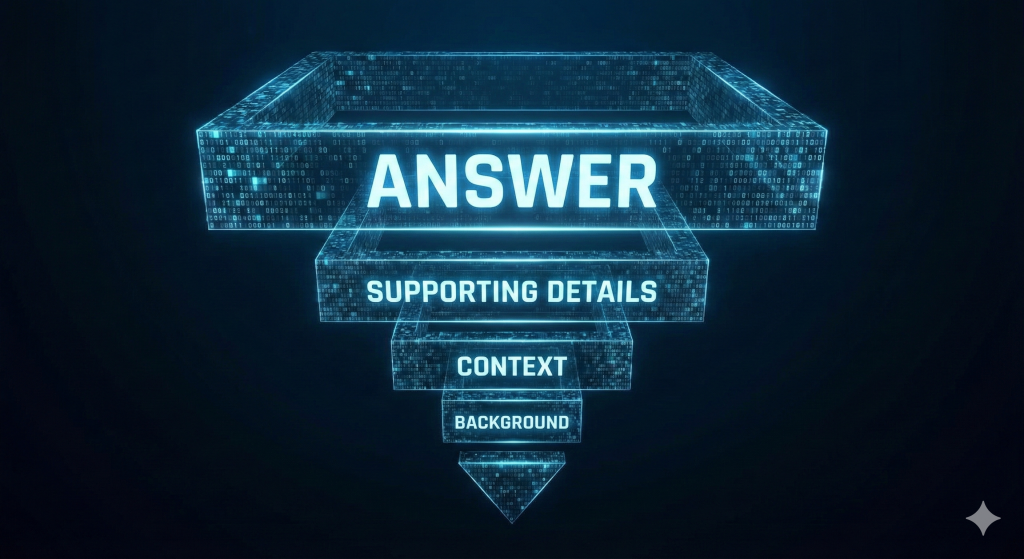
1. The Inverted Pyramid 2.0
AI engines value the user’s time. If your intro is filled with “fluff,” the AI might miss your point entirely.
- The Rule: Place the direct answer to the main question in the very first paragraph (first 2–3 sentences).
- Why it works: AI agents scan from the top down. Providing an immediate, clear definition increases your chances of being cited as the “source of truth.”
2. Structure is Your Map, Not Just Decoration
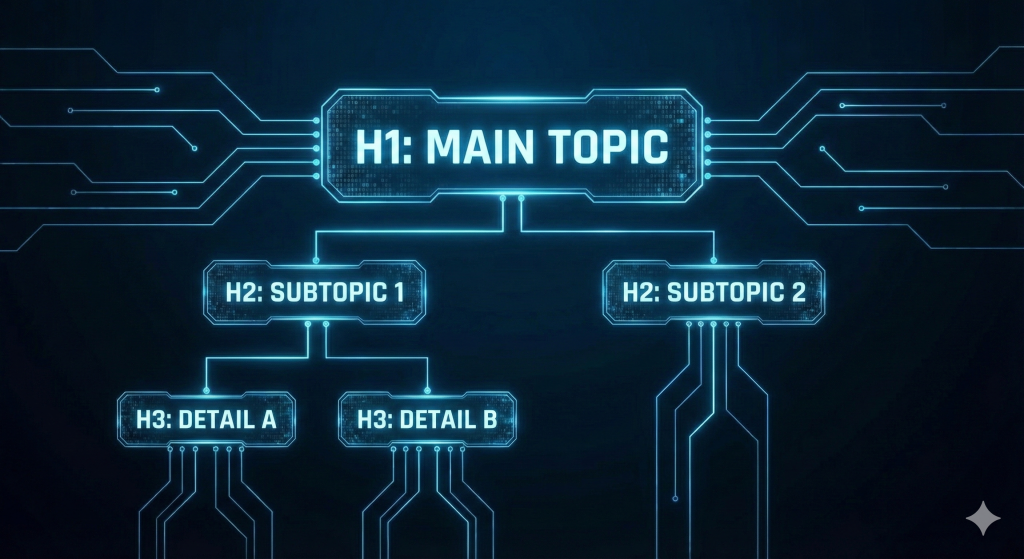
For an AI parser, headers are a roadmap. Move away from vague, “creative” titles and use functional ones.
- Use Question-Based Headings: Instead of “Our Method’s Benefits,” use “What are the benefits of [Method Name] for business?”
- Strict Hierarchy: Follow a logical H1 -> H2 -> H3 nested structure. This helps the AI understand which subtopic belongs to which category.
3. Tables and Lists: The “Cheat Code” for AI Summaries
AI loves structured data. It is much easier for an LLM to pull data from a bulleted list or a table than to extract meaning from dense blocks of text.
Pro Tip: If your article compares products or lists features, always use a table. There is a 90% chance the AI will use your table to generate its own response.

4. Semantic SEO: Expertise Over Keywords
SGE is built on E-E-A-T (Experience, Expertise, Authoritativeness, Trustworthiness).
- Specifics Matter: Don’t say “we are popular.” Say “we served 15,000 clients in 2025.”
- LSI Keywords: Use words from the same semantic field. If writing about coffee, include “roasting,” “extraction,” and “Arabica” to prove the depth of your content.

5. FAQ and Technical Signals (Schema.org)
An FAQ block at the end of your article is a gift to search AI.
| Strategy | Benefit |
| JSON-LD Markup | Helps the AI identify prices, authors, and specific answers. |
| Simple Syntax | Short, clear sentences are easier for NLP (Natural Language Processing) to parse. |
| Zero “Fluff” | In 2026, brevity is the key to being featured in SGE snippets. |
The Bottom Line: Write for the Scanner
Treat the AI like a busy executive who only has 5 seconds to scan your page. If the AI can’t find the core value in those 5 seconds, it will move on to another source.
FAQ
- What is SGE Optimization?
SGE Optimization is the process of structuring and formatting content so that AI-powered search engines can easily understand and rank it. It focuses on clarity, context, and semantic relevance. - Why is AI-readability important for content?
AI-readable content ensures that search engines can interpret your information accurately, improving visibility in search results and increasing traffic from AI-driven search features. - How can I make my content AI-readable?
Use clear headings, structured data, concise sentences, relevant keywords, and logical content flow. Including FAQs and tables can also improve AI comprehension. - What role does structured data play in SGE Optimization?
Structured data, like FAQ schema or JSON-LD, provides explicit information to AI systems, helping them understand your content and display rich results in search engines. - Are there common mistakes to avoid in AI-readable content?
Yes. Avoid keyword stuffing, vague headings, overly complex sentences, and missing structured data. Poor formatting and lack of context can hinder AI understanding. - Can SGE Optimization improve user experience?
Yes. Well-structured, AI-readable content is easier for humans to read, navigate, and understand, which enhances engagement and trust while boosting search performance.