I’ve put together the most complete and clear dictionary. No fluff—just the stuff you’ll actually use. Let’s go!
Basic Concepts and Market Players
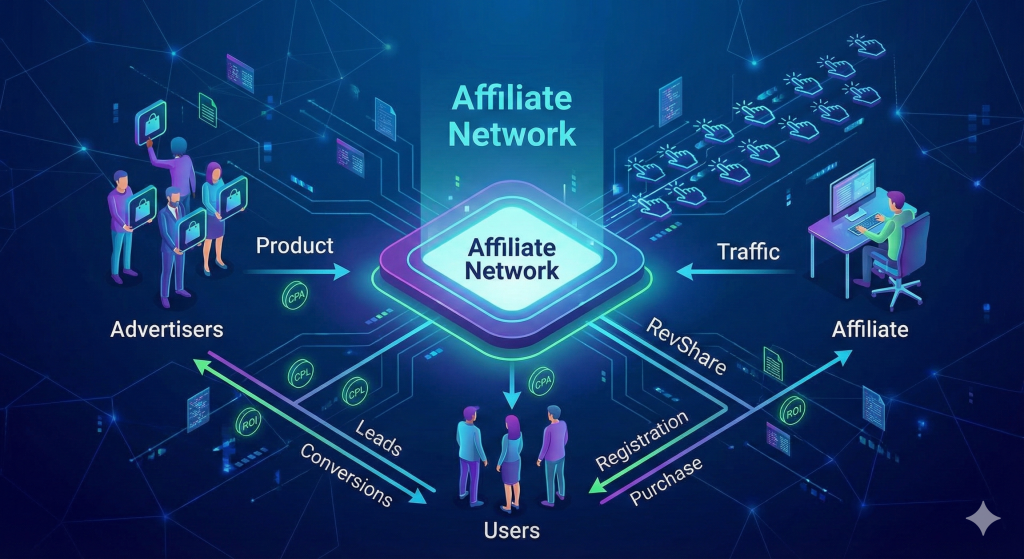
- Affiliate Marketing — A way to earn money where you get a commission for every target action (sale, registration) made by a user you referred.
- AdTech (Advertising Technology) — An umbrella term for technologies and software used to manage digital advertising.
- Affiliate (Webmaster, Media Buyer) — The person who sets up ads and drives traffic.
- Advertiser (Advert) — The product owner who pays for customers.
- Affiliate Network (CPA Network) — A platform/intermediary hosting hundreds of offers from different advertisers.
- Offer — A specific product or service to be promoted.
- Vertical — A category of products (e.g., Nutra, Gambling, Dating).
- Traffic — The flow of users who click on your ads.
- Lead — A potential customer who has left an application or contact details.
- Conversion (CR) — Turning a visitor into a customer (lead).
Payment Models
- CPA (Cost Per Action) — Payment for a specific action (usually a purchase).
- CPL (Cost Per Lead) — Payment for a registration or a filled-out form.
- CPI (Cost Per Install) — Payment for a mobile app installation.
- CPS (Cost Per Sale) — A percentage of the sale amount.
- RevShare — You receive a percentage of the user’s spending (e.g., in a casino) for a lifetime.
- CPC (Cost Per Click) — The price of a single click on an ad.
- CPM (Cost Per Mille) — The price for 1,000 ad impressions.
- Hybrid — A mix of models (e.g., a fixed fee for registration + a percentage of deposits).
- eCPM — Effective cost per thousand impressions (your actual earnings per 1,000 views).
- EPC (Earnings Per Click) — Your average earnings from a single click.
Metrics and Analytics
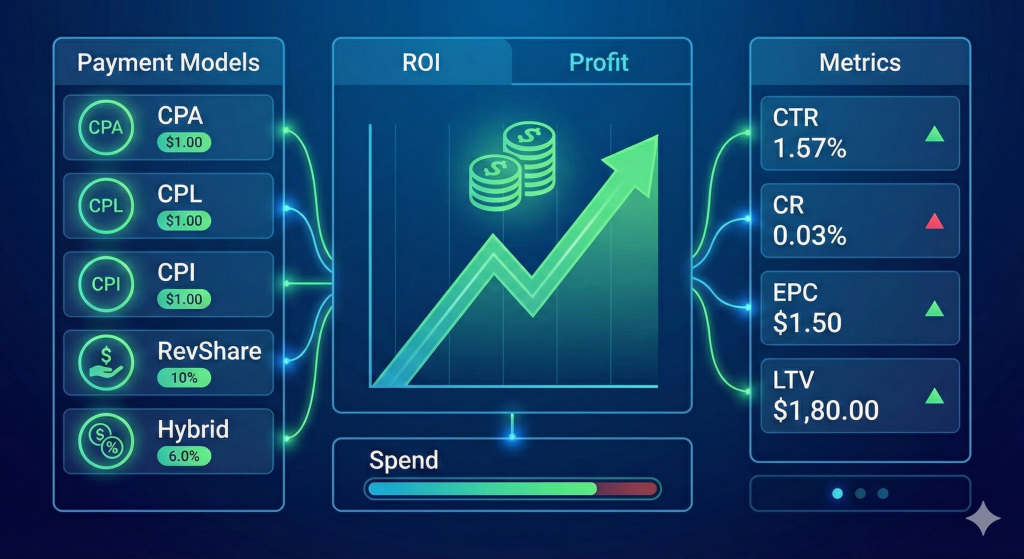
- CTR (Click-Through Rate) — The ratio of clicks to impressions.
- CR (Conversion Rate) — The ratio of leads to clicks.
- ROI (Return on Investment) — Profitability. How much you earned above your costs.
- ROAS (Return on Ad Spend) — Gross revenue generated for every dollar spent on advertising.
- LTV (Lifetime Value) — Total money a customer brings to the company over their lifetime.
- ARPU (Average Revenue Per User) — Average income from one active user.
- Hold — The period during which the advertiser checks your leads before releasing payment.
- Approval (Approve) — The percentage of leads confirmed by the advertiser.
- Trash — Invalid leads (wrong numbers, duplicates).
- Bounce Rate — The percentage of users who leave the site immediately after landing.
Tools and Tech
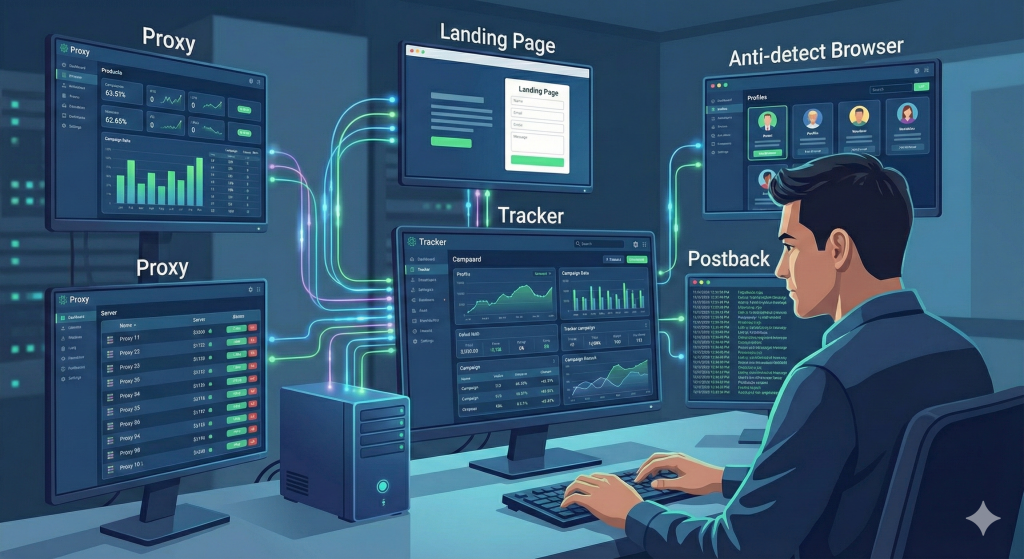
- Tracker — Software for tracking traffic, distributing flows, and analytics.
- Postback — A mechanism that sends conversion data from the affiliate network to your tracker.
- Landing Page — The one-page website a user sees after clicking an ad.
- Pre-landing (Bridge Page) — An intermediate page (like an article or story) to warm up the user.
- Domain — Your website address.
- Hosting — The server where your landing page files are stored.
- Cloaking — A technology that shows moderators a “safe” page while showing the actual offer to real users.
- Anti-detect Browser (Antik) — A browser that allows you to manage hundreds of accounts by spoofing hardware fingerprints.
- Proxy — An intermediary server used to change your IP address.
- API — A way to automatically transfer data between your site and the affiliate network.
Traffic Sources and Formats
- FB (Facebook) — A primary (and strict) source for running traffic.
- Google Ads — Search and display advertising via Google.
- TikTok Ads — A source for short videos and relatively cheap traffic.
- Native Ads — Ads disguised as the website’s content (e.g., news).
- Push Notifications — Pop-up notifications on mobile or desktop.
- In-page Push — Banner ads that look like system push notifications.
- Pop-under — A window that opens behind the active browser tab.
- Teaser — A clickbait headline with an intriguing image.
- SEO (Search Engine Optimization) — Traffic from search engines gained by optimizing your website.
- UAC (Universal App Campaigns) — A Google Ads campaign type for mobile apps.
Verticals (What we promote)
- Nutra — Health and beauty products (weight loss, skincare).
- Gambling — Online casinos.
- Betting — Sports betting.
- Dating — Dating sites and apps.
- Sweepstakes (Sweeps) — Prize giveaways (e.g., Win an iPhone).
- E-commerce — Traditional online stores (clothes, gadgets).
- Crypto — Trading education or investment platforms.
- Finance — Credit cards, loans, insurance.
- Essays (Edu) — Academic writing services for students.
- Adult — 18+ content.
Accounts and Moderation
- Ban — Account suspension by the ad network.
- Appeal — An attempt to restore a banned account via support.
- Creative (Creat) — The image or video the user sees.
- Farm — The process of simulating real user activity to “warm up” an account before running ads.
- Trust — The ad network’s level of confidence in your account.
- Self-reg — An account you registered yourself.
- Logs — Stolen data from real users’ accounts (obtained via stealer software).
- Fan Page (FP) — A Facebook page used to run ads.
- Business Manager (BM) — A FB tool to manage ad assets.
- Spend — The total amount of money spent on advertising.
Advanced Slang
- Whitehat — Completely legal offers that don’t violate ad policies.
- Blackhat — Aggressive offers that lead to immediate bans.
- Greyhat — Somewhere in between (e.g., replica brands).
- Cap — A daily limit on the number of leads allowed by the advertiser.
- Bump — An increase in your payout rate per lead.
- Payout — The amount you get paid for a single lead.
- Manual Check — A human review of your leads by the advertiser.
- Incentive Traffic (Incent) — Traffic where users are promised a reward for an action (usually prohibited).
- Lead Generation — The process of identifying and cultivating potential customers.
- Pixel — A snippet of code used to track user behavior on your site.
Programmatic and Ecosystem
- DSP (Demand Side Platform) — Software for buying mobile, search, and video ads automatically.
- SSP (Supply Side Platform) — Software for publishers to sell their ad space.
- RTB (Real-Time Bidding) — An auction-based system for buying ad impressions in real time.
- Ad Exchange — A digital marketplace where DSPs and SSPs meet.
- DMP (Data Management Platform) — A warehouse for user interest and behavior data.
- Click Fraud — Fake clicks generated by bots.
- Viewability — A metric measuring whether an ad was actually seen by a user.
- Frequency Cap — A limit on how many times an ad is shown to the same user.
- Direct Advertiser — Working directly with the product owner without a CPA network.
- Affiliate Manager — Your contact person at the CPA network who helps you with offers.
Scaling and Profit
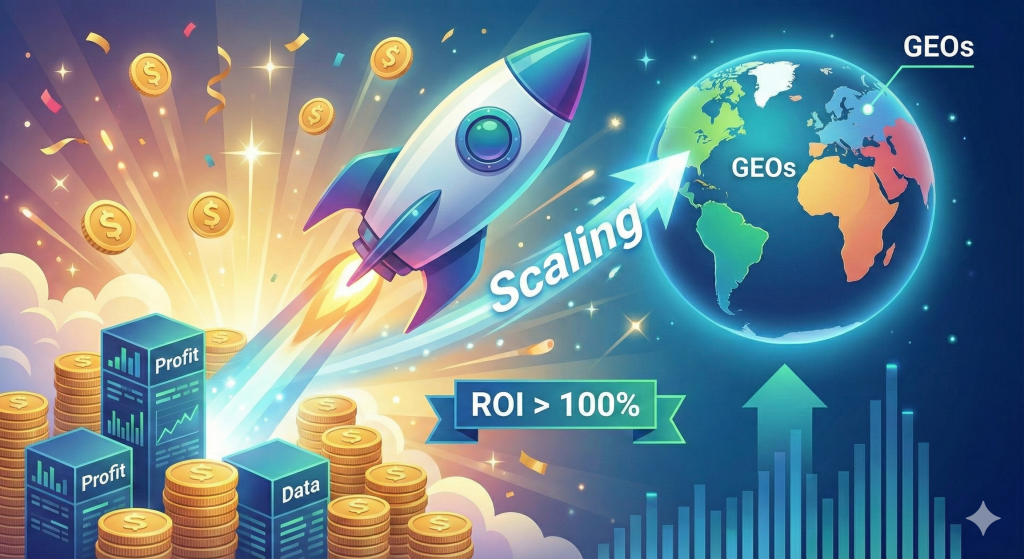
- Scalability — Increasing your budget to grow profit proportionally.
- Profit — Your net earnings.
- ROI > 100% — The dream: spend $1, make $2.
- Link Cloaking — Masking an affiliate link to make it look less suspicious.
- Smartlink — A single link that automatically redirects users to different offers based on their GEO and device.
- GEO — The country or region your ads are targeting.
- Tier-1, 2, 3 — Classification of countries by purchasing power (Tier-1: USA, Germany, etc.).
- A/B Testing (Split Testing) — Comparing two creatives or landing pages to see which performs better.
- Profit Margin — The difference between revenue and expenses.
- Burnout — When your creative stops generating leads because the audience is tired of seeing it.
Hopefully, you now feel more confident in this sea of acronyms! Save this to your bookmarks so you don’t lose it.
FAQ
What is Affiliate Marketing?
Affiliate Marketing is a way to earn money when a company pays commissions to partners for customers or sales generated through their links.
What is AdTech?
AdTech (Advertising Technology) refers to tools and technologies that help companies create, manage, and optimize online advertising campaigns.
What are CPA and CPC?
CPA (Cost Per Action) means paying for a specific user action. CPC (Cost Per Click) means paying for each click on an ad.
What is Programmatic Advertising?
Programmatic Advertising is the automated buying of ads using platforms and algorithms that target audiences in real time.
What is Cookie Tracking?
Cookie Tracking uses small files stored in a user’s browser to monitor behavior and show relevant ads.
What is Conversion Rate?
Conversion Rate is the percentage of users who complete a desired action, like a purchase or subscription, from the total visitors.