How to build monetization without burning out your audience or traffic
1) Design monetization as part of UX, not an “add-on”
Core idea. Ads, paid blocks, affiliate widgets, and owned products must be embedded in the reading journey—never break it.
How to do it
- Map 3–5 key user journeys (arrives from search → finds answer → leaves / subscribes / opens comparison, etc.).
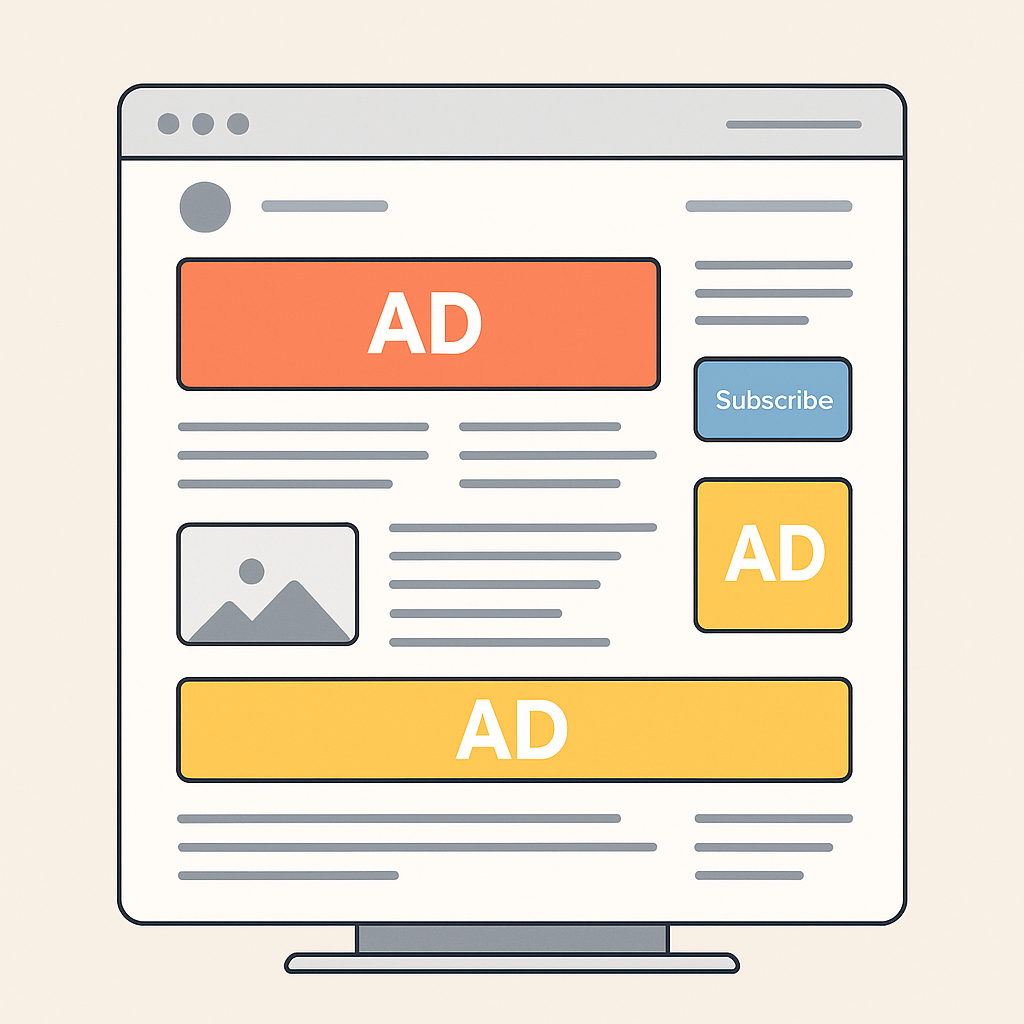
- For each journey, mark monetization “touchpoints”: in-content units after meaningful paragraphs, unobtrusive sticky, a logical CTA at the end.
- Set frequency caps per session and per user (e.g., viewability ≥ 60–70%).
- Watch speed: every ad tag or script has a millisecond “cost.”
Metrics
- CLS/LCP/TTFB (Core Web Vitals), viewability, zone-level CTR, scroll depth → where users actually engage.
- “Stop metrics”: a sharp bounce increase in the first 10 seconds, drop in engaged time.
Common pitfalls
- “Pasted ads after layout”: tags loaded after content is finalized.
- Huge interstitials on mobile—penalized by both search engines and users.
| Format | Max per Session | User Daily Cap | Min Delay (sec) | Trigger | Notes |
|---|---|---|---|---|---|
| Pop-up / Popunder | 1 | 4 | 20 | Delay/Exit-intent/Scroll | Avoid on first pageview |
| Display (Inline) | 3 | 12 | 0 | On-load after content | Viewability ≥ 60–70% |
| Sticky (Bottom/Top) | 1 | 4 | 10 | On-scroll 25–40% | Hide on small screens if overlaps |
| Video Preroll | 1 | 2 | 0 | On video start | Sound on click, skippable |
| Affiliate Widget | 2 | 6 | 0 | After section end | Contextual to topic |
2) Balance pop-up frequency and number of formats
Core idea. Overfeeding with ads kills loyalty and revenue. Keep the number of pop-ups per user and the simultaneous variety of formats under control.
How to do it
- Set strict caps on pop-ups/popunders per user/day and per session (e.g., “up to 3–4 per 24h” and “no more than one per session”—tune via tests). The source emphasizes moderation.
- Keep 1 pop format + up to 2–3 display zones on a page; rotate everything else. The source warns against running too many networks and formats at once.
- Prefer “quiet” triggers (delay, scroll, exit-intent) over immediate fire.
Metrics
Per-format CTR, advertiser-side CR, complaints/blocks, RPM per 1,000 pageviews.
Common pitfalls
- Launching multiple pop formats from different networks simultaneously → competition and analytics confusion (explicitly flagged by the source).
3) Don’t inflate the partner zoo: less is more
Core idea. Too many ad networks = code conflicts, extra requests, “leaking” clicks across formats, murky attribution.
How to do it
- Consolidate inventory to 1–2 primary partners + 1 backfill.
- Use partner-side priorities/viewability thresholds so you don’t bid against yourself.
- Centralize reporting (server-side header bidding / unified reporting).
Metrics
Time to ad render, network requests per page, clean RPM.
Common pitfalls
- “Give each network a format” → some clicks “leak” into competing pops, advertisers see unstable behavioral signals.
4) Flexible show rules: frequencies, triggers, cool-downs
Core idea. More money comes from smart delivery: per-user caps, gaps between shows, triggers by clicks/scroll/time. Clickadu stresses fine-tuning frequency, appearance gaps, and capping elements—turn that into a system.
How to do it
- For each format define: delay, interval, conditions (X sec on page, Y% scroll, Z-th click).
- Split new vs. returning users and mobile vs. desktop—different rules.
- Introduce a cool-down after a negative action (close/hide ad).
Metrics
Viewability, CTR without spikes in complaints, advertiser post-click conversion, retention.
5) Treat your ad-network manager as an extension of your team
Core idea. The article suggests “trust your account manager” and “don’t panic in the first hours of launch.” True: partners see demand, creatives, anti-fraud, and switches you don’t.
How to do it
- Share data: top pages/geo/devices, sensitive zones, UX “red lines.”
- Ask for experiments: frequencies, placements, format mix by page cluster.
- Agree on stabilization periods: first 24–48 hours after changes—don’t overreact to topline swings; the source also asks to give systems time to “spin up.”
Metrics
RPM growth trend, share of “clean” impressions, fewer blind edits over time.
6) RevShare strategy: when and why
Core idea. Revenue-sharing makes sense when your volume is stable and quality is predictable: you capture bid uplifts as advertisers optimize. Clickadu points to this upside.
How to do it
- Move to revshare on clusters with long-tail, steady traffic (evergreen, social core).
- Freeze benchmarks before switching: RPM/1,000, eCPM by geo/device.
- Agree on a “pain threshold”—when a drop triggers a temporary return to fixed rates.
Metrics
eCPM trend, day/week revenue variance, inventory LTV (geo × device).
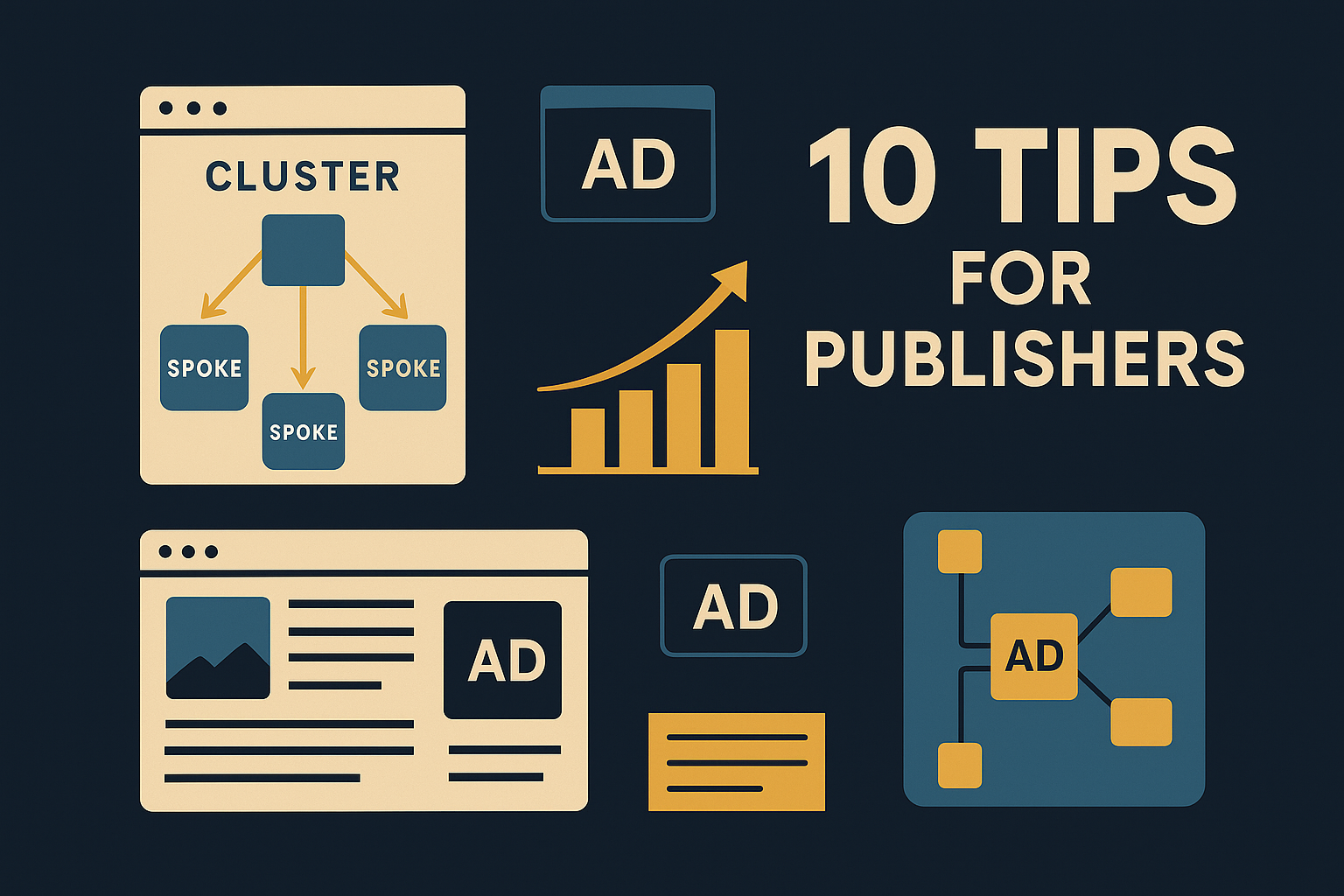
7) Content clusters and the “internal economy” of traffic
Core idea. Money comes from clusters, not single pages. A hub catches head terms. Interlinking and rec widgets keep sessions alive—place smart monetization points there.
How to do it
- On hub pages: short table of contents, “next step” widgets, embedded comparison tables/cards.
- On spokes: 3–5 precise internal links by intent; fill topic gaps.
- Embed commercial blocks near “choice moments” (comparisons, checklists).
Metrics
Pages/session, hub traffic share, contribution of recommendations to revenue.
8) Anti-AdBlock and domain hygiene
Core idea. The Adblock ↔ Anti-Adblock race is endless; the source reminds us to mind technical hygiene and delivery domains. You may need rotation of ad-serving domains and to watch the serving host’s “reputation”; security tools sometimes flag domains—this was noted as a real-world issue.
How to do it
- Maintain an allowlist of creative providers and networks; isolate serving domains.
- Set monitoring: sudden spikes in blocks/403/5xx, domain reputation signals.
- Keep a “warm” reserve of serving domains for quick switchovers.
Metrics
Share of blocked requests, “malicious ad” complaints, time-to-mitigation.
Common pitfalls
- Ignoring alerts in the ad network panel; the source explicitly advises watching in-account notifications.
9) Attribution and transparency for advertisers
Core idea. The clearer the user path and cleaner the inventory, the higher the bids. Avoid “inlined” external redirect logic that steals clicks from other formats (related to the warning about mixing networks/formats).
How to do it
- Clear UTM/ref tags, a unified redirect layer, post-click metrics (pages, events).
- Segment inventory by placement zones (Above/Inline/Below), keep a whitelist for premium demand.
- Provide regular “clean” reports to advertisers/networks: where ads showed, where conversions happened.
Metrics
Post-click engagement, advertiser reject rate, premium campaign share.
10) The content OS: refresh → prune → ship
Core idea. Your best revenue driver isn’t only new posts—it’s systematic updates to traffic leaders and pruning “dead” pages.
How to do it
- Every 90–180 days refresh top pages: data, screenshots, FAQ, schema (FAQ/HowTo/Review).
- Merge duplicates and fix cannibalization; delete what neither ranks nor monetizes.
- In parallel, release cadence: publish 1–2 evergreen pieces per cluster weekly.
Metrics
Organic lift for refreshed posts at 14/30/90 days, indexation health, share of fresh pages.
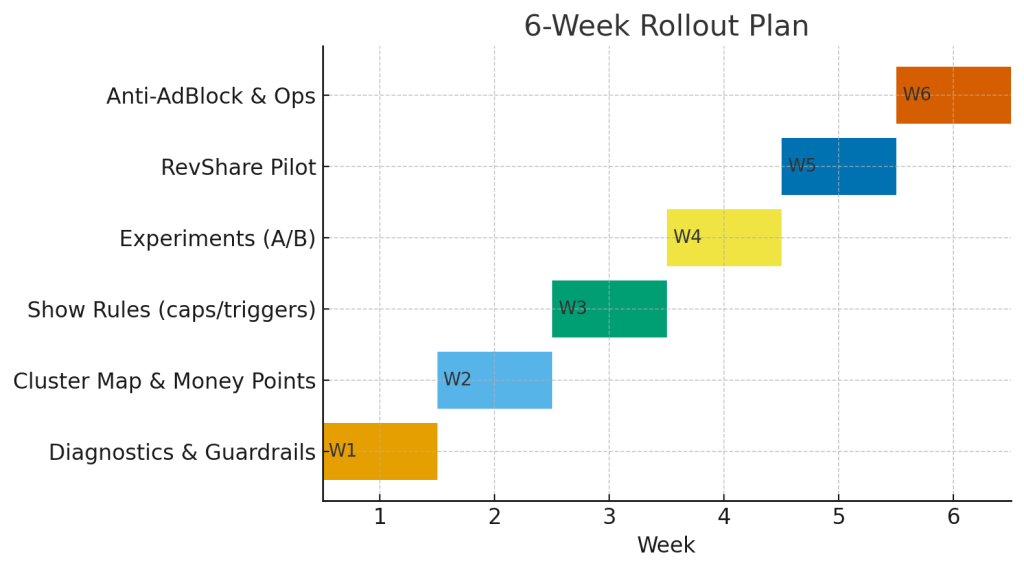
6-week rollout plan
Week 1. Diagnostics & guardrails
UX/ad audit (speed, overlays), set frequency caps, disable conflicting networks.
Week 2. Cluster map & “money points”
Hubs/spokes, conversion spots, sticky zones. Trial mix (1 pop + 2 display zones).
Week 3. Show rules
Delay/interval/scroll triggers, per-user/session caps, cool-downs after close.
Week 4. Experiments
A/B headlines, rec widgets, ad block positions. Quiet tests in low-risk geos/hours.
Week 5. RevShare pilot
1–2 clusters with stable traffic, before/after benchmarks, agreed “pain thresholds.”
Week 6. Anti-AdBlock & ops
Reserve serving domains, alerting, refresh/prune runbook and weekly releases.
Templates & checklists (quick)
Format limit template
- Pop format: no more than 1/session, delay ≥ 15–30s, cap ≤ 3–4 per 24h (moderation idea borrowed from the source).
- Display: 2–3 zones/page, viewability threshold ≥ 60–70%.
- Video preroll: max 1 per page, sound on click, skippable.
Pre-launch checklist
- Nothing overlays content on mobile?
- CLS ≤ 0.1, LCP ≤ 2.5s, TBT ≤ 200ms.
- Frequencies/caps enabled? Event logs flowing?
- No networks competing/“stealing” each other’s clicks? (source-inspired warning).
- Backfill/fallback ready? Plan for blocks? (anti-AdBlock/reserve domains—source-inspired).