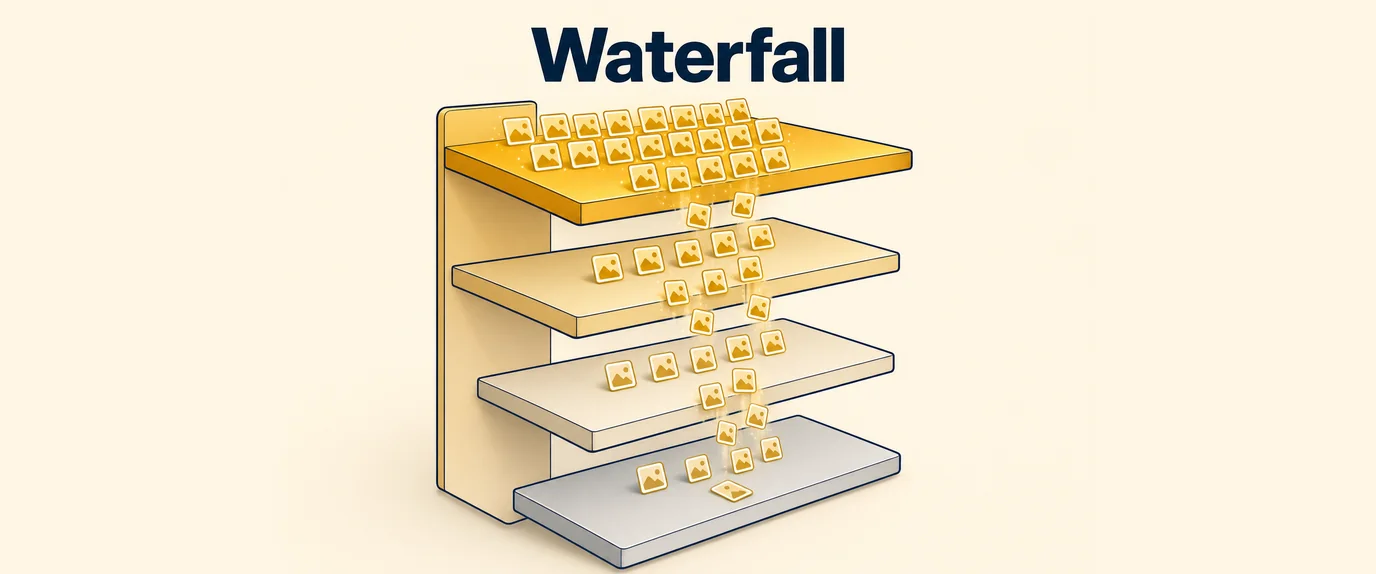
A monetization waterfall isn’t some “legacy relic” — it’s still a very practical engineering approach when you want hard control over the order in which demand sources get a chance to buy an impression: first the most profitable and predictable sources, then broader but less guaranteed ones, and finally rescue options so inventory doesn’t go unsold.
Below is a hands-on blueprint for building a waterfall around direct deals, RTB, and tier-2 networks, so you can:
- avoid revenue loss from a bad priority order,
- prevent crashes during downtime,
- stop eCPM volatility caused by wrong floors and weak fallback logic.
1) What You’re Actually Building: The “Sales Attempts” Logic
Think of each impression as an auction with a pre-written plan:
- Direct deals (guarantees, premium placements, fixed or dynamic CPM)
- Programmatic RTB (open auction / PMP / preferred)
- Tier-2 networks (remnant networks, older SSPs, local networks, “catch-all” partners)
- Fallback (house ads, cross-promo, PSA, internal recs, empty response only as last resort)
Two things matter most in a waterfall:
- Order (who gets first right of refusal).
- Eligibility rules (floors, targeting, frequency, geo/device, format, viewability, brand safety).
If these rules are off, the waterfall becomes a leaky bucket: requests get wasted, latency rises, fill drops, and eCPM becomes noisy.
2) Inventory and the “Control Unit”: What Exactly Are You Prioritizing?
Before tuning anything, decide what you’re managing as your core levers:
- Format (display/video/native/interstitial/rewarded)
- Placement / ad unit (where it appears in the product)
- Geo / language
- Device / platform
- Audience segment (if you have first-party data)
- Viewability class (if you measure and use it)
More segmentation gives more control — and more chaos risk. A strong approach is to start with 2–4 key placements that drive most revenue, perfect the model there, then scale.
3) Direct Deals: Put Them on Top, Without Breaking Delivery or UX
Direct is usually the most predictable and highest-margin layer. It belongs at the top — with guardrails.
3.1 Direct Types That Fit Waterfalls Best
- Guaranteed: you must deliver volume. This is top priority, but carefully capped so it doesn’t consume everything.
- Preferred deal: priority access at a fixed price, often without an auction.
- PMP: private auction; can sit above open auction but below guaranteed.
3.2 How Not to Kill Programmatic with Direct
Give direct campaigns these controls:
- Frequency caps and/or traffic share limits
- Time pacing (smooth delivery across the day)
- Geo/platform restrictions (if the advertiser is narrow)
- Clear content exclusions (brand safety) to avoid blocks and policy issues
Goal: direct takes the inventory it should, and everything else flows down fast — without extra retries or delays.
4) RTB: Competition Creates Money — If You Control It
In a waterfall, RTB commonly includes:
- PMP (if not implemented as ad-server line items)
- Open auction (your core revenue layer)
- Multiple SSPs / exchanges (sometimes many)
4.1 The Most Common Mistake: Too-High Floors Too Early
A floor is a filter. If you set a high CPM floor near the top, you might raise eCPM on winners, but you can also:
- crush fill (too many no-bids),
- push more traffic into lower layers, where you sell cheaply anyway.
Think of floors not as “I want more money,” but as “my efficiency threshold given win probability.”
4.2 Best Practice: Segment-Based Multi-Floor
Use different floors for:
- Tier-1 vs Tier-3 geos,
- iOS vs Android vs Web,
- high-viewability placements vs low-viewability,
- video vs display.
And always implement floor degradation rules when fill starts slipping (more on that later).
5) Tier-2 Networks: Not a Trash Bin — a Safety Net and Smoother
Tier-2 networks are useful when:
- you have long-tail countries/segments where SSPs can’t fill reliably,
- you need to catch impressions during RTB issues,
- you want stable fill even if eCPM is lower.
But they can easily hurt revenue and UX if they’re placed too high, ship low-quality creatives, or conflict with brand-safety rules. Their job is to close gaps, not compete with your best sources.
6) Source Prioritization: How to Order Layers in Real Life
6.1 A Universal Baseline Order
- Guaranteed direct
- Preferred / high-CPM direct
- PMP / curated deals
- Open auction (core RTB layer)
- Tier-2 networks (remnant / regional)
- House / PSA / internal
6.2 The Order Changes by Format
- Video is latency-sensitive → fewer attempts, stricter timeouts.
- Native can tolerate longer chains, but creative quality control matters.
- Interstitials demand strict partner selection (or complaints will spike).
6.3 Don’t Forget the “Cost of an Attempt”
Each extra call adds:
- latency,
- technical failure risk,
- viewability loss (the user scrolls away),
- client/page load overhead.
Sometimes it’s more profitable to cut 2–3 weak layers than to keep a long chain “just in case.”
7) Fallback Scenarios: Always Show Something — Without Collapsing Price
Fallback isn’t one line item. It’s a system.
7.1 Types of Fallback
- Technical fallback: RTB/SDK/script misses the deadline → switch immediately.
- Price fallback: too many no-bids due to floors → temporarily lower thresholds.
- Inventory fallback: targeting is too tight → expand eligibility (geo/device/category).
- Content fallback: brand-safety filters everything → show safe house/PSA.
7.2 Key Rule: Don’t Train the System to Sell Cheap
If your bottom layer is a network that nearly always pays “something,” it can raise fill but hide real problems in the upper layers. So:
- keep a minimum quality bar even for fallback,
- monitor the share of impressions that land in fallback (it’s a built-in alarm).
8) Downtime Protection: Build Anti-Fragile Monetization
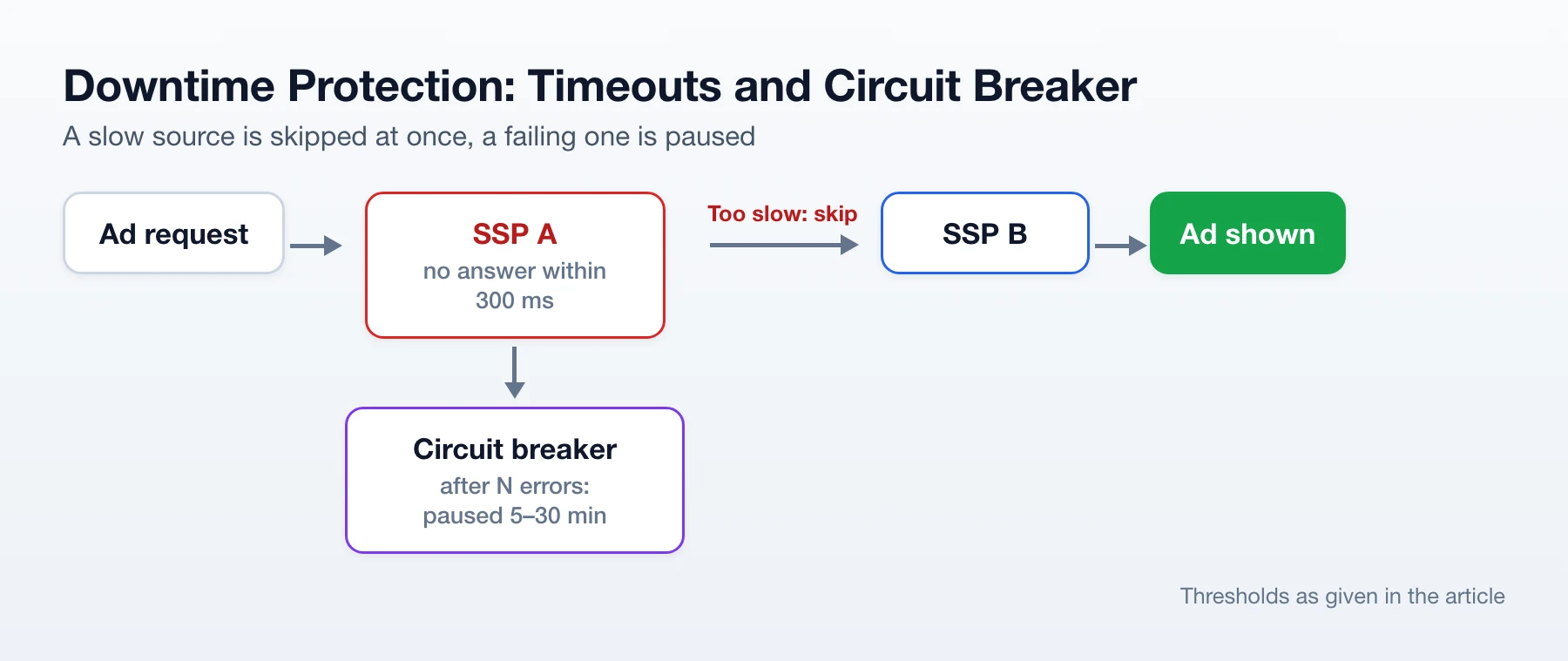
“Downtime” in ads often looks like:
- SSP responds in 5 seconds instead of 300 ms,
- SDK fails to initialize,
- DNS/SSL/script-blocking issues,
- no-bid spikes,
- degradation in one geo/carrier only.
8.1 What to Put in Place Upfront
- Per-layer timeouts: don’t let one source hold the entire chain.
- Circuit breaker (auto-disable): if a source hits N errors or latency exceeds threshold → pause it for 5–30 minutes.
- Redundant routes: at least 2–3 independent major RTB sources with different failure points.
- Caching / preloading where applicable (especially web).
8.2 A Practical Trick: “Fast Empty” Beats “Late Fill”
If the chain won’t respond within your UX window, it’s better to route down quickly than to wait and end up showing nothing (or showing too late, losing viewability).
9) Preventing eCPM Drops: Floors, Competition, and Mix Control
Most eCPM drops come from three places:
- Competition loss (fewer bidders, SSP disabled, ID/consent problems)
- Bad floors (too high → no-bid; too low → dumping)
- Traffic sliding downward (direct under-delivery, RTB latency, and everything falls into cheap networks)
9.1 “Smart Floor” Strategy: Three Thresholds
- Base floor: safe minimum that usually keeps fill.
- Target floor: your working segment-level threshold.
- Stretch floor: higher threshold for peak hours / premium placements.
Then apply rules like:
- If fill drops below X% → temporarily degrade from target to base.
- If competition is strong and fill is stable → test stretch on a portion of traffic (A/B).
9.2 Track More Than eCPM: Use RPM/ARPU
It’s easy to “improve” eCPM by cutting low-priced impressions — while total revenue falls. Business metrics are often:
- revenue per 1,000 sessions (RPM),
- revenue per user (ARPU),
- revenue per page/screen.
Sometimes the “best eCPM” produces worse total revenue because you lose too many impressions.
10) Monitoring: Metrics That Tell You If the Waterfall Is Healthy
At minimum, track:
- Fill rate (overall and per layer)
- eCPM / RPM (per layer and total)
- Timeout rate / latency (p50/p90)
- Error rate (SDK, network, no-fill)
- Traffic share by layer (direct vs RTB vs tier-2 vs fallback)
- Viewability (if measured)
- IVT / fraud signals (if available)
Crucially: monitor by segments (geo, placement, device). Drops almost always start locally.
11) A Practical “Healthy” Waterfall Example (Conceptual)
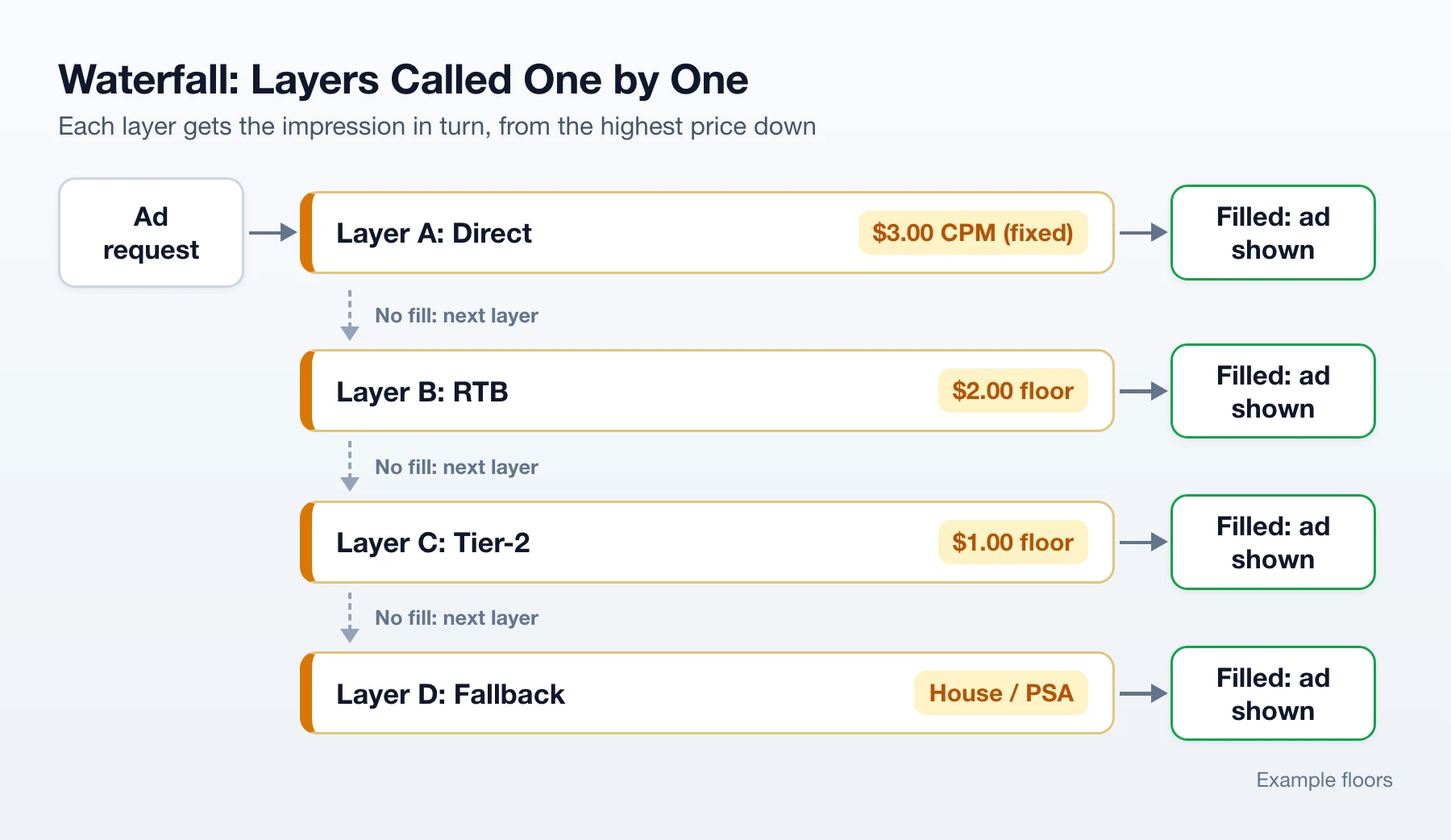
Let’s say you have one banner placement in an app.
Layer A: Direct
- Guaranteed campaigns (with pacing)
- Preferred (fixed CPM, caps)
Layer B: High-value RTB
- PMP (if relevant)
- Open auction via primary SSPs (2–4)
- Segmented target floors (geo/platform)
Layer C: Wide RTB / Tier-2
- Broader sources that fill long-tail geos reliably
Layer D: Fallback
- House / internal promo / PSA
- (Optional) one “insurance” network with strict quality filters and separate monitoring
Automation rules
- Circuit breaker disables sources on high error/latency
- Auto floor degradation when fill drops
- Alerts if fallback share rises above N%
12) Common Traps (and Fast Fixes)
Trap 1: The waterfall is too long
Fix: cut weak layers with low win-rate and high latency.
Trap 2: Direct consumes everything
Fix: caps + pacing + segment inventory (premium placements for direct, the rest for RTB).
Trap 3: High floors = pretty eCPM, but less money
Fix: optimize for RPM/ARPU and keep a base floor.
Trap 4: You can’t tell who’s responsible for a drop
Fix: per-layer reporting + alerts on fallback share and latency.
Trap 5: One partner’s downtime tanks revenue
Fix: redundancy (multiple SSPs), timeouts, circuit breaker.
Final Thought
A waterfall is about control: each impression follows a clear route. When it’s tuned well, it behaves like a resilient system: maximize price first, maximize sell-through second, insure the tail third — all while keeping latency low and automatically protecting you from outages.
A waterfall monetization model remains a reliable way to balance fill rate, CPM stability, and revenue predictability—especially for publishers working with multiple ad networks and direct deals. By prioritizing demand sources from highest to lowest value, you retain control over pricing while ensuring unused impressions are still monetized.
However, in 2025+, the strongest results come from hybrid setups: waterfall logic combined with real-time signals (floors, geo, device, user value) and selective header bidding. Regular optimization, data-driven floors, and continuous partner evaluation are essential to prevent revenue leakage.
| Element | Best Practice | Common Mistakes |
|---|---|---|
| Ad Source Priority | Sort by historical eCPM and fill rate | Static order without data review |
| Price Floors | Dynamic, geo- and device-based | One global floor |
| Ad Networks | Mix of premium, mid-tier, and fallback | Too many low-quality partners |
| Optimization Frequency | Weekly or bi-weekly | “Set and forget” approach |
| Ad Formats | Start with high-viewability units | Overloading pages with ads |
| Performance Tracking | eCPM, fill rate, RPM | Focusing only on CPM |
FAQ
What is a waterfall monetization model?
It’s a sequential ad-serving setup where ad networks are called one by one based on priority until an impression is filled.
Is waterfall monetization outdated?
No. While header bidding dominates, waterfall models still work well for smaller sites, direct deals, and as a fallback layer.
How many ad networks should I include?
Typically 5–10. More networks increase complexity and latency without guaranteed revenue gains.
How often should I optimize the waterfall?
At least once every 1–2 weeks, or after major traffic or seasonal changes.
Can waterfall and header bidding work together?
Yes. Many publishers use header bidding first, then route unsold impressions through a waterfall.