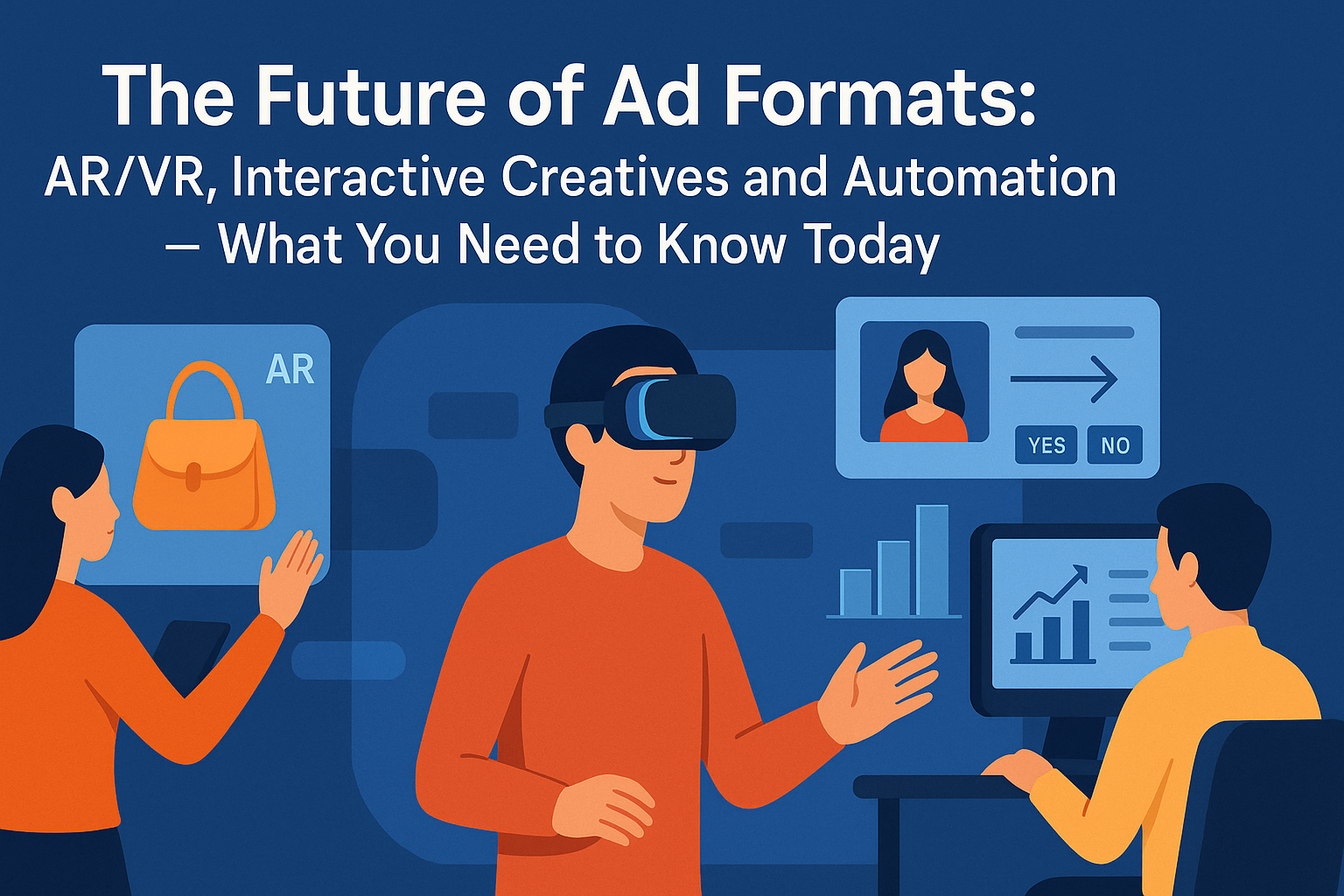
The digital ad market is rapidly moving away from “passive” formats. Brands don’t just want to show a video or banner anymore: they want to pull people into an experience, let them steer the story, personalize the message, and measure impact deeper than CTR. Below is a quick field guide to where AR/VR, interactive creatives, and automation stand today, what problems they solve, and how to use them without pain.
Why formats are changing
- Shrinking attention: average time spent with a single creative is falling; solutions win where the user actively does something.
- Dark social & privacy: fewer third-party data signals, higher value of first-party and contextual relevance.
- Creator economy growth: content and advertising blend; the format must feel native to the experience.
- Tech accessibility: WebAR, game engines, and no-code tools cut timelines and budgets.
AR/VR: from “wow” to business outcomes
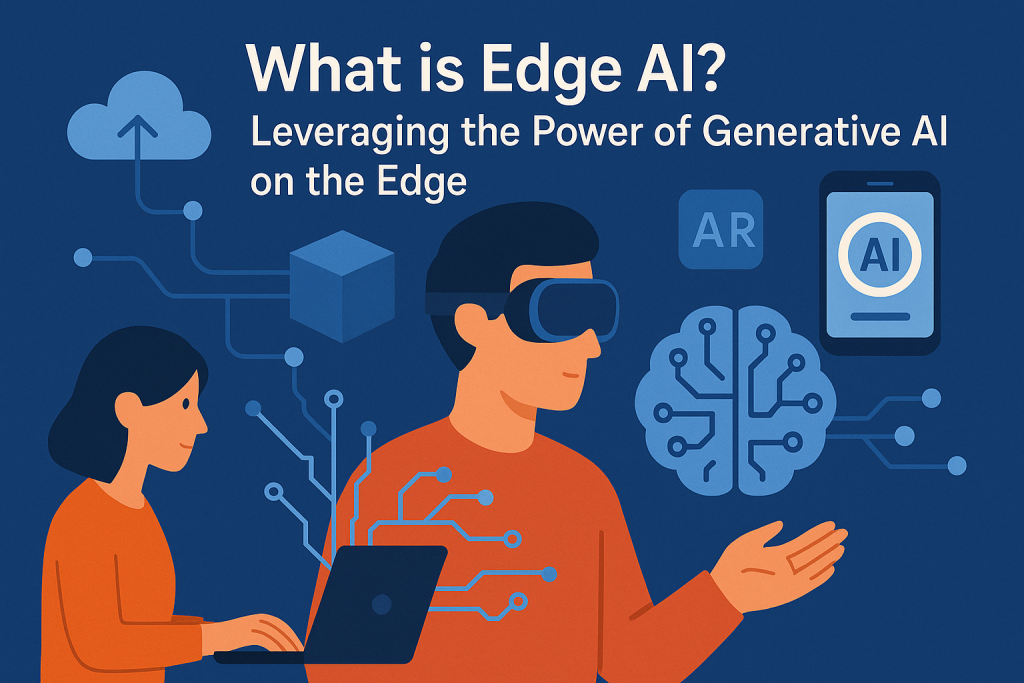
Where AR already pays off
- Try-on/try-out: cosmetics, accessories, furniture, auto configurators. Key metrics—conversion lift and reduced returns.
- Navigation & OOH: augmented layers on top of out-of-home and in-store retail—engagement plus first-party signal capture.
- Gamified promos: scavenger hunts, social filters and lenses—for organic reach and UGC.
What about VR
- Events and training: brand workshops, demos of complex products, B2B meeting spaces.
- Entertainment: in-game sponsorships and immersive storytelling.
Cons: audiences aren’t yet “mass,” and production is heavier. Use where deep but targeted contact matters.
AR launch playbook
- Tech stack: WebAR (broad reach, lower barrier), native social lenses (fast scale), custom engine builds (maximum control).
- Attribution: UTM on in-scene CTAs, scannable markers, CDP/CRM integration.
- Creative: lean into physics and utility. “Rotate—assemble—try on—compare” beats “look, it’s pretty.”

Interactive creatives: advertising the user controls
- Branching narrative (choose-your-path): different routes = different insights about interests.
- Micro-games (playables): especially for apps and e-commerce discovery.
- Calculators/quiz units: minimal cognitive load, maximum personalization.
- Dynamic video: scenes and offers adapt to context, weather, or inventory.
How to measure
- Behavioral signals: completion rate, time in format, chosen branches, repeats.
- Business metrics: lift in conversion/add-to-cart, lead quality, LTV proxies.
- Brand lift: recall, preference, intent—via test/control.
Automation: machines steer, people set the course
Where automation shines
- Media mix & bidding: budget allocates by margin and channel saturation.
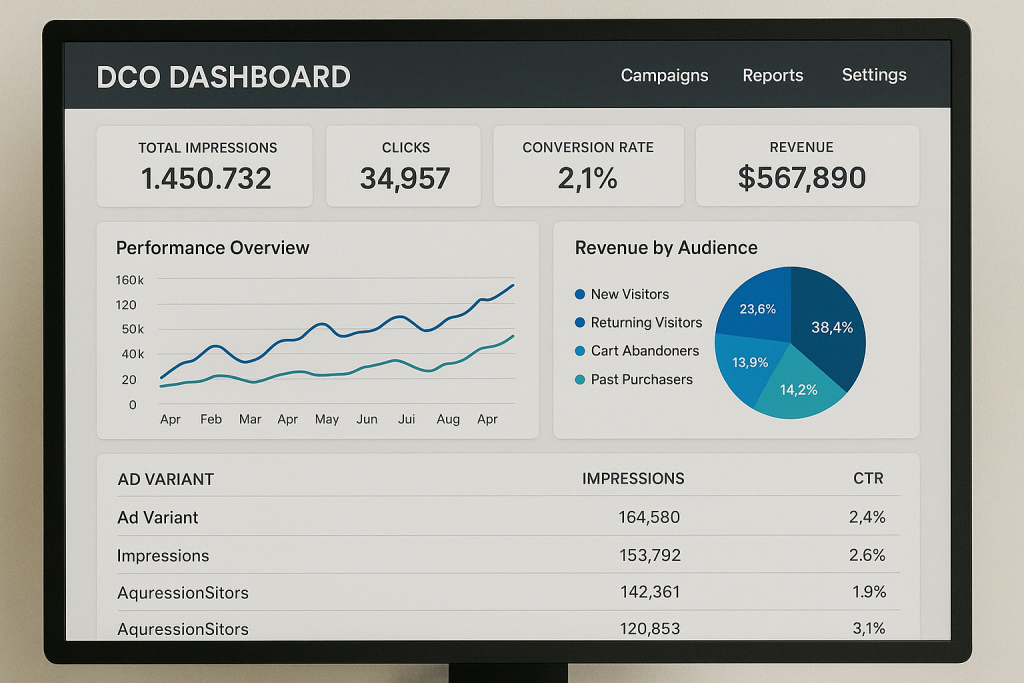
- Dynamic Creative Optimization (DCO): templates + feeds = thousands of variations without manual hell.
- End-to-end analytics: unifying impressions, visits, offline sales; MMM/geo-experiments.
- Ops: automated QA, brand safety, frequency deduping.
Constraints
- Garbage in—garbage out: without a clean feed and unified taxonomy, automation amplifies noise.
- Creativity: humans still originate ideas; machines scale and test them.
- Transparency: build in audits and a “manual override”—allowlists, frequency caps, CPA guards.
Compliance and trust
- Privacy: data minimization, explicit consent, server-side tagging, in-region storage.
- AR ethics: don’t place objects in ways that mislead (e.g., “faking damage” on real goods).
- Disclaimers: for try-on, show “visualization; actual appearance may vary.”
Creative strategy: the “three-layer” principle
- Core — the universal brand idea (one line, one visual code).
- Interactive layer — user actions: choose, assemble, play, try on.
- Data — personalization: tailoring offer, location, assortment.
This avoids a “format zoo” while preserving distinctiveness.
KPI framework by format
- AR/VR: time in experience, share of scenario completions, saves/shares, scan rate, in-scene CTR, conversion/returns.
- Interactive: completion rate, engagement depth (# of interactions), branch choices, lift to the target action.
- Automation: ROAS/margin lift at equal spend, CPA/CPP, share of automated tests, creative turnover speed.
Common pitfalls
- Doing AR for “wow” with no product link.
- Overcomplicating mechanics: 3–4 steps is the ceiling for mass campaigns.
- Launching DCO without a clean catalog and proper imagery.
- Skipping control groups and a “manual mode” for emergencies.
Budget & rollout plan (90 days)
Weeks 1–2: audit and hypotheses
- Inventory assets and data.
- 5 hypotheses: one AR scenario, one playable, two DCO pairings, one interactive poll.
Weeks 3–6: prototypes
- WebAR demo (up to a 30-second flow).
- Playable based on existing visuals.
- DCO feed: 10–20 variations per product/offer.
Weeks 7–10: pilots
- Launch on 10–15% of budget across 2–3 channels.
- Test/control, preliminary lift estimates.
Weeks 11–13: scale
- Kill weak bets, scale winners.
- Bake in automated optimization rules.
Team & process
- Creative + production: AR/3D designer, interactive producer, copywriter.
- Data: analyst, feed specialist, tracking engineer.
- Media: strategist, trader/buyer, brand safety.
Keep one sprint rhythm: idea → prototype → pilot → scale (2–3 weeks per loop)
Checklist: do this today
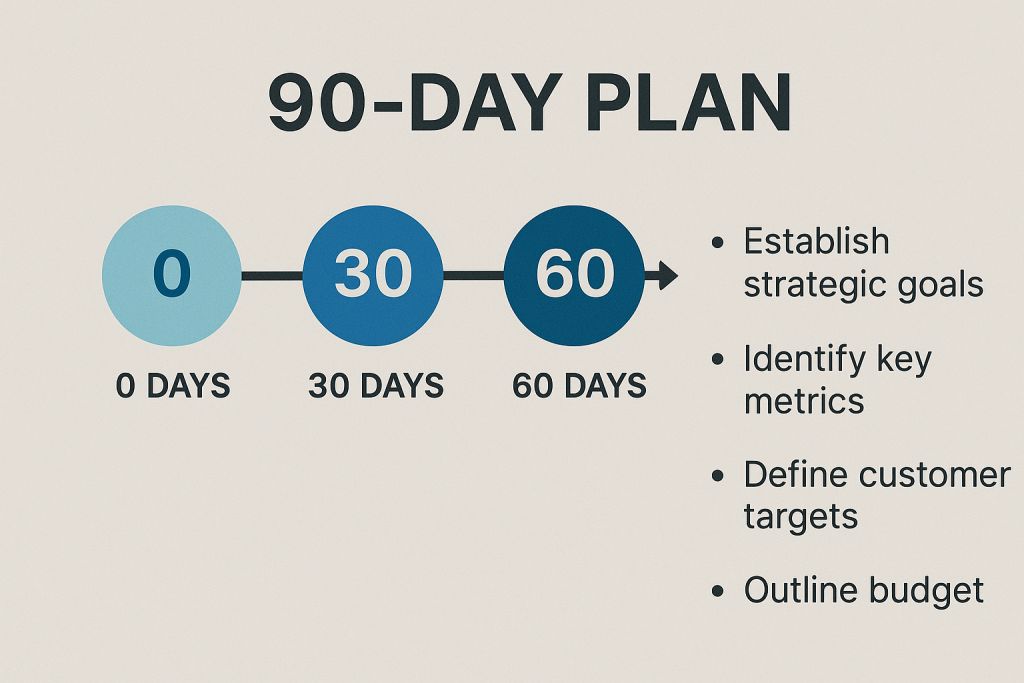
- Define 1–2 business metrics the new format must move (not “engagement for engagement’s sake”).
- Select 3 scenarios: AR try-on / interactive quiz / DCO for retail.
- Clean the feed: names, attributes, images, stock.
- Set up minimal analytics: in-scene events, UTM, test/control.
- Draft risk policy: frequency caps, placements, disclaimers.
- Assign owners and a 90-day timeline.
Takeaway
The future of formats isn’t “another banner,” but an experience the user controls—one that adapts to context automatically. AR/VR deliver depth, interactive creatives deliver choice and data, and automation delivers scale and efficiency. Winners aren’t those with the most tech, but those with a resilient cycle: ship fast → measure honestly → scale boldly.
Conclusion
The future of advertising is moving decisively toward immersive, interactive and automated formats. AR/VR experiences are transforming brand engagement by blending digital elements with real-world environments, creating deeper emotional connections. Interactive creatives are shifting ad consumption from passive viewing to active participation, dramatically increasing user involvement and campaign efficiency. Meanwhile, automation driven by AI and machine learning is optimizing ad delivery at scale—ensuring the right message reaches the right audience at the right moment.
Brands that embrace these innovations early will gain a significant competitive edge, benefiting from improved performance, richer customer insights and more personalized user journeys. The evolution of ad formats is not a distant possibility—it’s happening now, and advertisers who adapt quickly will shape the next era of digital marketing.
| Ad Format / Trend | Key Features | Benefits | Challenges | Best Use Cases |
|---|---|---|---|---|
| AR Ads | Visual overlays on real-world environments (mobile, smart glasses) | High engagement, memorable brand experiences | Requires creative resources and technical expertise | Retail try-ons, automotive previews, product demos |
| VR Ads | Fully immersive 3D experiences | Deep emotional impact, high attention levels | Limited user base, hardware dependence | Travel, gaming, real estate, entertainment |
| Interactive Creatives | Clickable, swipeable, dynamic elements | Boosts engagement and CTR, gamified experiences | Requires strong UX design | E-commerce, product launches, brand awareness |
| AI-Driven Automation | Automated targeting, bidding, creative optimization | Efficiency, real-time personalization | Limited transparency (black-box algorithms) | Performance marketing, large-scale campaigns |
| Dynamic Creative Optimization (DCO) | Real-time ad personalization | Higher relevance, improved conversions | Needs strong data infrastructure | Remarketing, personalized offers |
| Shoppable Ads | In-ad checkout experience | Shortens consumer journey | Platform dependency | E-commerce, retail |
| 3D/CGI Ads | High-quality 3D product visuals | Strong visual impact, scalable | May require specialized production | Tech, fashion, automotive |